'My 20-hour A&E wait left me horrified and heartbroken'

 BBC
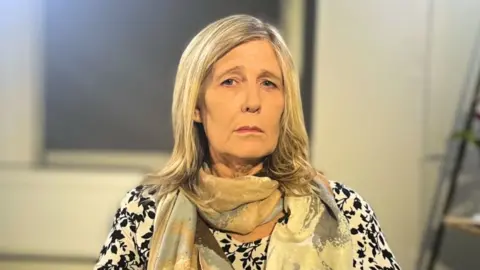
BBCPartially paralysed, sitting for hours on end under the bright, harsh lights of the emergency department (ED), there was a word that came to Vanessa Andrews to describe what she was witnessing - inhumane.
She spent 20 hours in the ED at the Royal Victoria Hospital (RVH) in Belfast over the Christmas holidays and said she was "horrified and heartbroken" as she watched older people sitting on hard chairs, waiting to be treated.
On average, there were almost 2,600 patients in EDs across Northern Ireland per day in December.
The Belfast Health Trust has apologised to everyone who has experienced a lengthy wait in their emergency departments.
Vanessa, who had a stroke in 2024 and uses a wheelchair, said the experience meant she would no longer voluntarily go to an ED.
The 53-year-old said the pain "etched" on older people's faces was distressing to watch as was the lack of dignity, with some men and women requiring toileting and feeding support.
"At one stage, I got quite tearful because I didn't think I could deal with the pain much longer and all they gave me was a paracetamol which did nothing," she added.
"I was one of the younger ones in the ED but being disabled was agony as I sat in this wheelchair for almost 12 hours before they moved me onto a trolley."
Vanessa, who is a mother and grandmother, said she would not voluntarily go back to an ED unless she was unconscious and left with no other choice.
What are the latest ED figures?
Figures from the Department of Health show that during December 2025 a total of 66,737 people visited an ED.
That is 327 more people than in December 2024.
The average time patients who were admitted spent in an ED was more than 13-and a-half hours - two hours 42 minutes less than December 2024.
The longest wait from arrival to admission was recorded in the Causeway Hospital ED where one patient spent 19 hours and 19 minutes in a waiting room.
The shortest wait of six hours 18 minutes was recorded at the Royal Victoria Hospital ED in Belfast.
During December almost 13,800 people used the phone first system which means they are assessed before arriving at an ED - more than 60% of them resulted in a referral to an ED.
Almost 204,400 people used an ED between October and December last year, which is a 1% increase compared to the same period in 2024.
Figures reveal that in December 2025 95% of patients received treatment within around nine hours of being triaged.
Why are ED's under pressure?
ED pressures in the UK are now recognised as a year-round crisis rather than just a seasonal winter issue, with high demand and overcrowding persisting throughout the summer months.
Few hospitals are meeting targets to see patients and it is expected that the latest figures reflecting the Northern Ireland picture will not be any different.
The target which requires 95% of patients to be admitted, transferred, or discharged within four hours, has not been met nationally since 2013-14.
This crisis is fuelled by an older and growing population with increased comorbidities, which is the presence of two or more health conditions in one person.
In addition, people are also finding it difficult to see their GP.
There are added problems of people being stationed and treated on corridors, and delayed discharges where a significant number of patients remain in hospital beds who are well enough to go home.
Without suitable community care in place, these patients are forced to stay in hospital.
 Getty Images
South African-born Vanessa, who has been living in Northern Ireland for several years, said she felt frustrated and anxious as she waited to be called.
"I hadn't eaten, and the vending machine wasn't working, all those things including toilet facilities, the bright lights and the noise all impact on you especially if you aren't well," she said.
According to Vanessa, the staff were overwhelmed by the sheer number of people packed into the waiting room.
However, it wasn't until she was being wheeled into a different area that she saw the extent of the problem.
She said it just didn't look right as people lay on trolleys outside resuscitation areas, adding that they must have witnessed horrific things.
"People were constantly being wheeled up and down and people had to squeeze past.
"I felt so sorry for the staff and those they were treating," she said.
Hospital bed shortages
The Belfast Trust said the demands for a hospital bed are considerably more than the number of beds available, with patients facing long waits as staff discharge as many medically fit inpatients as possible.
It said it wanted to pay tribute to the exceptionally hard working and dedicated staff, who take care of patients in difficult circumstances.
The Belfast Trust has advised people to consider if they have a genuine emergency before visiting emergency departments.
Where possible, they advise using the phone first service on 028 9615 9444 where callers will be assessed by a healthcare professional.
