'After 15-hour hospital wait Mum signed a DNR'

 BBC
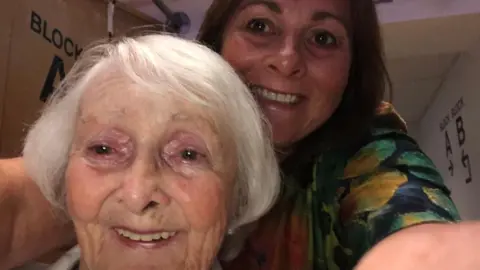
BBCThe daughter of an elderly woman who signed a do not resuscitate form (DNR) after her experience in a hospital Emergency Department has described what happened as "grim" and "heartbreaking".
Bernie McGrogan was 87 when she died at home surrounded by her family in October last year.
Her daughter Fiona McAreavey said her mum, who was immobile and incontinent, lay on a trolley in a hospital corridor for 15 hours.
The family's story has emerged as the Royal College of Nursing (RCN) warned that corridor care was becoming more entrenched across hospitals in the UK and that issues in Northern Ireland's hospitals are pushing staff morale almost "past the point of no return".
Fiona McAreavey said her family were very angry at how their mother was treated and also about the state of the health service in Northern Ireland.
"I feel very angry at the politicians, I don't think they are doing enough, I don't think they care, we are just going round in circles."
The Department of Health said the pressures at hospital emergency departments were "complex" with "no quick fix but the only medium to long-term solution is to reduce demand and manage demand differently".
It said work it has undertaken to alleviate the issues has not been helped by the "very challenging position" but it will "continue to manage the quality of care we are able to provide to the best effect".
What happened to Bernie McGrogan?
McAreavey described the scene at the emergency department when she brought her mother in as "grim".
She had various tests done and then was brought to an area of the hospital for assessing elderly patients, her daughter added.
"It has some cubicles, but not very many, but for the many people who were in A&E and in that area they would need three times the amount of cubicles."
She said the corridor was lined with elderly patients and that her mother was put on a trolley just at the door of the area, where she stayed for 15 hours.
"I don't know how much care mum would have had in the 15 hours that she was in that area on that trolley with everybody walking past.
"There was no privacy at all," McAreavey said.
She added that when her mother needed to change there was nowhere to go, and they had to secure a cubicle and a nurse to take her.
"There was no dignity for my mum."
Despite the long waiting times McAreavey said the staff were "doing a good job".
"The nurses, all the medical staff were busy all the time. There was never anybody hanging about. There was never anybody doing nothing."
 Getty Images
Describing the experience as "appalling" she said her mother did not want to be there.
"When we got her home, she said she was never going back to hospital. She didn't want to ever see the inside of a hospital again."
It was at this point that her mother decided to sign a DNR.
"We knew that, in a way, that was the beginning of the end," she said.
A month later Bernie McGrogan died at home.
McAreavey said her mother - who had been a midwife, nurse and primary school teacher - had led a life "of helping others".
"She was loved by so many people. To see her on a trolley where she couldn't even have proper care after the life she had led, it just breaks your heart."
What are nurses saying?
On Thursday, the RCN published testimony from members after contacting hundreds of the same nursing staff who contributed to its report On the Frontline of the UK's Corridor Care Crisis, published last year.
The organisation said the updated testimony shows corridor care – and care in other non-clinical areas – has become further entrenched across hospitals in the UK.
The RCN has reiterated its call for a plan to stop the practice, by investing in beds, the nursing workforce, community services and social care.
The Department of Health said its services face extra pressure during winter and that it "has a finite capacity and severe pressures arise when hospitals are forced to operate often well beyond capacity".
"Staff are doing their best 24 hours a day, seven days a week often in very difficult situations to try and alleviate those pressures and give the best care they can.
"Unfortunately, it is a complex problem and there is no quick fix but the only medium to long term solution is to reduce demand and manage demand differently."
It added that it has undertaken two pieces of work to tackle patient flow, particularly in caring for frail, elderly patients, and refocus on community care but that "this will take time to impact and is not helped by the very challenging financial position".
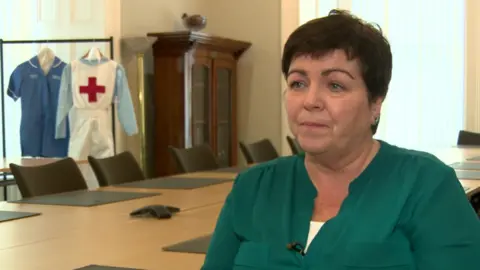
The executive director of the RCN in Northern Ireland, Professor Rita Devlin, said it is "soul-destroying" that patient care and staff morale are not improving.
She told BBC News NI that older patients are impacted most by having to receive corridor care, which in some cases, is lasting up to three days.
"It is an overstimulating environment" she said.
"Bright lights and lots of noise can make older patients very disorientated, which can actually turn into delirium. That in turn, slows the process of being able to get home."
Devlin said there is no "privacy and dignity" with corridor care, and it can compromise the pace of which emergency equipment can be transported to patients.
She described staff as feeling "embarrassed, ashamed and losing hope that things will change".
The article was updated for clarity on 22 January 2026.
