Could Northern Ireland make better use of its waste?

 Getty Images
For most people, thoughts of what happens to our rubbish begin and end with which bin is due to be emptied this week, but for politicians decisions around what to do with Northern Ireland's ever-increasing waste can be problematic.
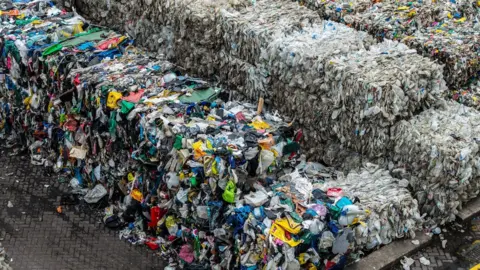
Hundreds of thousands of tonnes are shipped abroad to provide provide heat and power in other countries, with thousands more going straight to landfill - but space is running out.
More than half of our waste is recycled, but the latest figures from the Department of Agriculture, Environment and Rural Affairs (Daera) show this has stagnated.
A decision on a controversial waste incinerator plan near Mallusk is expected this year.
It is a plan which has divided opinion in the area, but one which its supporters say is crucial for how we deal with waste.
They say Northern Ireland is missing out on jobs and emissions reductions.
The application proposes taking waste from six councils - Antrim and Newtownabbey, Ards and North Down, Belfast City, Lisburn and Castlereagh, Mid and East Antrim and Newry, Mourne and Down.
The collections would be sorted, recyclates removed, the non-recyclable waste processed to produce heat and energy, and the ash used in construction materials.
The application has been in the planning process for 12 years.
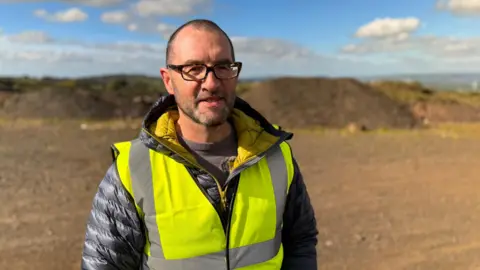
The chief executive of ARC21, a waste management body for the six councils, said the waste industry was a victim of its own success - that it had "magically" made waste disappear.
"All I would suggest to any of the viewers is to look at what they throw away every week, every month, and what their neighbours throw away and realise that that waste doesn't evaporate, it doesn't dematerialise," Tim Walker said.
One of the councils - Antrim and Newtownabbey - sought advice on pulling out of the agreement some years ago.
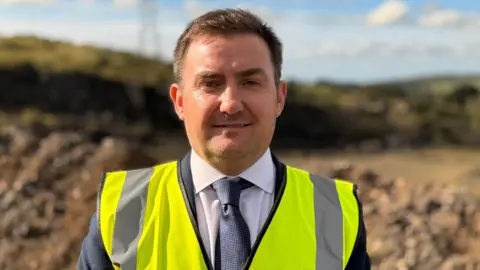
Colin O'Hanlon from Indaver, the consortium that would operate the plant, said all councils would have to grapple with the question of what to do with their waste.
"With our circular economy, our recycling, our energy recovery targets and our now reliance on exporting, it is clear to most stakeholders that there is need for infrastructure and the opportunity for us to deliver it is now," he said.
"We should take that opportunity - our future generations will thank us if we do."
Other plans have been approved for similar facilities at Kilroot Power Station.
One is already in place in the Belfast Harbour Estate.
A community divided
Because of those facilities, the NoArc21 campaign group says the Mallusk one is not needed.
The group's chair, Colin Buick, said it was prepared to go to court again if the project was approved.
"There are multiple objections - the toxins, the costs, and the need," he said.
"If Northern Ireland is real about recycling, it doesn't need an incinerator."
But not everyone in the area agrees.
William Sloan thinks the facility is "a great idea", that it is "about time that Northern Ireland looked after their own rubbish instead of shipping it across Europe".
Others have been on both sides of the debate.
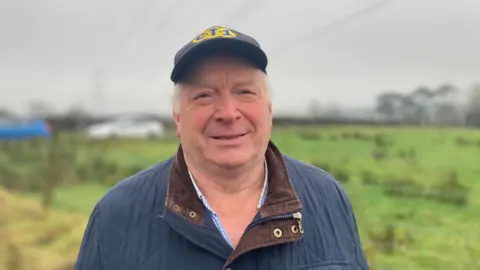
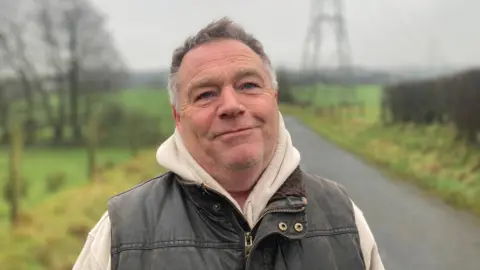
Ian Montgomery, who farms at the end of the lane that leads to the quarry where the EfW plant would be, was opposed but has now changed his mind.
"It'll create a lot of jobs, directly and indirectly," he said.
"The quarry will be better managed and kept tidy if there was someone in it rather than lying derelict."
What happens to our waste?
Northern Ireland councils collected more than a million tonnes of waste in 2024-25 - up slightly on the previous year.
About half is recycled - mostly sent abroad as we do not have local processors for various types of waste.
Just over 140,000 tonnes (14%) goes to landfill.
That amount has been decreasing but under current waste policy it needs to fall further, to 10% by 2035.
That leaves more than a third (34.3%) being "sent for energy recovery", but not in Northern Ireland.
Instead, it is shipped to places like Scandinavia to be burned in incinerators - Energy from Waste (EfW) plants - that provide heat and power.
But sometimes those countries have enough of their own waste to fuel their plants or there is not a high enough demand - climate change is generally making winter milder in Scandinavian countries - and bales can stack up at ports like Warrenpoint.
Warrenpoint woes
Re-Gen has processed waste in the County Down town for more than two decades, preparing Refuse-Derived Fuel (RDF) for shipping overseas.
But there have been complaints over the years, when bales are stored at the port, which the company has a licence to do.
Independent councillor Jarlath Tinelly, who sits on Warrenpoint Harbour Authority, acknowledges there have been problems, primarily in the warmer months.
"There's no doubt the RDF which was the pure black bin waste was the cause of most of the odour and the upset around the town that ensued from it."
He added that the stored bales were cleared last August and now, they go directly on to the ships.

Shay Daly, a volunteer with the community group, the Carlingford Lough Keepers, said it was an environmental issue at first due to the impact it was having on wildlife.
"Now it's become a community personal issue as well, affecting people sitting in their houses so it has to be dealt with and I hope it's dealt with in a proper way. And we don't want to put it on to somebody else," Daly said.
A spokesperson for Re-GEn said the company was Northern Ireland's biggest waste management company, provided more than 400 jobs and saved 300,000 tonnes of CO2e a year.
"We produce more recyclate materials for reprocessing than Northern Ireland's reprocessors can handle, and because of this, we export materials that cannot be reprocessed in Northern Ireland to Ireland, UK and Europe," the spokesperson said.
They added that black bin material was turned into fuel and that the company recognised some people did not want this to be stored near residential properties.
They said they were seeking alternative storage.
What about landfill and recycling?
Landfill in Northern Ireland is running out.
There are now just four sites across Northern Ireland deemed to have the potential to accept what is broadly categorised as black bin waste - nappies, food wrapping and so on.
We have done really well to increase our recycling rate from 10% in 2000 to just over 50% in 2020, but since then it has stagnated.
Our climate change legislation sets a target of recycling at least 70% of our waste by 2030.
A report by the Northern Ireland Audit Office recommended that "sufficient local infrastructure" should be in place "to process waste in an economic and environmentally friendly manner".
Lack of infrastructure
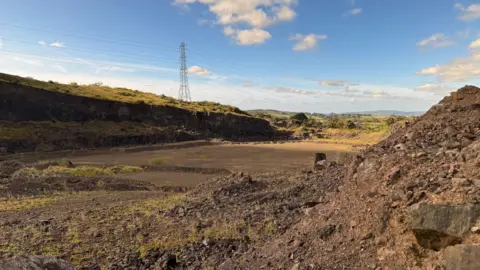
Daera is carrying out an assessment of local waste infrastructure.
Officials told a committee in 2025 it was "clear that there is not enough waste infrastructure in Northern Ireland or on this island" to deal with what we are throwing away.
There is also a proximity principle in waste management - that it should be dealt with as close to where it originates as possible.
Minister Andrew Muir said it was "not a secret" that local waste infrastructure needed to improve, "whether it's in relation to recycling, but also in terms of that residual waste that we need to deal with."
Daera is currently consulting on waste management.
There will be more on this story on The View at 22:40 on BBC One and iPlayer.
