What makes the Spitfire so iconic after 90 years?

 BBC
BBC"Well apart from being totally gorgeous as an aeroplane, it's a symbol."
Thursday marks the 90th anniversary of the first test flight of a new prototype plane that would go on to become Britain's most iconic aircraft - the Spitfire.
Pilot Captain Joseph 'Mutt' Summers took to the skies in a prototype Spitfire for the first time above what is now Southampton Airport on 5 March 1936.
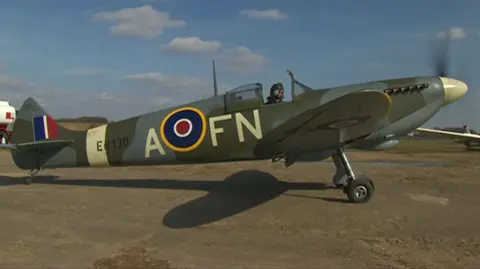
Almost a century on from that first flight, aircraft enthusiasts in Enstone, Oxfordshire, still make and fly replicas of the legendary protector of Britain's skies during the Second World War.
Paul Fowler, who is project leader of the Ace Squadron at Enstone Flying Club, said of the Spitfire's appeal nine decades on: "It is a fabulous looking aeroplane, and if it looks right, it flies right."
"It's a very recognisable shape, and it has a beautiful sound from the Rolls-Royce Merlin engine," he added.

Enstone Flying Club is home to a squadron of replica Supermarine Mk 26B Spitfires, which are a 90% scale version of the original three-tonne aeroplane.
Fowler said the aircraft "was the beginning of a new phase of aeronautical design" when it was originated in the 1930s by designer Reginald Joseph Mitchell.
"The Spitfire was a blank sheet of paper and Mitchell and his team took everything new that they could, and they built it into this aeroplane."
He said the Spitfire became "such a brilliant" aircraft because it was "able to be modified".
"It became this spectacularly successful aeroplane because it could do almost anything," Fowler added.
You can follow BBC Oxfordshire on Facebook, X (Twitter), or Instagram.
