Spitfire celebrated 90 years on from maiden flight

 BBC
BBCThe legacy of the Supermarine Spitfire has been commemorated in its birthplace 90 years after its first flight.
The iconic aircraft, which played a pivotal role in the RAF's victory in the Battle of Britain, returned to the skies above Southampton for a flypast on Thursday, March 5.
On the same day in 1936 Captain Joseph "Mutt" Summers took off from Eastleigh Aerodrome, now Southampton International Airport, at 16.35 for the first test flight.
The city, where the Spitfire was built, has played a central part marking this historic milestone, with two flypasts - one planned for the same time as the test flight - and two commemorative plaques unveiled at Southampton Airport.
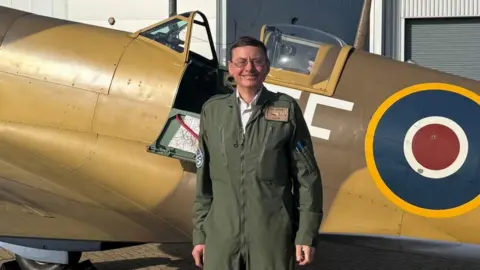
As part of the celebrations, pilot Mark Bennett landed a Spitfire at the airport on Thursday morning. He said it was "pretty amazing and incredible" to fly on the 90th anniversary of the first flight.
Bennett has flown a number of planes over the years but admitted there is something different about flying a Spitfire. He said: "It's iconic. Every time I approach the Spitfire, climb in and go flying in it, is always special."
He added: "It's very gratifying to find so many people are interested in these old aircraft. Lots of people are here celebrating the achievement - 90 years - I find it incredibly gratifying that there is such a wide interest."
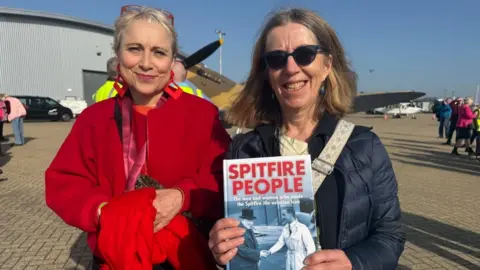
Two plaques honouring both the fighter plane's global significance and the thousands of local people involved in its design and build, were unveiled at Southampton Airport.
Among those invited to the celebration were Katie and Angela, granddaughters of lead designer Alf Faddy, who has been honoured as part of the celebrations.
Angela said: "It's mind-blowing. We didn't know Alf's name was going to be up on the board. We feel completely staggered. It's a very emotional day for us, we're very pleased to be here. We have seen quite a lot of things over of the years, like Spitfire taking off. But this is probably the pinnacle."
One of the plaques was unveiled by J. Willgoose Esq, founder of the band Public Service Broadcasting, which wrote the song 'Spitfire' about the plane.
J. Willgoose Esq said: "We all still owe so much of a debt to this machine and the people who built it and the people who flew it.
"It's very humbling to be asked to come down. We just wrote a song about this plane, we're not even a tiny footnote in the history of this wonderful machine to be recognised even for that is very flattering."
Maurice Boyle, operations director at Southampton Airport said: "Southampton is the home of the Spitfire, and today's dual unveiling reflects the deep pride our region holds in that legacy.
"These plaques honour both a world‑changing first flight and the extraordinary men and women who built the aircraft that helped change the course of history. We are privileged to work with our heritage partners to ensure this story continues to inspire future generations, and we are proud that Southampton Airport remains central to telling it."
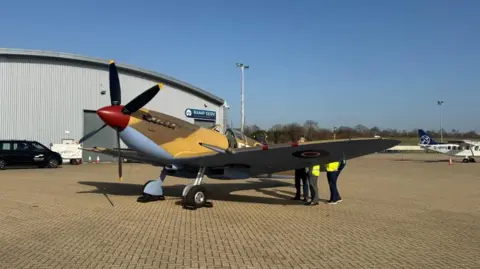
As part of the 90 year celebrations there is also a chance to experience the thrill of flying in a Spitfire as special flights are being auctioned off. The flights will take off from Southampton airport and visit historic locations across the country connected to the aircraft's history. Proceeds from the auction will go to Mark Long Trust and the RAF Benevolent Fund.
The Supermarine Spitfire was designed by Reginald Joseph (RJ) Mitchell, who worked for the Southampton aviation company Supermarine from 1916 until 1936.
Capt Summers who piloted the first plane famously declared after just eight minutes: "Don't change a thing."
At the beginning of World War Two the Spitfire was only being manufactured at the Supermarine works beside the River Itchen in Southampton.
The National Spitfire Project (NSP) has also marked a significant milestone in the development of the National Spitfire Monument.
NSP chair John Hannides called it "a moment of national pride and reflection".
NSP representatives will host a programme at Voco Hotel and Mayflower Park that will include "a ceremonial groundbreaking, an immersive augmented reality experience of the future monument, and - weather permitting - a commemorative Spitfire flypast".
Project chair Hannides said they were "honoured to celebrate this milestone in the city where the Spitfire story began".
"The 90th anniversary of the Spitfire's first flight is a moment of national pride and reflection," he added.
"This event marks not only the legacy of an aircraft that helped shape history, but also the beginning of a permanent monument that will inspire future generations."
You can follow BBC Hampshire & Isle of Wight on Facebook, X (Twitter), or Instagram.
