Treasury to repay £260,000 in VAT on two NI schools
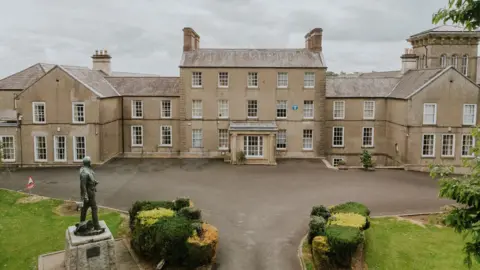 Royal School Dungannon
The UK government has agreed to repay £260,000 in VAT on some fees charged by two Northern Irish schools.
The government introduced VAT on fees across the UK in January 2025 to pay for more state school teachers in England.
Value added tax (VAT) is one of the government's main sources of income and the standard rate is 20%.
The Treasury will now repay VAT on boarding fees charged by the Royal School Armagh and the Royal School Dungannon.
Why did the government decide to charge VAT on school fees?
UK schools did not previously have to charge VAT on fees because of an exemption for organisations providing education.
But the government changed this in January 2025.
It estimated the policy would raise over £1.5bn by 2029/30 and help pay for the recruitment of 6,500 new teachers in England.
The decision proved to be politically controversial, but three High Court judges dismissed a legal challenge.
The body that represents independent schools in the UK said fees paid by parents had gone up by 22% in a year as a result.
Compared to England where there are more than 2,000 independent schools, there are few in Northern Ireland.
In England, the best known are Eton and Harrow, who charge about £50,000 a year - much higher than any school in Northern Ireland.
Why were some schools in Northern Ireland affected?
 PA Media
Only a small number of schools in Northern Ireland charge fees.
They include grammar prep departments, schools that have boarding and independent and church schools.
About 2,500 pupils in Northern Ireland attend grammar school preps, Christian and other independent schools.
There are some independent Christian schools run by the Free Presbyterian Church who charge fees to parents to pay for running costs.
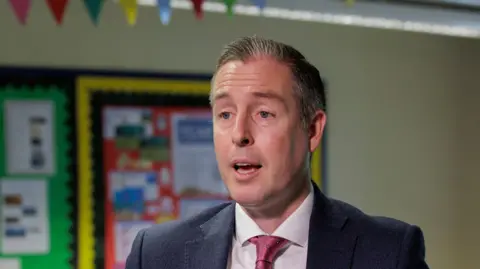
The education minister Paul Givan had criticised the move to put VAT on school fees.
Givan said fee-paying schools were different in Northern Ireland from those in England.
While education is devolved to the Northern Ireland Assembly at Stormont, taxation is decided at Westminster.
Why has the Treasury decided to exempt two schools in Northern Ireland from VAT on fees?
 Getty Images
BBC News NI has established that the Treasury has agreed to reimburse the VAT on some fees charged by the Royal School Armagh and the Royal School Dungannon.
Both have boarding departments and charge fees to families whose children live there during term-time.
These range from under £10,000 to around £16,000 depending on how many nights pupils board.
The Treasury decision means parents of boarders who are from the UK and European Union (EU) at the two schools will not pay VAT on those fees.
In a statement to BBC News NI, a Treasury spokesperson said that it was because the two schools were regarded as "state" schools.
"To ensure parity with English state boarding schools, the UK Government has provided financial support to voluntary grammar schools in Northern Ireland providing an equivalent service to state run boarding in England for whom it was not possible to legislate for a carve-out from the VAT charge," they said.
"This ensures that pupils boarding at these schools are on the same footing as those attending English boarding schools."
The decision means that the Treasury will pay £260,000 to the Executive to pass to the two schools to reimburse them for the VAT they pay, which means the additional 20% tax will not be paid by parents.
Ringfenced funding to cover VAT liability
A spokesperson for Northern Ireland's Department of Finance said the move ensured "consistent treatment of schools here".
"This funding will be provided annually by Treasury to the executive to compensate for the overpayment of VAT in relation to these two schools," they said.
"This will, in turn, be provided to the Department of Education (DE), as the department with policy responsibility for schools.
"This funding cannot be used for any other purpose and as such it does not require Executive approval."
The DE said that the UK Government provided the executive with "ringfenced funding to cover the VAT liability of boarding fees relating to 'state boarders' (i.e. pupils who pay for boarding, but not education)".
"The intended effect of this funding is that schools provide a discount to parents equal to the amount of VAT due on these boarding charges for which the Education Authority will reimburse the school."
What have the schools said?
 Royal School Dungannon
The principal of the Royal School Dungannon (RSD), Dr David Burnett, told BBC News NI that around 55 of 690 pupils were boarders.
"Similar schools exist in England and are usually referred to as state boarding schools," he said.
"English state boarding schools were excluded from the VAT legislation from the outset."
But Burnett said his school had to go through a "unique, labyrinthine system" to get the money paid on VAT on fees back.
"We still believe that RSD should be exempt from VAT legislation like English state boarding schools," he said.
"A scheme aimed at raising tax income from independent schools, to fund more teachers in state schools in England, has trapped and damaged state schools in Northern Ireland."
 Royal School Armagh
The principal of the Royal School Armagh (RSA), Graham Montgomery, said that the school did not charge tuition fees for day pupils but VAT was imposed on it "because it has a boarding department".
He said around 10% of the 800 pupils were boarders.
"The boarding school community in Northern has declined in size over recent decades but remains important in presenting Northern Ireland positively to young people from across the world and in contributing to the local economy," he said.
"RSA is required to pay VAT for all non-UK boarders and the government then makes a compensatory payment for those from the EU.
"In lay man's terms the VAT is returned in respect of those who wouldn't have paid it in the first place in England.
"We continue to believe that RSA should be exempt from the VAT measure like the English state boarding sector."
