Old-style politics beats youthful ideals in Thai election

 Chutiphong Pipoppinyo/Facebook
"One time I went to a children's day fair and found myself sitting next to another politician. He was holding a stack of 100 baht notes to hand out to the children, while I had come empty-handed. How could I compete with that?"
Chutiphong Pipoppinyo was part of the "orange wave" of idealistic young candidates who stunned Thailand in the 2023 election by winning more seats for the progressive Move Forward party than any other party.
This year though, he lost his seat in his home province of Rayong to a rival from an old established family which has traditionally occupied positions of power there.
"In 2023 we were like a storm that swept through and the other parties weren't ready to fight back. They thought I was just a no-name candidate. The wave of support for Move Forward in the final stretch of that election really encouraged voters to try something new."
Now renamed the People's Party, their hopes that they would improve on their 2023 performance were dashed on the rocks of the old-style patronage networks which have dominated provincial politics in Thailand throughout its modern history.
The results are not yet official, and a number of election irregularities are being investigated, but that won't change the overall outcome: a steep drop of more than 20% in the number of seats won by the People's Party, and a remarkable surge by the conservative Bhumjaithai party, increasing its share of seats from 71 in 2023 to an estimated 193 in the 500-seat parliament this year.
'They never spoke to me again'
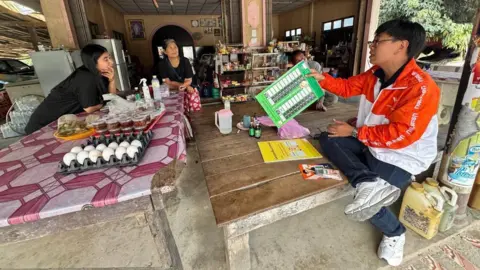
After winning his seat in 2023, Chutiphong threw himself into his new job, travelling around his constituency hoping to help solve the problems faced by his neighbours. But he quickly encountered resistance from those working for the established power-brokers. Worse still, he found he was expected to donate generously, from funds he simply did not have.
"I was invited to a women empowerment event - a regular activity for the locals to join and enjoy themselves. But they told me if I wanted to come, I had to give 25,000 baht. I told them I didn't have that money. They were very unhappy about that and said I was cold-hearted. I asked them if there was something else I could do to help out. But they never spoke to me again."
What he had run up against was a deep-rooted system of patronage controlled by a single family.
Rayong is best known as part of the Eastern Economic Corridor, Thailand's largest industrial zone, hosting many of the factories which drive its export-dependent economy. This has brought in migrant workers from other regions, and also created an urban middle class which is more responsive to the reformist ideas of the progressive movement.
In 2023 Move Forward won all five constituencies there.
But a lot of Rayong is still rural, home to farmers and fruit growers. This is particularly the case in District 4, where Chutipong won his seat. He is a local man, but spent several years living in California. The province has for decades been dominated by a single powerful clan, the Pitutecha family. This is what is known in Thailand as "Baan Yai" – big house – politics, and across the country it is the way local power has always been managed.
 AFP via Getty Images
Pitutechas run much of the local government.
Piya 'Chang' Pitutecha, the current patriarch, is the elected head of the Provincial Administration Organisation, a hugely influential position as the PAO manages most government spending in Rayong.
Until 2023 Pitutechas had always been among the MPs elected to parliament, with one the deputy health minister in Bangkok.
Like other "Baan Yai" they have no particular allegiance – over time they have represented five different political parties. They are also prominent in the local business community, and, unlike Chutipong, have plenty of funds to distribute. It was almost impossible for the first-time MP to compete.
The "Baan Yai" rely on extensive networks of canvassers - local people who know their neighbourhoods, and who mobilise voters to support their candidate. And although it is officially not allowed, they also hand out money during and after elections. They have always been critical to the success of local politicians, and as a new, largely urban organisation, the People's Party had no access to them.
"So I adjusted my strategy," says Chutipong. "I announced that I would try to fix any complaints right away. If your water doesn't run, your electricity isn't on, your road has potholes, I would be there.
"But the villagers who called me in then faced pressure from the network. Some got criticised in the village's chat group or through the PA system in the village. They were accused of bringing me - an outsider they said - into the area.
"When I tried to inspect factories after receiving some complaints about pollution, I faced a backlash from local communities because they had been receiving envelopes from these factories."
By the time of the 2026 campaign, the Pitutechas had learned from their setback in the previous election.
In Districts 3 and 4, they ran younger members of the family, better educated and with less of a godfather image than the older generation. In District 3 they ran under the Democrat party, traditionally their preferred political partner, but in District 4, 34-year-old Chatchai Pitutecha ran under Prime Minister Anutin Charvirakul's Bhumjaithai party, known for its deep pockets and its skill in winning "Baan Yai" over to his side.
Chutipong was outgunned.
The Pitutechas won both seats back from the People's Party, although the progressives retained three seats in Rayong.
"They would have welcomed me if I had given them money, but I could not do that forever given my limited resources. I had to decide whether I would be the representative they wanted, or I whether would keep my principles and see if the villagers would buy the idea. The election results have shown that they didn't buy it."
The BBC has asked Chatchai Pitutecha for his own views on why he won the seat, but he declined to comment.
"'Baan Yai' politics has recovered in eastern Thailand," says Olarn Thinbangtieo, a political scientist from Burapha University in Chonburi.
"Villagers still have expectations of their MPs because under our centralised government system they can't access resources fairly. They have to rely on the patronage network for their families' security."
The young MPs of the People's Party lacked social capital, he says. Their faces might be familiar on social media, but they lacked the recognition and trust enjoyed by established power brokers in the villagers.
They were also unable to connect with voters as effectively as they had in 2023, when they presented themselves as a fresh and youthful alternative to the military men who had by then led the country for nine years, instilling a broad yearning for change.
But the ease with which the courts and other conservative institutions blocked Move Forward from forming a government after their win in 2023 left many Thais cynical about the possibilities for change, and more focussed on more immediate economic challenges.
It is a different story in the big cities.
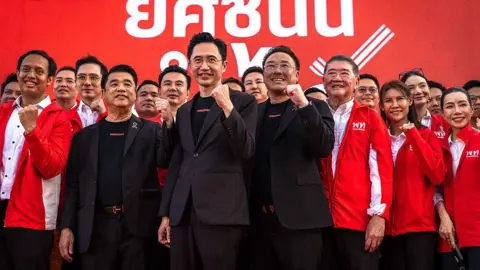
In the capital Bangkok, the People's Party cleaned up this year, taking every seat – an improvement on their 2023 performance. They also dominated in the second largest city Chiang Mai. But this only highlights how much their appeal is limited mainly to urban areas.
They still eclipsed all their rivals in their share of the nationwide vote, for party list MPs. But they only make up one fifth of the members of parliament. The remaining 80% are allocated on a constituency basis, and there the progressives clearly lost this time to the entrenched power of the traditional big families in the provinces.
