ICC confirms murder charges against ex-Philippine president Duterte: What you need to know

 Getty Images
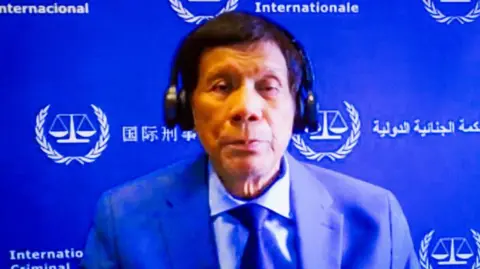
The International Criminal Court has unanimously confirmed all charges of crimes against humanity against former Philippine president Rodrigo Duterte.
The decision means there is sufficient evidence to establish "substantial grounds to believe" that Duterte committed the alleged crimes, officially committing the case to trial.
The charges include three counts of crimes against humanity in the forms of murder, torture, and rape during Duterte's bloody "war on drugs".
The campaign, which Duterte waged as a city mayor and then throughout his six-year presidency, saw the extrajudicial killings of tens of thousands of alleged dealers, users and others, human rights groups say. ICC prosecutors previously alleged he was involved in at least 76 murders, and charged him with three counts of crimes against humanity.
Those crimes were allegedly committed between 1 November 2011 and 16 March 2019, covering Duterte's time as both the mayor of Davao City and the president of the Philippines.
Duterte, 80, drew international condemnation over the campaign, but was unfazed, at one point saying he'd be "happy to slaughter" millions of "drug addicts" who he said were destroying the country.
"Duterte's so-called war on drugs resulted in the killings of thousands of civilians and many of these victims were children," prosecutor Mame Niang told an ICC court in February, calling for Duterte to be held to account. The proceedings were "a reminder that those in power are not above the law", he said.
Duterte has previously waived his right to be present in the courtroom, saying he did not recognise the ICC's authority. He maintained his innocence, his lawyer said at the time.
Who is Rodrigo Duterte?
Duterte was elected president of the Philippines in 2016, having promised to eradicate street crime by cracking down on illegal drugs. He had built a reputation for being tough against crime as mayor of Davao, a sprawling southern metropolis, and said peace and order were necessary to spur investments.
Despite his contentious legacy, his presidential campaign and strongman style proved hugely popular in a country with rampant drug issues. He frequently portrayed himself as a political outsider, and promised to champion the interest of Filipinos in the provinces who felt marginalised by Manila's elite.
Duterte is also notorious for his shocking rhetoric. He has been known to make sexist remarks, previously cursed at the late Pope Francis and former US president Barack Obama, and once compared himself to Hitler.
He has remained staunchly unapologetic about his drug crackdown over the years, saying in a video filmed as he was being taken to The Hague: "What is the law and what is the crime that I committed?"
Despite being in jail at The Hague, he remains popular, especially in Davao where he won the 2025 mayoral race by a landslide.
His daughter, Sara, is the current vice-president, while his son, Sebastian, is vice-mayor of Davao, currently serving as acting mayor.
Shortly after his father's hearing commenced on 23 February, Sebastian Duterte condemned it.
"Let's call this what it is - not justice, not accountability, but selective prosecution dressed up as moral superiority," he wrote on Facebook.
The older Duterte is the first Asian former head of state to be indicted by the ICC.
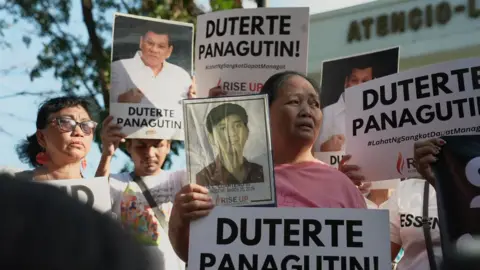
Families of drug war victims staged a protest on 23 February before watching Duterte's Confirmation of Charges hearing.
What is the case against Duterte?
Duterte is accused of "crimes against humanity" for murder and attempted murder, as well as other offences between 1 November 2011 and 16 March 2019, when he withdrew the Philippines from the jurisdiction of the ICC.
During this period, which straddled his time both as Davao mayor and the first half of his six-year presidential term, he is accused of acting as an "indirect co-perpetrator" who used others as tools to kill.
Prosecutors claim he used police officers and hired hitmen to "neutralise" people branded as criminals, and the tactic was part of his flagship anti-drug drive called Operation Double Barrel.
 Virma Simonette Rivera/BBC News
As president, Duterte openly encouraged the police to shoot and kill suspected drug dealers and users. The killings, which often involved people being gunned down on the streets or in alleys by unidentified men, sparked outrage.
Human rights monitors say the campaign targeted small-time pushers from the country's urban poor, while failing to bring big-time dealers and kingpins to justice. They also say suspects were summarily executed.
The true toll will never be known, although some rights groups believe as many as 30,000 people were killed in the campaign.
Duterte has denied the allegations - condemning the charges against him as "an outrageous lie"- as have his officials. The police have always insisted that they only killed in self-defence.
Duterte has refused to recognise the ICC proceedings, arguing that during his term, the country pulled out of the Rome Statute, the international agreement that established the ICC.
What led to his arrest?
Duterte's arrest and deportation last March was the result of a dramatic chain of events - precipitated by a falling out between his daughter, Sara, and hissuccessor, President Ferdinand Marcos Jr.
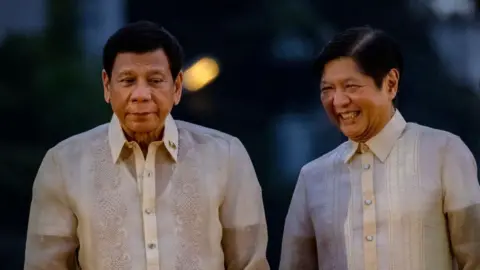
The Marcos and Duterte families had formed a formidable alliance in the 2022 election to solidify their support bases, but later feuded as they pursued divergent political paths.
Marcos had previously refused to co-operate with the ICC investigation, categorically declaring that the Philippines "will not cooperate" with the Court "in any way, shape, or form".
But as his relationship with the Duterte family deteriorated, he changed his stance. Duterte's supporters now allege that Marcos is using the ICC as a political tool.
The arrest shocked the nation. Duterte was apprehended at Manila airport after arriving from Hong Kong and hours later was flown to The Hague, where he is detained to this day.
The whole process of his extradition, from his detention in Manila to his arrival in The Hague, has been documented on social media by his daughter Kitty - as well as by Duterte himself, through his aide.
Over the course of more than 24 hours during his transit from Manila to The Hague, Duterte shared to Facebook a series of videos which allowed the world to follow the details of his journey - right down to the meals he was served on board his chartered jet.
These provided rare insight into what is usually an opaque process.
Why is the Duterte case important?
In the Philippines, the case is part of a broader power struggle between the Duterte and Marcos families.
The son of the ruthless dictator Ferdinand Marcos and his wife Imelda, Marcos Jr had a political career charted out for him by his parents – but this was derailed by a revolution in 1986 led to the family's downfall.
In the 1990s, Marcos became a provincial governor, congressman and senator, before running and winning the presidential race in 2022 after striking a deal with the Dutertes and making Sara his vice-president.
 Getty Images
The Duterte-Marcos alliance of 2022 had resurrected the Marcos dynasty - but there was not enough power to share after the election victory, and the so-called UniTeam alliance quickly unravelled.
As the feud heated up, Marcos allowed authorities to arrest the elder Duterte and bring him to The Hague.
More recently, Sara Duterte declared her intention to run for president in 2028, an election where Marcos is barred from seeking re-election because the country's presidents are not allowed to serve more than one term.
For the ICC, the Duterte case is a test of the court's ability to prosecute a former head of state over domestic policies.
It is a court of last resort designed to hold the most powerful to account when domestic courts are unable or unwilling to do so. However, it has no power to arrest people without the co-operation of the countries they are in.
What is the timeline of the Duterte case?
The case will now be transferred to a Trial Chamber, which will be responsible for the actual trial phase.
The confirmation of charges on 23 April followed a four-day hearing in February, after which the ICC had 60 days to issue a written decision on whether there was enough evidence to bring the case to a full trial.
It also came after a major ruling on 22 April, where the ICC Appeals Chamber officially rejected Duterte's challenge to the court's jurisdiction.
It took almost a year from Duterte's arrest for the pre-trial confirmation of charges to start.
Duterte announced last week that he would not be present at this week's hearing, saying he is "old, tired and frail" - and before Monday, the court heard petitions by his lawyers to stop the proceedings for health reasons.
The court ruled that Duterte is fit to participate. He was absent for the first day of the trial, however.
