The taekwondo teacher tasked with healing India's troubled state

 Ch. Chidananda Singh & Mutum Yoiremba
Manipur, in India's northeast, has a new chief minister after being under direct federal rule, which was imposed a year ago, following ethnic violence that left more than 260 people dead.
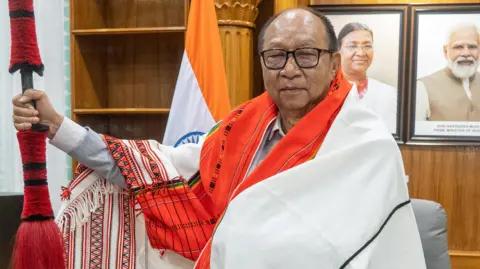
Yumnam Khemchand Singh, a fifth-dan black belt in Korean martial art taekwondo, took oath last week, inheriting a state still scarred by clashes between the majority Meitei and the minority Kuki-Zo communities.
Since the 2023 violence, the communities have been largely segregated, confined to separate regions, with thousands displaced from their homes.
Singh has a long association with taekwondo and has taught the martial art for years. But he is also a seasoned politician. Despite long ties to the Rashtriya Swayamsevak Sangh (RSS), India's governing Bharatiya Janata Party's (BJP's) ideological parent, the 62-year-old was a late entrant to electoral politics.
Singh, who belongs to the BJP, was first elected in 2017 and has since served as assembly speaker and a state minister overseeing portfolios including education and rural development.
Now, as he takes charge of a troubled state, the question is whether he can help bring peace?
Opinion remains divided. While some Manipur residents and analysts told the BBC they see hope in his leadership, others remain sceptical.
"It is difficult to say anything right now, and the next few weeks will be crucial in giving a clearer picture," Pradip Phanjoubam of the Imphal Review of Arts and Politics magazine, told the BBC.
Even as Singh takes office, tensions in Manipur continue to simmer.
On 21 January, a man from the Meitei community was killed in a Kuki-Zo-dominated area where he had been living with his wife, who is from the Kuki-Zo community. This was the latest in a series of killings linked to the conflict.
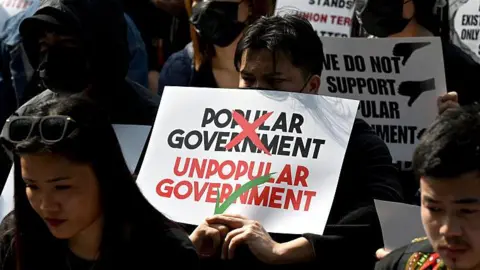
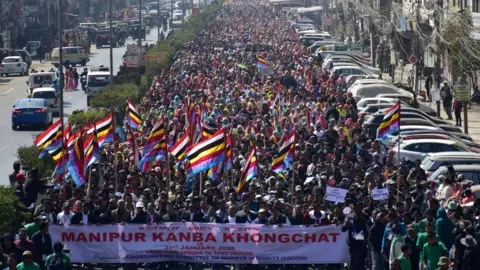
Hours after Singh took oath on 4 February, protests broke out in the state's Churachandpur district, with roads blocked and markets and offices shut.
Kuki-Zo civil society groups and student organisations condemned the participation of some Kuki-Zo legislators in the formation of the new government, calling it a "betrayal" and reiterating their demand for a separate administrative arrangement for Kuki-Zo-dominated areas.
While the valley areas in Manipur, including its capital, Imphal, are largely inhabited by the Meiteis, Kuki-Zos predominantly live in the surrounding hills.
Even as tensions between Meitei and Kuki-Zo communities persist, new frictions have emerged between Kuki-Zo and Naga tribal groups, adding another layer of complexity to Manipur's unrest. Tensions were reported on Sunday in the state's Ukhrul district, where authorities have imposed restrictions on gatherings following an alleged assault involving villagers from the two communities.
 Getty Images
Singh belongs to the Meitei community. While one Kuki-Zo legislator has been appointed as his deputy, two more legislators from the community are due to soon join as ministers in his cabinet - a composition that reflects an effort by the BJP to balance ethnic representation in a deeply divided state.
But some in the Kuki-Zo community are not convinced.
"Peace is not just the absence of violence. It requires trust, justice and political sincerity," Mang Khongsai, a Kuki student leader, told the BBC.
Khongsai says he does not believe that Singh can bring peace under the current circumstances.
"He [Singh] is part of a political establishment that has failed to produce a credible roadmap to resolve the conflict, assure security or address the core demand for separate administrations."
Glady Vaiphei Hunjan, an adviser to the Kuki-Zo Women's Forum in Delhi, says peace could not be "imposed by maintaining the status quo".
"Leadership that can bring peace must demonstrate moral clarity - by acknowledging where the state has failed, engaging all stakeholders equally and committing to a political solution rather than administrative management of a conflict," she says.
Manipur, with a population of about three million, covers roughly 22,327 sq km (8,620 sq m), is one of India's smallest states that is slightly larger than Wales.
The state has a long history of armed resistance and the violence of the past two years has seen militias and village volunteers take up arms amid deep communal mistrust. It has long been subject to a controversial law that gives the military sweeping power in regions designated as "disturbed areas".
Despite decades of unrest, Manipur has built a reputation as one of India's most consistent producers of elite athletes - such as Olympic weightlifter Mirabai Chanu, boxer Mary Kom and judo champion Sushila Devi Likmabam. This is often attributed to a strong local sporting culture, early exposure to football, boxing and martial arts and community-run clubs that have long offered structure and opportunity - a tradition Singh himself was part of.
 Reuters
Sunzu Bachapatiyum, a filmmaker who belongs to the Meitei community, says he is optimistic about Singh's leadership.
"He [Singh] is one politician who has working relationships with leaders across communities - that is a significant advantage," he says. "The fact that he could gather sufficient legislative support to form a government suggests a degree of acceptability. In the current climate, that is at least a step forward."
Singh can play a "significant role" in bringing peace in Manipur, says journalist Kshetrimayum Premchand, who belongs to the Meitei community. "He is a good administrator. Whether as a legislator or a state minister, he has been transparent about his functioning."
Some observers also point to Singh's December 2025 visit to a relief camp for internally displaced Kuki-Zo people as a significant factor in his emergence as the chief ministerial choice. The outreach, widely seen as unusual for a senior Meitei leader during the conflict, could have helped broaden his acceptability among Kuki-Zo legislators, say analysts.
But Seram Rojesh, convener of the Delhi Meitei Coordinating Committee, says lasting peace would require the "disarming of armed ethnic groups" that have played a role in the violence.
Arambam Noni, an associate professor in Imphal's Dhanamanjuri University says Singh should prioritise "dialogue" and "ensure non-violation of the rule of law". He also cautions against giving into the demand of Kuki-Zos for a separate administration because "it can have ripple effects for others, who can escalate similar demands, given Manipur's overlapping cultural and ethnic diversities".
The return of an elected government creates space for political engagement, but deep mistrust between communities has resurfaced even in periods of relative calm, say analysts.
"Peace will depend on whether that authority is used to rebuild trust across communities rather than simply restoring administrative normalcy," says Phanjoubam, the Imphal-based editor.
