Thailand election: The result the polls never saw coming

 AFP via Getty Images
As the dust from what has been a hard-fought election campaign in Thailand settles, many Thais may be rubbing their eyes and asking, "what just happened?".
Most of the opinion polls published before the election predicted a win for the progressive People's Party. Some suggested it would get more than 200 seats in parliament, a significant improvement on its already impressive 2023 result when it won 151. Few polls put the party of Prime Minister Anutin Chanrvirakul ahead.
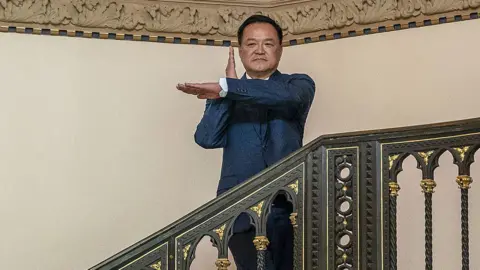
Yet once most of the votes had been counted, it was clear Anutin had achieved a stunning victory, and the young reformists had suffered a big setback. With a projected share of more than 190 seats, the path of Anutin's Bhumjaithai party is clear to form the next government, albeit with coalition partners.
So why did a youthful, progressive party with an imaginative and tech-savvy campaign do so poorly compared to a transactional, old-style party with little ideological identity aside from strong loyalty to the monarchy?
A harder race for the reformists
The mixed voting system played a part. People in Thailand cast two ballots, one for a candidate in their constituency, and one for the party they prefer.
At the national level the People's Party, with nearly 10 million votes, did much better in the party list than Bhumjaithai, with just under six million votes, although this was still a big drop compared to the more than 14 million Move Forward, the previous incarnation of the People's Party, won in 2023.
But the party list accounts for only 20% of the 500 seats in parliament.
As many as 80% of the seats are allocated by local contests, where whichever candidate get the most votes in each constituency wins the seat on a first-past-the-post basis.
This is where the People's Party, which is relatively new and urban-based, is weaker because it lacks rural networks.
Bhumjaithai, by comparison, is a past master at using its substantial resources to win local power-brokers to its side, and they exercise a lot of influence over voters in their areas.
Anutin has used the defections of political veterans from other parties to grow Bhumjaithai from a medium-sized provincial movement which won only 51 seats in 2019, to a national-level election-winning powerhouse today.
It was also harder for the reformists to distinguish themselves on a single issue this time. In 2023, after nine years being ruled by the stern, avuncular Prayuth Chan-ocha, the general who led the 2014 coup, there was a broad yearning for change, and the Move Forward party, under its suave, telegenic leader Pita Limjaroenrat, promised no deals with "the uncles" – those involved in the coup.
This captured the imagination of the public, and there was a last-minute wave of support for them.
In this election, there was no such defining issue, and the party had been forced to drop its campaign to amend the harsh lese majeste law after this was used by the courts to justify dissolving Move Forward and banning its leaders from politics.
Anutin was also able to coalesce conservative support around his party, as opposed to having their voters split among several parties in 2023.
His strident nationalism over the border conflict with Cambodia, his staunch support for the army and his intense loyalty to King Vajiralongkorn all defined him clearly as the standard-bearer for Thai conservatism.
 AFP via Getty Images
Another big factor was the steep decline in the fortunes of Pheu Thai, the once unbeatable election machine backed by former prime minister, Thaksin Shinawatra.
It came second in 2023, with 141 seats, but is likely to see that total halved this time round after the past three years of political turmoil in which two of its prime ministers were dismissed by the constitutional court, and it was accused of mishandling relations with Cambodia.
Thaksin has been jailed on old corruption charges, and could face further criminal complaints.
Back in 2023, Pheu Thai lost support to Move Forward. This time, Bhumjaithai and other conservative parties were the beneficiaries of Pheu Thai's falling popularity in its old strongholds of the north and north-east.
Some in the reformist camp will look back on their party's controversial decision to back Anutin to become prime minister last September, after the fall of the second Pheu Thai administration.
At the time, the People's Party justified this strange alliance with its ideological opposite by promising not to join his government, and by extracting from him a pledge to hold a referendum on changing the military-drafted constitution, a priority for the reformists.
But by not insisting on cabinet positions in return for their votes in parliament, the People's Party allowed Anutin to fill his cabinet with capable technocrats, burnishing his credentials as a can-do leader.
And while the constitutional referendum was indeed held at the same time as the election on Sunday, and produced a clear vote in favour of changing it, the process of drafting and approving a new charter is so protracted it might be indefinitely delayed.
Some now see this as a poor decision, which tarnished their reputation among more idealistic followers.
In the end, though, the reformists always had a mountain to climb to get into government.
Many of their leaders have already been banned from politics, their party has been dissolved twice, and one of their best members of parliament is likely to go to jail for six years on lese majeste charges.
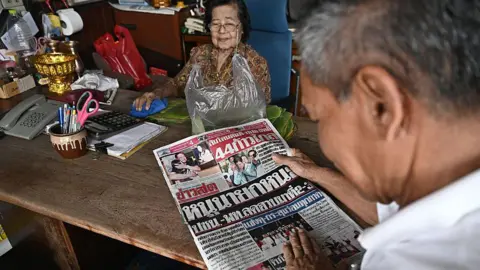
Even after their election loss, another 44 of their leading members now face bans from politics by the Supreme Court for supporting the proposal by Move Forward to soften the punishments under the lese majeste law.
These impediments may well have disillusioned some of the voters who backed Move Forward three years ago. Turnout in this election at 65% was sharply down from the 75% seen in 2023.
Anutin will face no such impediments.
The many means by which elected governments, parties and politicians can be constrained by unelected bodies – the "handcuffs" on Thai democracy – have only ever been used on those challenging the status quo.
Provided he can make terms with smaller coalition partners, the prime minister has a good chance of completing a full four-year term, something no civilian leader has managed to do in Thailand for 20 years.
