How were 500 patients evacuated from a hospital?

 BBC
BBCMost office workers and schoolchildren are familiar with fire drills.
An alarm sounds and people head to the nearest fire escape before assembling at a designated point outside the building.
But how much harder is that process when it includes people who are very unwell, bed bound, recovering from surgery, elderly or disabled?
When a fire broke out at Southampton General Hospital on 1 February, more than 500 patients were safely evacuated in 40 minutes.
Here's how a combination of training, experience and building design helped what has been described as a "textbook" operation.
What happened?

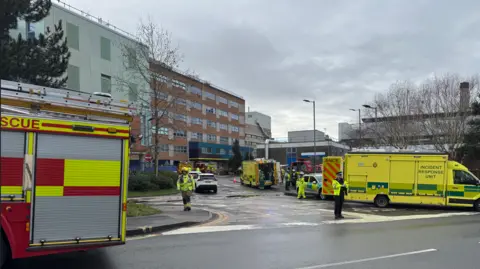
An electrical blaze broke out in the endoscopy unit on level L in the west wing of the hospital at about 05:30 GMT.
A major incident was declared and Hampshire & Isle of Wight Fire and Rescue Service deployed more than 110 firefighters to tackle the blaze at its peak.
Hospital staff and fire crews moved 502 patients to safe areas across the hospital site within 40 minutes.
Surrounding roads were closed while emergency services dealt with the fire.
Most closures were lifted shortly after 14:00, with only access to the hospital's west wing remaining blocked.
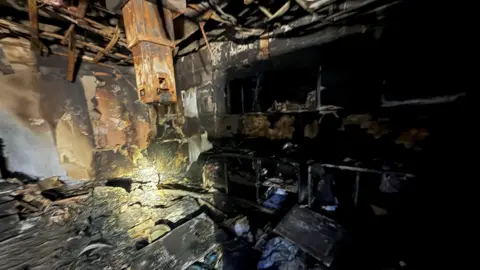
The entire endoscopy suite was completely destroyed and the hospital was left 200 beds down.
It was forced to close wards due to damage and reschedule elective surgeries.
How was the hospital evacuated?
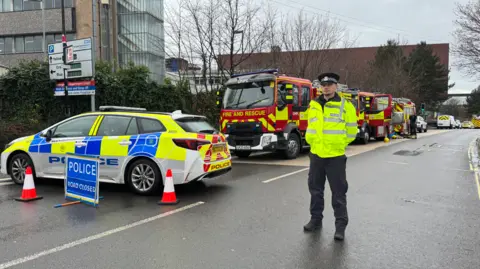
Many patients would have been awoken by an alarm early on Sunday morning, said University Hospital Southampton's chief executive David French.
That alert would have quickly gone through to the fire service, triggering the emergency response.
The BBC understands the majority of evacuated patients were then taken to the hospital's east wing, rather than outside the building.
This is not an uncommon practice, according to fire safety expert Dr Tony Fogarty, who said hospitals are expressly designed with these kinds of incidents in mind.
"They're built very much like Russian dolls," he said.
"You open the doll and there's another one inside, so the outer layer is always protecting the next layer.
"It's what we call 'compartmentation'. So that allows people to move to the next area safely, stay there, assess the situation and decide whether they actually need to move any further."
This allows for a "horizontal" evacuation, meaning patients can be moved to other spaces on the same level, rather than using stairs or lifts.
"It's a progressive evacuation, not a rapid full evacuation," Fogarty said.
"Essentially, you defend in place. The fire and rescue service will defend the fire where it starts, and patients are moved horizontally from one area to the next."
This method is particularly useful in situations where some evacuees are restricted to beds or wheelchairs.
Fogarty said the response would have been a team effort between firefighters coordinating the emergency response and the clinical and estates teams in charge of evacuations.
The hospital staff would "explain patient conditions and how long moves take, and fire crews advise on whether it's contained and whether further movement is needed", he said.
"I would say... it was textbook," he added. "This was a very slick operation, in my professional opinion, and all the staff and firefighters should be commended for that."
How do hospitals prepare?
 University Hospital Southampton
Fogarty says firefighters and hospital staff would have been fully prepared to deal with this kind of emergency.
"It's very challenging," he said. "You couldn't get much more challenging in an emergency situation. That's why hospitals take it seriously and why fire and rescue liaise closely with estates and clinical teams.
"You can't do a full real-time hospital evacuation drill for obvious reasons, so you do desktop scenarios, modelling and planning, including computer modelling of how smoke could move through wards, how moving beds affects timings, door sizes, and so on.
"You can also practice in areas of the hospital that are closed or not in use."
He says firefighters do familiarisation exercises in hospitals to ensure they have an understanding of the building layout.
What was it like for patients?
 Beth Kelly/Nicholas JP
Beth Kelly, from Winchester, was among the patients to be evacuated and said she would be forever grateful to staff at the hospital.
She was recovering from gall bladder surgery on a ward, one level above the endoscopy unit.
Her partner Ben Stanbrook was staying with her in a room with their five-week-old son Wilfred.
Kelly said she had been woken up by the baby just before 05:30, shortly before the alarm sounded.
"A nurse came in said there was a fire but that their instructions were to just close the windows," she said.
But when smoke began to enter the ward, the evacuation was initiated.
Kelly said: "We opened the door and I said 'I have a baby'. They told us to go and so we went down the fire escape.
"We could see and smell smoke at this stage."
While other patients were moved from the west wing to the east wing, the family made their way down the fire escape and out of the building, where they joined several other patients.
During their escape, Kelly said her partner helped another patient who had fallen on the stairs.
After the evacuation, staff checked on them and collected nappies and milk for Wilfred from the paediatric ward.
"It was very surreal," said Kelly. "I don't know how anybody prepares for what happened.
"I think they did an incredible job. I can imagine it was an absolute logistical nightmare."
You can follow BBC Hampshire & Isle of Wight on Facebook, X (Twitter), or Instagram.
