How love united a Venezuelan liberator and a shoemaker's daughter

 Getty Images
It was an unlikely romance: he was a Venezuelan revolutionary and she was a shoemaker's daughter from rural East Yorkshire. But together, Francisco de Miranda and Sarah Andrews helped pave the way for South American independence.
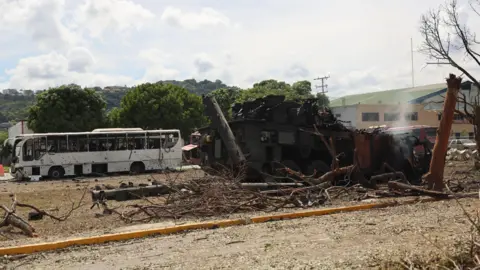
After the US said the president of Venezuela was captured during an operation earlier this month, damage was reported at an airbase named after a much earlier leader of that country.
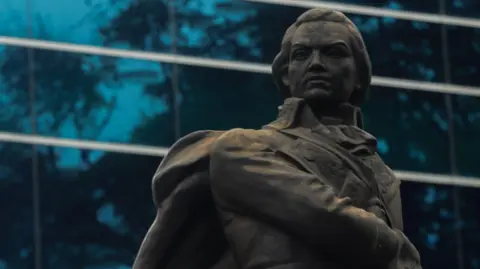
General Francisco de Miranda is known as the "First Universal Venezuelan" and played a key role in the fight for the country's independence from the Spanish empire in the early years of the 19th Century.
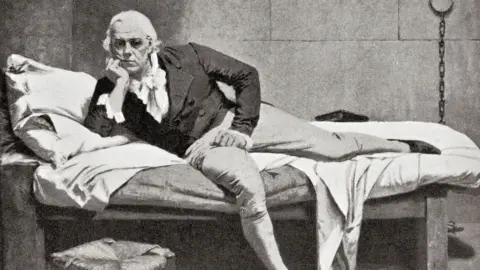
Miranda became leader of the First Republic of Venezuela, only for Spain to fight back and throw him in prison.
Thousands of miles away, his wife Sarah Andrews was raising their two children in a grand house in London, where she hosted and supported key allies of her husband, as the Hidden East Yorkshire podcast has been hearing.
It was a far cry from her humble upbringing in the quiet town of Market Weighton, East Yorkshire.
So how did Andrews and Miranda come to be together? Local historian David Neave has looked into their stories.
Miranda was born in Caracas, now Venezuela's capital, in 1750, and would have been almost 25 years older than Andrews when they met.
"He was very well-educated, from a wealthy family - he had education in Venezuela, but also in Madrid," says Neave.
"He joined the Spanish army, fought in Morocco for the Spaniards, then travelled to Europe."
Miranda met Catherine the Great, empress of Russia, fought in the French revolution and visited the US just after the American revolution.
Eventually he moved to Britain and set his mind on freeing Venezuela from Spanish colonial rule.
"He came and settled in London in 1798 with a hope of getting English support for a campaign to free Venezuela, and so he talked to William Pitt, the prime minister, and other people," says Neave.
"He got support whenever Britain was at war with Spain. When they weren't, he didn't get the support."
 Getty Images
During his time in London, Andrews, the young woman from Market Weighton, became his wife.
"She came from quite a modest family - shoemakers were not all that grand," Neave says.
"Her grandfather had been a cooper and her mother died when Sarah was not quite six."
Andrews' family home can still be seen in Market Weighton today, on the Hull to York road, but after her mother died it is possible she was sent to be a servant in the house of her uncle, who was a quite well-known portrait painter in London.
"By 1800, she was clearly in the household of Francisco Miranda," Neave says.
"She was running his household and had two children - a boy, Leander in 1803, and another boy, Francisco, in 1806."
When he went back to Latin America, she was left in charge of a grand house in Fitzrovia, London, where South American liberators gathered.
"He had a library of 6,000 books, remarkable at that time, which he was willing to lend out.
"He inspired people. The most important South American liberator was Simon Bolivar, who became the liberator of Venezuela, of Colombia and Bolivia and down into Peru. He stayed at their house."
'Ready to fight'
Letters from Andrews to Miranda, written to him while he was away, have survived.
"She's not that educated a writer, but they're still very good letters, in which she writes about the children - about how Leander, even when he was three, was hoping to go to South America to support his father, and had a sword and was ready to fight," says Neave.
"They never saw their father much at all and he died before they'd grown up."
In 1811, Venezuela declared independence from Spain - the first South American nation to do so - and Miranda went on to become its leader.
"He had a brief period of success and, for a short period, he was nominally almost the president of the freed Venezuela, but, in the end, Spain captured him and the independence didn't get through straightaway," Neave says.
"He actually ended his life in a Spanish jail.
"He is called the precursor of Latin American independence. He is the man who started the idea."
 Miguel Gutierrez/EPA/Shutterstock
Miranda died in 1816, but Andrews lived until 1847. She is buried in Kensal Green cemetery, London, where a plaque from the people of Venezuela thanks her for her achievements.
She is also remembered by a plaque at All Saints church, Market Weighton, which was laid by the Venezuelan ambassador to the UK.
"She is seen as important because she was the host of this house, even when he wasn't there, to people who were so important to the future of South America," adds Neave.
"It does make you think what effort was done by so few people to achieve so much."
Listen to highlights fromHull and East Yorkshire on BBC Sounds, watch the latest episode of Look Northor tell us about a story you think we should be coveringhere.
Download the BBC News app from the App Store for iPhone and iPad or Google Play for Android devices
