The small village that became a Mecca for cyclists

 Send and Ripley History Society
Long before Surrey's Box Hill became an Olympic landmark, a quiet village on the Portsmouth Road was the unlikely centre of British cycling culture.
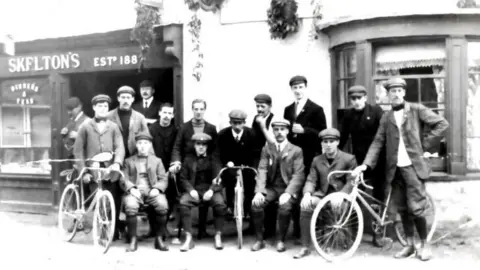
In the late 19th century, Ripley, a modest parish between London and Guildford, drew thousands of riders every weekend.
Indeed, the route to it from the capital became known simply as the Ripley Road and a pilgrimage place for a new generation of cyclists.
"Cycling became the sport for the common man, and Ripley was the perfect distance from London for a good ride," said Clare McCann, curator at Send and Ripley History Society.
She added that the cycling boom was initially helped by the arrival of the railway at Woking in 1838.
"As a result, coach traffic, which had been very busy, dwindled to nothing," said McCann.
"And, with cars not yet having arrived, you were left with a perfectly good road with very little using it."
Stopping off at pubs along the route also became a big draw, making cycling as much a social movement as a sporting one.
By far the most popular of these haunts was The Anchor Inn, which evolved into the most famous watering hole for pedal pushers in Britain.
 Fiona McCarthy
Run by the Dibble family, its walls were covered with club pennants, photographs and trophies, while its guest books read like a roll call of Victorian cycling pioneers.
"At its height in the 1880s there'd be thousands of signatures in there," she added.
"The ultimate kudos went to whoever was first to write their name in the new visitors' book on 1 January.
"So New Year's Eve was a big deal at The Anchor, which would always be packed," McCann added.
On peak weekends, hundreds of bicycles would be propped against the inn's walls, with riders spilling onto the village green.
But all that came at a cost, with the rowdy behaviour of some groups eventually rubbing locals up the wrong way.
"The beginning of the end came when tea shops became more in vogue than pubs, which created a very different culture," said McCann.
That was compounded by the increasing modernisation of roads, which saw cars take over and other cycling routes emerge.
Today, Ripley's role as the birthplace of mass recreational cycling is largely forgotten, despite its profound influence on British leisure culture.
Follow BBC Surrey on Facebook and X. Send your story ideas to southeasttoday@bbc.co.uk or WhatsApp us on 08081 002250.
