Police using facial recognition: Is it a problem?
More than 400,000 faces have been scanned by police in the south of England using live facial recognition (LFR) technology, leading to a handful of arrests. But what is it?
Cameras take a digital image of a human face and a computer program compares it against a database of faces which police have prepared, that can recognise wanted suspects and missing people.
Officers can then seek to take any action if people on the database are matched.
Following the recent use of LFR in the Thames Valley and in Hampshire last month, here is a look at what issues the use of it raises.
How has it been used in the South?
Hampshire and Isle of Wight Constabulary used LFR for the first time in Portsmouth in September 2024 as part of a pilot project. It used it in Southampton, Basingstoke and Winchester in that same month as part of the same scheme and again in Southampton on 18 December 2025.
In total, it said it had images taken of nearly 324,000 faces, with 10 people arrested, though not all of those were as a result of using LFR.
In December, when 1,277 faces were pictured, no one was directly arrested as a result but one person was arrested for shoplifting.
"We know that these vans are not just about alerts, they are about increasing visibility of our teams within the communities that we serve and disrupting those intent on committing crime," a force spokesperson said.
"We know that the deterrence factor they bring is a really important part of helping to make those living and working in the area to feel safer, knowing that we are there, carrying out patrols and making arrests."

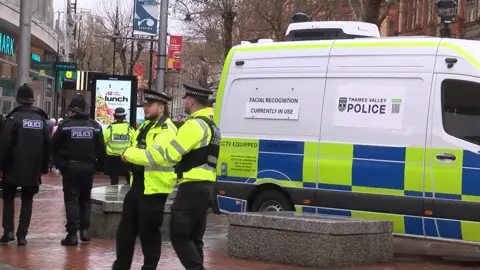
The force said it planned to use it again in Commercial Road in Portsmouth on 26 January and posts future deployments on its website seven days in advance.
Thames Valley Police (TVP) used LFR in Cornmarket Street in Oxford on 22 December 2025 and in Milton Keynes, High Wycombe, Oxford and Reading last week.
TVP said it scanned 86,540 faces and arrested three people.
The two forces share the technology as part of their Joint Operations Unit.
As of the end of last year, 13 of the 43 police forces in England and Wales had used or were using LFR, including the Metropolitan Police.
Civil liberties group Liberty said the "powerful tech" was likely to be used disproportionately against people of colour and could misidentify people.
A High Court case will be brought next week by Shaun Thompson, who was stopped by police in February 2024 outside London Bridge Tube station.
Privacy campaign group Big Brother Watch said the judicial review would be the first legal case of its kind against the "intrusive technology".
Thompson had been returning home from a shift with a community group when he was approached by Met Police officers after he was wrongly identified as being on a watchlist. He was detained for about 30 minutes.
Liberty said the use of it was currently a "regulatory Wild West" and that other countries' governments were putting laws in place to limit the technology's "dangerous effects".
Its director Akiko Hart said the government must stop any further rollout of LFR "to protect each of us and prioritise our rights – something we know the public wants".
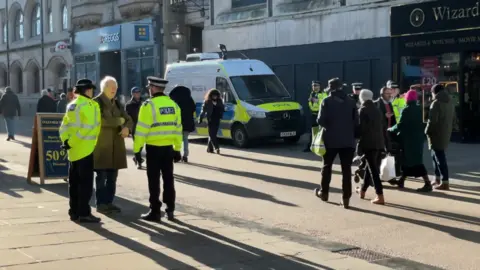
Is its use worth it?
TVP said it believed LFR was a "highly effective and valuable tool" that helped it protect communities.
It said everyone on its watchlist must be based on the "principles of necessity and proportionality" and that its use must be "balanced with public confidence of our use of LFR".
The Home Office published a consultation in December and said successes of LFR included more than 1,300 arrests of individuals wanted for crimes including rape, domestic abuse and grievous bodily harm.
Both TVP and Hampshire and Isle of Wight Constabulary said the data held on people was minimal.
In Hampshire's case, it said its watchlist at any one time "could include hundreds or potentially thousands of individuals per deployment" but no more than about 3,000 people.
It said any processing of images should "last no longer" than the time it takes an individual to walk past the camera "before their personal data is deleted". Any impact on them was considered "negligible".
All other data is deleted within 24 hours, even if they have been flagged by LFR, that force said.
