Marooned Byron statue to be moved into Hyde Park

 Heritage of London Trust
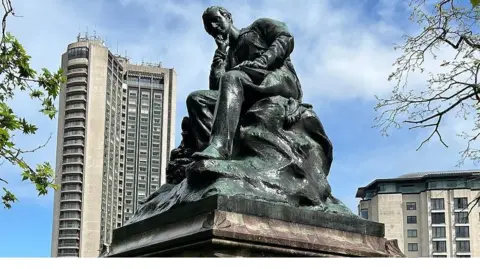
A memorial statue of the 19th Century poet Lord Byron marooned on an inaccessible traffic island on Park Lane for decades and left to deteriorate is to be restored and moved to a new home in Hyde Park.
After being restored the statue and plinth will be placed at a more visible location near Victoria Gate in the central London park.
The Grade II listed bronze sculpture, created in 1880 by Richard Claude Belt, was first erected in Hamilton Gardens, originally part of Hyde Park, but a three-lane dual carriageway built in the 1960s on Park Lane made it hard to reach.
The current Lord Byron, president of The Byron Society, said the group was "thrilled that work is finally about to start".
A fundraising campaign supported by the Heritage of London Trust and the Murray family raised the £380,000 required for the restoration and relocation, including a £230,000 grant from The National Lottery Heritage Fund.
The president of The Byron Society thanked "all the people who have supported us to make this happen".
Work to put in the foundations at the new site is expected to begin on 13 April while the statue and plinth is repaired.
The statue is expected to be in place by the end of June.
 Nottingham City Museums and Galleries
Stuart McLeod from The National Lottery Heritage Fund said: "This project will give this important cultural landmark the prominence and public access it deserves, ensuring Byron's legacy continues to inspire."
'Mad, bad and dangerous to know'
The statue's location was previously discussed in the House of Lords in April 2024, when a descendant of Lord Byron cited a government pledge to move the statue was made in 1958 during a debate on the Park Lane traffic scheme.
In January this year, The Byron Society sought planning permission from Westminster City Council to move the statue, which has since been approved.
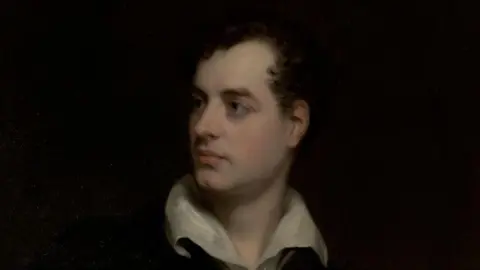
Lord Byron, described by the Poetry Foundation as "the most flamboyant and notorious of the major English Romantic poets", was born in London's Holles Street, off Oxford Street, in 1788.
One of his lovers, Lady Caroline Lamb, famously said he was "mad, bad and dangerous to know".
He died from a fever in 1824 in Missolonghi, in modern-day Greece, after joining Greek insurgents the previous year in their war of independence against the Ottoman Empire.
Listen to the best of BBC Radio London on Sounds and follow BBC London on Facebook, X and Instagram. Send your story ideas to hello.bbclondon@bbc.co.uk
