Medieval loo and evidence of a murder among finds of 2025

 Alexander Jansen/Durham University
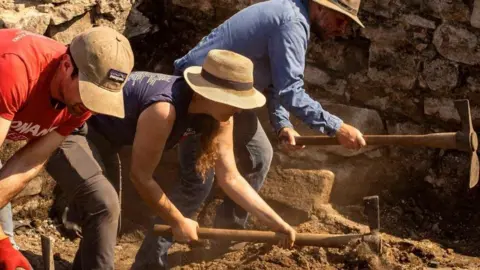
A medieval toilet, a "murder" victim and the remains of an extinct species of cattle are among the discoveries that have helped to shed light on the past this year.
Archaeologists also uncovered one of the largest Iron Age hoards to date and part of a shipyard linked to Lord Nelson's fleet.
Meanwhile, a growing number of amateur detectorists have been in the news, with one haul of Civil War coins fetching £63,000 at auction.
Here, we take a look at some of the most interesting items making headlines in 2025, and hear from some of those with a passion for unearthing the past.
 Durham University
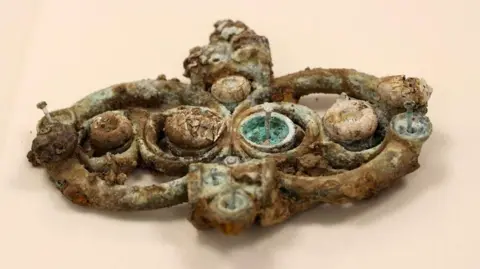
Back in March, one of the "largest and most important" Iron Age finds in the UK was uncovered in North Yorkshire.
The Melsonby Hoard was discovered in a field near Melsonby by metal detectorist Peter Heads and excavated with the help of Durham University.
There were more than 800 items, including two cauldrons or vessels, horse harness, bridle bits, ceremonial spears and 28 iron tyres, believed to have been buried about 2,000 years ago.
Historians believe the discovery could lead to a "major re-evaluation" of the wealth and status of the elite living in northern Britain at the time.
Other interesting finds include a grave slab raised from the site of a 13th Century shipwreck off the Dorset coast, and a slipway from the 18th Century in the New Forest, where ships for Lord Nelson's fleet were built and launched.
Researchers from the University of Southampton said the slipway at Buckler's Hard, a hamlet in the New Forest, was once home to one of the busiest private shipyards of the 1700s and would improve their understanding of shipbuilding techniques.
 Durham University/The Auckland Project
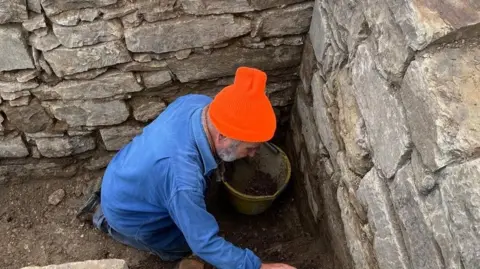
Elsewhere, a medieval loo and a jet die used to predict the future were among the finds uncovered at Auckland Castle in Bishop Auckland, County Durham.
At least three medieval toilets have been found over the years "dotted around the site", according to John Castling, the Auckland Project's archaeology curator.
"One is ironically very near to where the toilets are now for our visitors," he added.
The latest loo, known as a garderobe, was discovered in June and is located next to the Great Hall, where bishops and their guests would have feasted.
Experts said the finds, which also included a whale baleen and French jettons - coin-type objects used in calculations - would help build a picture of everyday life at a medieval bishop's palace.
 Steve Hickman
Recent figures recorded by the British Museum's Portable Antiquities Scheme show 1,446 discoveries in England in 2024 - up from 1,266 the previous year, with many of the finds uncovered by metal detectorists.
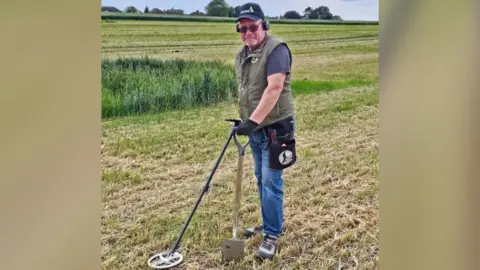
Steve Hickman, who says he was inspired by the BBC comedy Detectorists, found a valuable Civil War coin haul near Aylesbury, Buckinghamshire, just two months after taking up the hobby.
The haul fetched £63,000 at auction in Essex, with the proceeds being split with the owner of the farm.
"It's a ridiculous story. I was detecting in a field with power cables above when I got this really puzzling signal," he said.
"I looked up, thinking it was going to be those cables, but decided to dig because when you're starting out, you need to try everything to learn the good from the bad."
However, after not getting a signal, he filled the hole in, only to have second thoughts. He returned later that day and unearthed an orange pot containing no fewer than 1,064 silver coins dating back to the reign of Elizabeth I.
 Bournemouth University
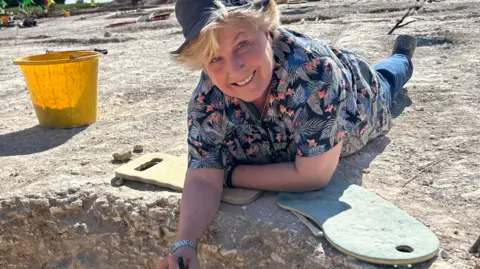
In Dorset, TV personality Sandi Toksvig has been helping to unravel a 2,000-year-old murder mystery as part of a new TV series.
The presenter filmed with Bournemouth University researchers and students at an archaeological dig near Winterborne Kingston, where an Iron Age settlement and cemetery was excavated.
During the episode of the Channel 4 show, called Hidden Wonders, researchers discovered the skeleton of a teenage girl buried face down in a pit, believed to have been murdered as a human sacrifice.
Dr Miles Russell, the university's principal academic in prehistoric and Roman archaeology, worked with the former Great British Bake Off host during filming.
"The team were particularly shocked to hear that this could have been a human sacrifice, but it was obvious from Sandi's own interest in archaeology that she was deeply moved by what had been uncovered," he said.
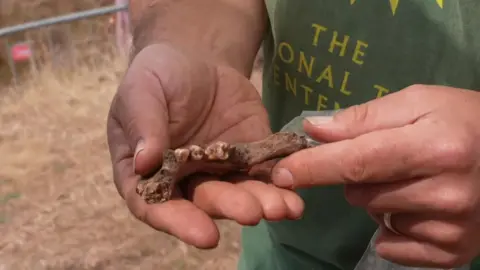
Archaeologists also uncovered what may be a significant historic burial site on the south coast of Cornwall.
It followed the chance discovery of human teeth by a young boy near Lizard Point, who was holidaying with his family.
Following the discovery, the police were initially called to investigate, but quickly determined the remains were historic.
National Trust archaeologist Jim Parry said they had since uncovered multiple burials.
Mr Parry said he believed the site could be linked to one of the area's many shipwrecks.
"It's exactly the kind of event that could explain a site like this," he said.
"But it's also possible the burials span centuries, with individuals added over time," he added.
 York Archaeological Trust
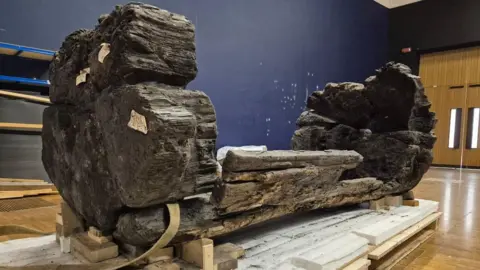
Meanwhile, a 4,000-year-old Bronze Age coffin unearthed at a golf club will go on show at Lincoln Museum next year.
The 10ft (3m) coffin, made from a hollowed-out oak tree, was unearthed by chance at a golf club in Tetney in 2018 during work on a pond.
The 'Tetney Coffin' has undergone two years of conservation work carried out by York Archaeology with a £110,000 grant from Historic England.
Experts were also astonished to find the remains of a man buried with a finely crafted axe, still with its wooden handle in place.
An investigation of the plant and pollen remains found inside the coffin revealed that the man was laid on a bed of oak and yew branches and had a garland of flowers around his neck.
Hazelnuts and other plants may have formed part of a food offering.
Natalie Oliver, executive councillor for culture at Lincolnshire County Council, said the coffin was "one of the most extraordinary objects - both in terms of its archaeological significance and its physical scale".
 Yorkshire Dales National Park Authority
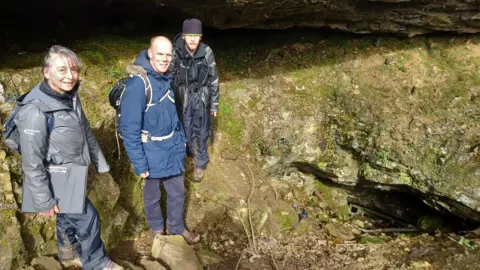
In August, remains of an extinct species of Bronze Age cattle were found in a cave in the Yorkshire Dales.
Researchers worked with cave explorers to uncover the remnants of an aurochs while surveying caverns and sinkholes near Ingleborough.
Aurochs, which are regarded as the wild ancestor of modern cattle, were once found across Europe before habitat loss and hunting wiped them out in the 17th Century.
Rick Peterson, a caving archaeologist at the University of Central Lancashire, said: "It's often experienced local cavers who are the first to encounter archaeological finds such as these as they are the only ones who can access the caves."
The team also found evidence of the area being used as a human burial site during the Neolithic period.
 Sally Fairfax/BBC
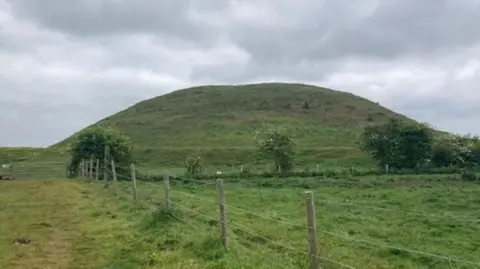
Archaeologists from the University of York were wowed by a remote abandoned Norman castle site near Skipsea, East Yorkshire.
Although little evidence of it remains today, recent research has revealed that the motte - or mound - previously thought to have been created by the Normans, actually dates from the Iron Age.
Dr Elaine Jamieson, fieldwork project manager, said: "I probably see it with completely different eyes to the tourists who are looking for a stone castle, but I see the castle in all the earthworks," she said.
The castle would have likely originally have been built from timber, before being rebuilt in stone, she added.
After the castle was abandoned, Dr Jamieson said it was possible local villagers took the stone to use elsewhere.
 Face Lab/Liverpool John Moores University
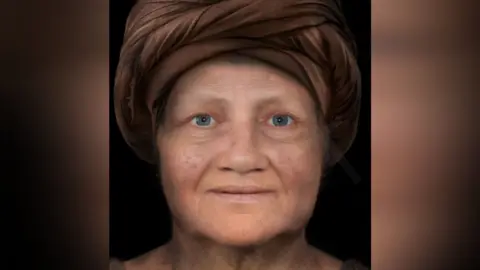
Meanwhile, scientists at Liverpool John Moores University used computer technology to recreate the face of a woman from her 900-year-old skull.
Skeletons from 14 bodies were found buried at Holy Trinity Kendal Parish Church in Kendal, Cumbria, when the Environment Agency (EA) started work on a flood management scheme in 2022.
Stephen Dean, a senior archaeologist at the EA, told BBC Radio Cumbria the woman's bones suggested she led a hard life, working outdoors extensively, probably in the fields, and eating a poor diet.
There were also indications she had been buried without a coffin, and her position in the church yard suggested she was not of high status, he said.
The woman was estimated to have been about 50 when she died in the 1200s.
