Why do the West's farmers pay the price for war in Iran?

 BBC
BBCFarmers are paying "crippling increases" in the cost of essential fertiliser and fuel as the global price of oil rises.
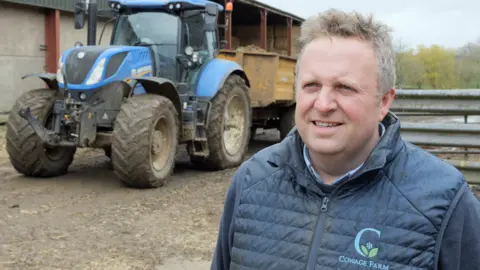
The war in the Middle East has caused an "overnight shock" to West of England farmers, according to local farmer Tom Collins.
For most consumers, the immediate impact of the war has been an increase in heating oil prices, which have more than doubled since the war began, and in petrol prices, which have risen by 9%, according to the RAC.
But Collins, who speaks for the National Farmers' Union (NFU) in Wiltshire, said the price of farmers' fuel and fertiliser had "doubled overnight, and it's really tough".
So why have costs for farmers risen so fast, and will it mean higher prices for the food they produce?
Why have farm diesel prices doubled?
Far from the war torn Gulf of Oman, Collins drives his favourite blue tractor through his farmyard, near Malmesbury in Wiltshire. But filling this tractor with fuel has been directly impacted by the war.
"This tractor holds 400 litres of diesel," he explains," and it's doubled in price in the last seven days, which has been a huge impact for our business."
The war has seen large oil and gas facilities attacked and it has effectively closed a key shipping channel, the Strait of Hormuz, which runs close to the Iranian coast. One fifth of the world's oil passes through here, so the disruption has sent global oil prices soaring, and the price of diesel has followed.
But why has farm diesel doubled? In ordinary UK filling stations, diesel has risen by 24p a litre, or 17%, according to RAC research.
The reason lies in the "red diesel" farmers use, which is taxed much less to support agricultural use. Consequently, much more of the price they pay comes from the actual oil price.
Before the war began, farm diesel was sold for about 65p per litre. Now farmers are paying about £1.20, even £1.30 per litre, plus VAT.
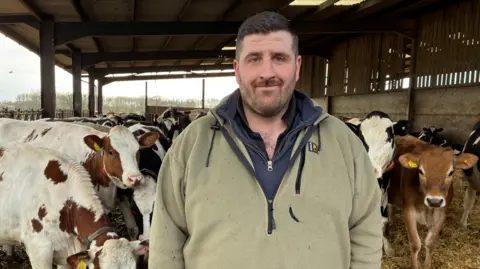
"It's crippling," says Mike Catley, a dairy farmer who runs 250 cows at Mile Elm farm, near Calne.
The price hike is bad enough, but farmers are now facing rationing as well. He normally orders 3,000 litres at a time, but is now being limited to only 1,000 litres a time.
"And it's taking twice as long to get it. But if we can't fill the tractors, we can't feed the cows, simple as that," he said.
James Cox from Hazlecote Farm in Tetbury, Gloucestershire, said: "The fuel price has been astronomical, red diesel has more than doubled.
"Farmers as a whole don't dictate the price, it's not like manufacturing which can charge more.
"The market hasn't changed dramatically at all for wheat and barley, so we're still being paid similar prices to what we were offered a month ago, but production costs have significantly increased."
Why are fertiliser prices going up too?
As spring weather finally comes to Wiltshire's arable fields, farmers are getting busy preparing to plant. That means spreading fertiliser, and that too has shot up in price.
Robin Aird manages a big farm, Charlton Park, in north Wiltshire. Like many big estates, he has space to store fertiliser and so he bought ahead, in the autumn.
He paid £350 a tonne in September but, if he needed to buy more now, "we'd be looking around £600 a tonne".
"And the biggest issue is availability. I mean, there is very little in the country, you can't get hold of liquid fertiliser at all."
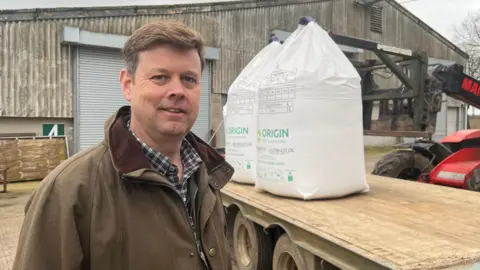
Everyone knows oil comes from the Middle East, so a price hike in diesel is unsurprising. But a third of the world's key fertiliser chemicals also pass through the Strait of Hormuz.
Many smaller family farms buy fertiliser when they need it, which for many is now.
Aird says he has calculated exactly how much this war is costing small farms.
He explained: "For a 100 hectare farm (250 acres), if you were looking to go and purchase fertiliser today, you'd be having to find around £14,000 extra."
Will farmers charge more for their food?
"If only we could," laughs Collins when I ask him if food prices will be put up by farmers.
For many businesses, when their costs increase they absorb what they can and then pass the rest onto their customers.
But farmers are "price takers, not price setters", as he put it.
He explained: "The price of milk is set by the processors, and the price of grain is set by the mills.
"And we live in a world market as well, so we can't ask for more money for our wheat or our milk.
"It just is what it is, and we have to absorb these costs, and it's a real shock for most of us."
Eventually, farmers believe the rapid increases in their costs will filter through to higher prices.
NFU President Tom Bradshaw said that while some of the extra costs might be absorbed by farmers and businesses within the supply chain, "some costs will inevitably be passed on to the consumer".
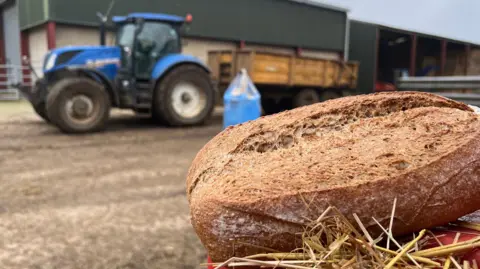
All of the farmers I spoke to acknowledged their problems were tiny next to the suffering of people in the war zone itself. And that if the bombing stopped soon and the oil flowed again, prices would gradually come back down again.
But Aird is worried about next year's crops already.
"If this carries on much longer then it will have a big impact," he said.
"I can see prices rising and rising. Because at the moment most people are covered but we all go back to the fertiliser market in May.
"And May is not very far away."
Follow BBC Wiltshire on Facebook, X and Instagram. Send your story ideas to us on email or via WhatsApp on 0800 313 4630.
