Farmers 'hammered' by fertiliser and fuel rises

 Ellen Knight/BBC
A farmer has said his industry is struggling to keep produce affordable due to the rising price of fertiliser and red diesel.
The cost of fuel and natural gas has been volatile over the past weeks, due to war in Iran and neighbouring Gulf states.
Last week the price of oil soared to more than $100 a barrel, and governments around the world have moved to release emergency reserves.
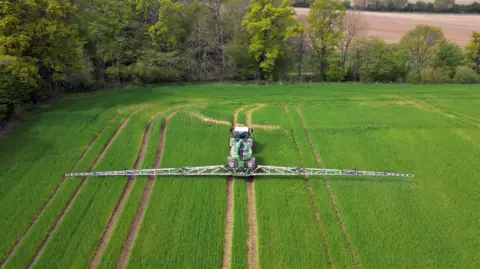
Andrew Williamson, who farms 900 acres of arable land near Bridgnorth in Shropshire, said he was concerned for next year's crop in the face of current "very expensive prices".
Williamson's farm, on which he grows a variety of crops including wheat, barley, and oats, has been "fortunate," as like many arable farms, they bought most of the fertiliser needed for this season last year.
But he is worried about how it might affect next year's crop - which he would usually buy fertiliser for later this year.
Williamson said farms like his were already "struggling to break even and cover our cost of production" - but the rising price of fertiliser "makes that even more difficult".
The crisis also hits hard as it has "come off the back to two really poor harvests," he added.
 Getty Images
According to the National Farmers' Union, natural gas makes up around 60-80% of the cost of producing nitrogen fertilisers, commonly used on farms.
Since July 2025, when Williamson stocked up on fertiliser, the price had gone up by 50%, he said.
"Rather than being £330 a tonne, it's now £490 a tonne," he said.
Livestock farmers would be "hammered" by the price rise, Williamson added, as they bought fertiliser as and when they needed it, not in advance like arable farmers.
'Concerning and worrying'
The situation was incredibly frustrating for farmers, he said.
"Farming is a long-term investment, we're two years from when we purchase things to when we [see] return from it," Williamson explained.
For farmers across the UK, "every single decision we make carries more risk and more change of getting it wrong," he added.
"It's really quite concerning and quite worrying."
It has been particularly galling, Williamson said, because "confidence was starting to build a little bit" in the sector.
"Spring's here, the crops look well, and then you get hit by costs of fuel, fertiliser, and everything is out of our control," he explained.
Consumers will undoubtedly feel the effect on the shelves, the farmer added.
"But it won't be down to the commodity prices - if you look at the value of wheat in a loaf of bread it's very small."
 Getty Images
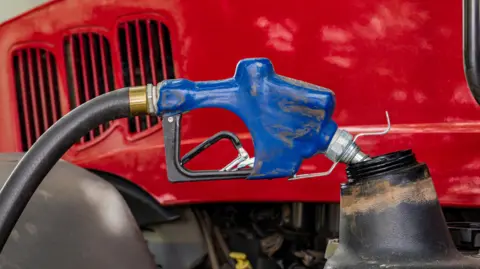
Agriculture is also being affected by the price of red diesel - which is subject to a much lower fuel duty rate than normal diesel, but can only be used by specific industries, including farming.
The price has "gone up massively", Williamson said, explaining that he had seen an increase of roughly 50% compared with before the Iran war.
"The difference between fuel and fertilisers is that you have to keep buying your fuel as you need it," he added.
"You're always going to be struck by it."
Williamson is calling for "real transparency" in the fuel supply chain, as the prices, in his view, "rocket up and then fall like a feather".
"I don't mean just for farmers, I mean for consumers, and people buying fuel at the pumps," he said.
"We are unfortunate as an industry - we can't automatically pass on our costs.
"We're price-takers, not price-setters and that is something... we've got to deal with."
Last week there were accusations of price gouging in the fuel supply sector, with Energy Secretary Ed Miliband saying on Friday that the government would "not tolerate" profiteering from the Iran conflict.
Follow BBC Shropshire on BBC Sounds, Facebook, X and Instagram.
