Why I keep blockading food distribution centres

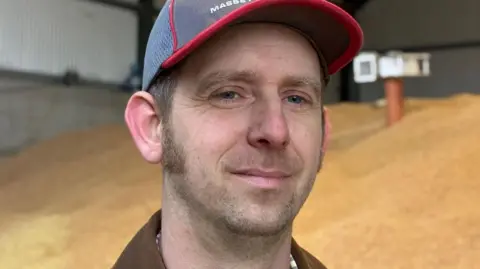 Andrew Sinclair/BBC
Farmers from across the eastern region have been blockading transport hubs and food depots around the country as part of a new campaign for better support for the agricultural industry in the UK.
One of them, Philip Weston, from Northamptonshire, said farmers were feeling "desperate" and needed supermarkets to pay more for quality British produce.
Their concerns included the impact of foreign imports, rising production costs and what they see as excessive government red tape.
The government said it was committed to making agriculture productive and profitable while a leading supermarket insisted it was proud of its "longstanding relationships" with British farmers.
'It's one thing after another'
 Philip Weston
Weston, 40, who farms 300 acres at Hartwell, has been involved in blockades every week this year.
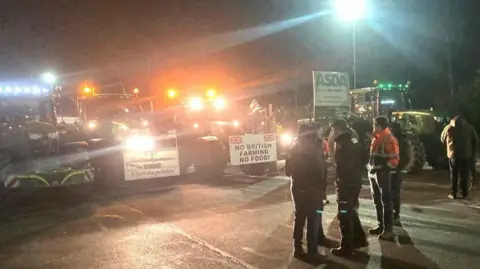
On one occasion he helped block the rail freight terminal in Rugby in neighbouring Warwickshire, last week he was outside a Lidl distribution depot in Hertfordshire and this week joined 30 farmers who took part in an overnight blockade at the Magna distribution centre in Leicestershire where Asda has a base.
"I'm a fifth generation farmer. The first time I sat on a combine and drove it I was 10. I went away and studied architecture but you still come back to it. It is quite a draw; it is a way of life. It's hard for people who don't farm to understand," he said.
He joked that farmers are often accused of grumbling all the time, but said the crisis facing his industry at the moment was very serious.
"It's just one thing after another. If it's not inheritance tax it's trade deals or it's the cost of what we're getting for our produce," he said.
"We've got machinery dealerships going out of business, no real sign of the market for our produce picking up, [government-funded] environmental schemes which should be happening, but we're not clear how they will work.
"My neighbour has just sold up after being in the village for years because he couldn't afford to keep going. We have friends who will use their combine for the last time this summer."
Trade deals and fertiliser
He says new trade deals are bringing in imports from countries with lower welfare and safety standards which make it cheaper for them to produce food and undercut British farmers.
"These protests aim to bring about a realisation that these trade deals don't take into account British farmers and allowing this influx of food from abroad is impacting prices over here," Weston added.
"There needs to be something to bring those prices in line with our cost of production. There needs to be some disincentive to import it over here.
"Fertiliser was £180 a tonne four or five years ago; now it's over £400."
He said a new fertiliser tax would probably increase the price by about £100 a tonne.
Weston said farmers were becoming more militant following their success in forcing the government to backtrack on some of its plans for inheritance tax.
"All those people who met at those protests have now come together locally and we feel that we have a voice and we can actually fight for other matters now," he said.
'We need a level playing field'
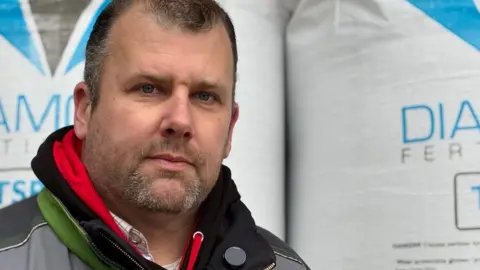 Andrew Sinclair/BBC
Russel Abbott, 43, who farms arable land at Tattingstone near Ipswich, is another farmer involved in the protests.
He organised tractor go-slows along the A14 and through the centre of Ipswich and played a part in a seven-hour blockade of the Port of Felixstowe two weeks ago.
"Farmers are desperate to be listened to," he said.
"At the moment many are going into other lines of business away from farming like farm shops, storing caravans or running business units [to help] subsidise the food we're producing.
"For a bag of potatoes it's around £175 a tonne to break even. At the moment we're getting just under £200, which is barely covering our costs.
"How can you invest on that sort of profit? You can't.
"We need a level playing field.
"The government needs to listen and it needs to put measures in place which will make a future for the next generation and allow farmers to invest."
What does the government say?
A Department for Environment, Food & Rural Affairs spokeswoman said: "We're backing British farmers as part of a new era of partnership to create a productive, profitable and sustainable future for farming.
"More than half of farmers are in our farming schemes benefiting from £11.8bn across this Parliament.
"Our new Farming and Food Partnership Board will bring government, farming and the food industry together to better enable farm businesses to grow, invest and plan for the future."
What do the supermarkets say?
Andrew Opie, director of food and sustainability at the British Retail Consortium, said: "Food retailers source, and will continue to source, the majority of their food from the UK.
"They remain committed to supporting British farmers and have invested heavily in UK agriculture through partnerships, dedicated programmes and additional support.
"Ultimately, meaningful and lasting solutions will rely on collaboration across the entire supply chain."
An Asda spokesperson said: "We are proud to have many longstanding relationships with British farmers and suppliers.
"As a retailer, our priority is to provide a range of products to customers at the value they expect, and we offer a wide range of British products across our stores."
BBC Politics East will be broadcast on Sunday 1 February at 10:00 GMT on BBC One in the East of England, and will be available after broadcast on BBC iPlayer.
Follow Northamptonshire news on BBC Sounds, Facebook, Instagram and X.
