Rowers turned boat into floating farm to fuel Pacific crossing

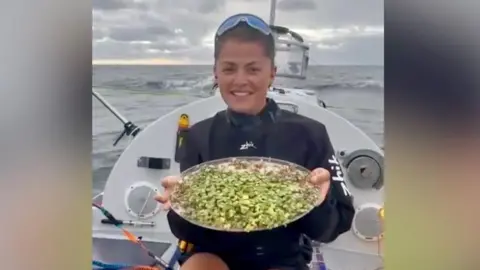 Seas the Day
How do you grow food on a small boat in the middle of the Pacific Ocean? It's a question Miriam Payne and Jess Rowe found themselves asking when preparing to row non-stop from South America to Australia.
The answer was a "smart farm" that allowed them to grow their own salad on board their 30ft-long (9.1m) ocean-going rowing boat.
The women made headlines when they completed their epic 8,000-mile (13,000km) journey last month.
Just eight days into their gruelling six-month adventure, Miriam and Jess had their first crop of greens ready to harvest.
It was a big step forward from the dehydrated food packs they had previously used.
"There really is no substitute for fresh food which is difficult, if not impossible, to come by on our row," Miriam, from Market Weighton explains.
"In order to take on the challenge we needed to hit about 5,000 calories per day. The salads were incredible for our physical and mental health."
 Seas the Day
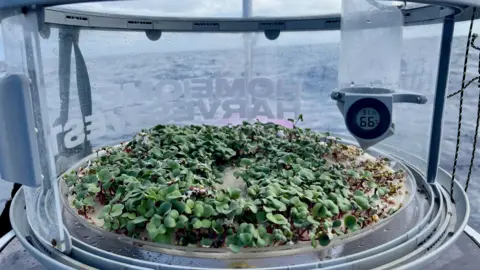
The smart farm device was developed to grow food in extreme environments and works by inserting paper penetrated with seeds into what the women described as a "waterproof pizza box".
It was built to sustain 30ft (9.1m) waves and incorporated a solar-powered fan to cool the crop during hot days. As well as salads, they were able to grow vegetables, including radish and cabbage.
The device also helped to avoid excess weight on the vessel, a key plus for the pair.
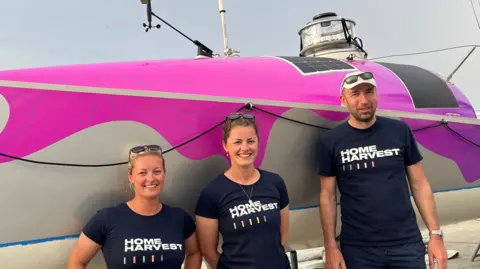
The device was invented by Andrew Johnson, a former grower from Sancton, East Yorkshire, and Hedley Aylott, a digital innovator.
Andrew, whose previous experience included growing salads for major supermarkets in glass houses near Brough, says it was an "exciting opportunity" to design the "smart farm" for the expedition.
 Andrew Johnson
Following the successful completion of the journey, he says he has now been approached by other groups and organisations, including the British Army, to work with them on similar smart farms.
"We have been approached by the British Antarctic Expedition so that they can grow salads out there," he says.
"We have been approached by the military in terms of growing, because for them, shipping seed mats with a longer shelf life is really important.
"If you think when we deploy all our troops overseas giving them a fresh diet to keep them fit and healthy is really critical."
 Home Harvest
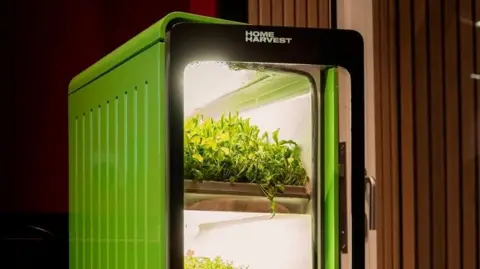
Designers who have previously worked for Dyson have also helped to adapt a version for family homes.
Controlled using a smart phone, Andrew believes it could revolutionise food production in the future and help cut down on waste.
He says 40% of salad taken into the home is wasted, a figure backed up by a report earlier this year from the Waste and Resources Action Programme – a British charity that works to reduce waste and develop sustainable products.
The organisation estimates wasted food costs each UK household £620 per year.
Andrew believes growing at home would save money and reduce food miles.
He estimates that the amount of salad being wasted in the UK is equivalent to 400 articulated lorries worth being discarded each year.
Listen to highlights fromHull and East Yorkshire on BBC Sounds, watch the latest episode of Look Northor tell us about a story you think we should be coveringhere.
Download the BBC News app from the App Store for iPhone and iPad or Google Play for Android devices
