Custody death probes 'traumatising' for families - human rights report

 PA Media
The Scottish Human Rights Commission (SHRC) has described the investigation of deaths in custody as "traumatising" for families and warned that an increase in fatalities was "unacceptable".
Alongside the charity Inquest, the commission spoke to 33 grieving relatives in a bid to improve the fatal accident inquiry (FAI) system in Scotland.
FAIs investigate deaths in custody as well as other fatalities, and consider what went wrong and what can be learned from the incident.
Justice Secretary Angela Constance said the Scottish government would fully consider the recommendations.
The government set up the review in January following a previous report from the SHRC which criticised a lack of action on reducing deaths in state custody in Scotland.
The new report has been submitted to Sheriff Principal Ian Abercrombie, who is chairing the review.
'People blaming each other'
Stuart Allan, whose daughter Katie took her own life in Polmont Young Offenders institution in 2018, said the FAI process was "very traumatising" for his family.
Katie was found dead in her cell three months into a 16-month sentence for dangerous and drink driving following a hit-and-run.

"It took us six years for the FAI to actually start and that is a long time when you're a family that's grieving and waiting for answers," Mr Allan told Radio Scotland Breakfast.
He said the process was "harrowing" and "retraumatised" the family as they went through the details of his daughter's death.
The court process often felt like people were "blaming each other", he said, with lots of legal representation at the hearings for the various organisations.
"Whereas the FAI is really a process about learning, about finding out what went wrong and how to improve it," he added.
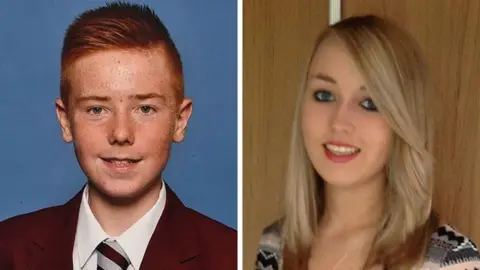
Following the inquiry, the sheriff ruled that a "multiple failures" within the system led to Katie Allan's death.
Mr Allan said his family were "buoyant" that the Scottish government had accepted the recommendations of the report and taken action to improve their suicide prevention strategy.
"The grief never goes away," he added. "It's always there with you.
"Katie's not going to come back, no matter how many changes they make. We've learnt to live with our grief.
"We still want to do some campaigning, we still want to make sure that the people who have made those promises are held responsible."
'We tried to warn them'
The report heard from grieving families who recalled their experiences during a "listening day".
They said that potential risks to life were ignored, that the cause of death was given and then retracted, and that one person was referred to as "the body".
The report included an account of prison officers eating a packed lunch on a hospital bed containing the body of a prisoner, of belongings being wrongly attributed, and of one family being given three different causes of death.
One parent said: "It feels like you are the one on trial."
Another relative said they had little reassurance of the prevention of future deaths, and added: "Six years of fighting... what difference has it made?"
Another family member said: "We tried to warn them... four hours later we got the call saying he was dead."
One person said: "It felt like they were looking for things to blame on our relative."
 SPS
SPSThe report suggested improvements including guaranteed legal representation, trauma-informed practice, legally enforced time-scales, and co-ordinated communication after a death.
It also suggested specialist sheriffs for deaths in custody, and an independent oversight of FAI recommendations.
The report said: "It has become increasingly clear to the SHRC that Scotland's FAI system must be significantly and quickly reformed.
"Several families recounted interactions that felt rude, abrupt, or even hostile and accusatory which further eroded trust."
Examples of good practice were included, but the report said: "They were described as rare exceptions within a broader landscape of confusion, silence and neglect."
'Deaths are rising'
Prof Angela O'Hagan, who chairs the SHRC, said the system would only be improved if decision-makers listened to the experiences of families who went through FAIs.
She added: "Scotland has a very high rate of deaths in its places of detention, and these deaths are rising. This is unacceptable and is a grave human rights concern."
Deborah Coles, executive director of Inquest, said the report should be a "wake-up call" for "fundamental reform" of the system.
"Families describe the legal process after a death as being another layer of harm, extending their grief for years," she added.
Justice Secretary Angela Constance said she recognised the impact a death in custody had on families, as well as the concerns families raised about FAIs.
She added: "That is why we have established an independent review to consider the efficiency, effectiveness and trauma-informed nature of how FAIs deal with these cases.
"As part of this work, Sheriff Principal Abercrombie attended the family listening day to hear directly from bereaved families.
"The review is examining evidence from a wide range of sources, including the experiences of families, to identify the barriers they face in engaging with the process and the timescales involved."
A spokesperson for the Crown Office and Procurator Fiscal Service said: "We understand the distress that investigating the death of a loved one can cause for grieving families.
"We recognise that more can be done across the whole justice system to improve how deaths are investigated, and we will continue to work closely with our partners to drive those improvements."
