Scotland becomes first UK country to allow water cremations

 BBC
BBCScotland has become the first country in the UK where water cremations are now legal.
The process - called alkaline hydrolysis - will offer families a third option instead of burial or traditional cremation.
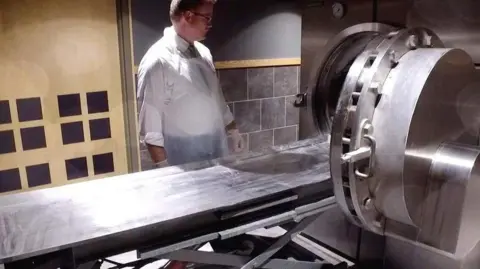
Bodies are wrapped in a shroud of biodegradable material such as silk or wool before being placed in a pressurised chamber with hot water and chemicals, speeding up decomposition.
The powdered remains are given back to relatives in an urn.
This story contains details of water cremation which some readers may find upsetting.
The company supporting the introduction of the practice in Scotland described it as the biggest change to cremation law since it was introduced in 1902.
Water cremations already happen in countries including the Republic of Ireland and the United States.
They are considered to be "green cremations".
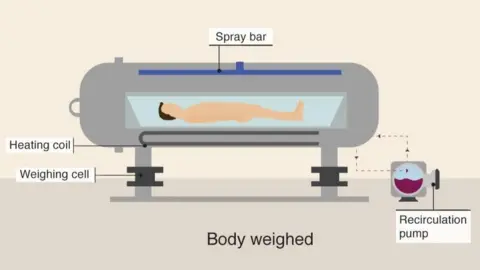
The process involves weighing the body, then heating it to 150C (300F) in a mixture of potassium hydroxide and water for up to 90 minutes.
This dissolves the body tissue, leaving only the bones - which are then rinsed at 120C, dried, and pulverised into a coarse powder using a machine called a cremulator.
Remains can be returned to next of kin, as ashes are following cremation.
It has been estimated that a typical cremation has a footprint equivalent to about 320kg of carbon dioxide- Alkaline hydrolysis is found to result in the emission of seven times less CO2.
The process is used in other countries around the world and was chosen as the cremation method of anti-apartheid campaigner Archbishop Desmond Tutu.
Public Health Minister Jenni Minto said it was an "environmentally friendly alternative" to more traditional burials or cremations.
She added: "The choices people make about their remains prior to death are deeply personal, shaped by individual values, beliefs and the wishes of their families.
"The process will be subject to the same assurances and regulatory requirements as existing methods, giving bereaved families confidence that their loved ones are treated with care, dignity and respect."
Before water cremations can start taking place in Scotland hydrolysis equipment will need to be built. This would be subject to planning permission and approval from Scottish Water.
The Scottish government expects the first procedures to take place in the summer.
Kindly Earth, which holds exclusive rights to manufacture hydrolosis equipment in the UK, said it had been in discussions with several Scottish organisations for a number of years.
General manager Hannah Chandler said she did not expect hydrolosis to become the new funeral standard, but said its introduction would offer a different choice for grieving families.
"We know that not everyone will choose hydrolysis - and that's the point. It's about giving families more choice," she said.
"Each family has different values and priorities. Some people, particularly those planning ahead for their own funeral, are looking for options that feel more aligned to their own preferences."
Plans already in place
Andrew Purves, chief operations director at William Purves funeral directors said it was an exciting day for his industry.
"For me, funerals are all about choice and having a funeral that somebody feels is fitting to them," he said.
"For many people in their lives they get lots of choices so it's nice to know that for their funerals they now have another choice.
"We have some people who have already written it into their funeral plans for the future."
Purves added that the price was expected to be similar to, or slightly more than, a normal cremation.
A spokesperson for Co-op Funeralcare said: "At Co-op Funeralcare, we are committed to offering the most sustainable and affordable services for our member owners and clients and therefore welcome the legislative change in Scotland in relation to alkaline hydrolysis.
"Providing consumers with greater choice is an integral part to our offering, so we are heavily supportive of the exploration into alternative funerary methods."
