What does the Manchester by-election result mean for Scotland?

 PA Media
A by-election in Greater Manchester might seem somewhat distant from Scotland - several hundred miles away at best, across a border.
But it has still caught the attention of political parties here, as they gear up for a Holyrood election.
It was an immediate issue for Labour MSPs as they gathered for their conference in Paisley, and for Scottish Greens toasting the success of their southern sister party.
And there are broader lessons too in the way tactical voting played out, and the presence of Reform UK on the ballot paper, which may shape campaign tactics ahead of May's crucial contest.
It goes without saying that it was a bad night for Labour, north and south of the border.
There wasn't exactly an air of shock among members milling around the tea and coffee tables in Paisley.
For most hardy Labour delegates, defeat is not an unfamiliar feeling. And this was one they had rather seen coming.
 PA Media
Anas Sarwar had already come out against Sir Keir Starmer, warning that the UK party was on the wrong path.
But there is little triumph in vindication for the Scottish leader here.
The spectre of Labour bleeding votes at both ends of the political spectrum - to Reform on the right and the Greens on the left - is all too familiar to Scottish Labour.
It's exactly what happened to them after the 2014 independence referendum, when centre-left pro-indy voters moved en masse to the SNP, and centre-right unionist voters swung behind the Conservatives.
They will hope this is a one-off by-election campaign where the government of the day has been given a kicking, and that things will be different in a national election where they can frame the SNP as the establishment.
But they need a healthy swing in their favour if they stand any chance of taking seats from the SNP - and this is another data point which suggests Labour's vote is going down, not up.
As Labour suffers from a Starmer slump, could the Scottish Greens benefit from a Zack Polanski bounce?
 PA Media
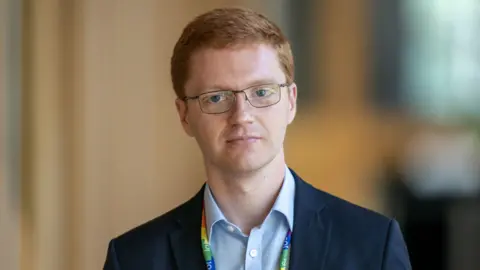
The two parties are separate entities, but they have moved to strengthen their ties - and Scottish co-leader Ross Greer has talked about how he and Polanski are old pals.
An apparently popular UK leader could be an electoral asset.
But the contest in May will be a very different one for the Greens.
Gorton and Denton was a very focused campaign, both geographically and in terms of issues, with the party able to flood the streets with activists talking about things like Gaza.
And while there are a handful of Scottish seats where the Greens hope to make an impact, they are only expected to stand in about a dozen.
In Holyrood's proportional representation system, the regional list ballot is a far bigger deal for the Greens - and that requires broad messages that can land nation-wide.
Reform UK is the other story of the by-election, and is also a party hoping to capitalise on the regional list vote come May.
But they are also expected to stand in every constituency, which could have a big bearing - it could decide the fate of some tighter contests.
Nigel Farage's party looks set to be talked about a lot between now and 7 May, not least by their opponents.
Tactical voting
Labour's hope that an anti-Reform vote would coalesce around them in Greater Manchester was dashed when it coalesced around someone else instead.
We are already seeing loads of Scottish parties pitching themselves as the anti-Reform vehicle of choice.
The SNP, the Lib Dems and the Greens have all bigged up the potential impact of Reform or their own position as an "antidote" to the party's brand of politics.
The only thing party leaders like more than a photocall wearing a hard hat is a bogeyman to scare their supporters to the polls.
But how does that play into a Scottish election campaign where tactical voting is already a given?
Gorton and Denton was a true three-way contest of the type we have not seen in Scotland for some time.
At Holyrood and Westminster, almost every seat in the country has of late been a two-horse race between the SNP and whichever party between Labour, the Tories and Lib Dems who have the best shot at challenging locally.
That has traditionally been seen as a split between pro-independence on one side and pro-union on the other, although it remains to be seen if the constitution is a particular driving force in this election.
The other parties increasingly pitch their campaigns as "only we can beat the SNP", while the SNP can take its pick of who to pitch itself against.
John Swinney's party has essentially been watching on with a bucket of popcorn as Labour has become mired in problems at Westminster.
It's meant the SNP has stayed firmly in first place in the polls - and are routinely forecast to retain the lion's share of seats even with a reduced share of the vote, as their opponents fall apart.
But the localised nature of tactical voting makes it quite hard to tell, from nationwide polls where people just say which party they like the best, how results will play out in any given constituency.
Adding an extra layer of tactics in terms of everyone wanting to oppose Reform UK complicates things still further.
Swinney certainly will not be taking anything for granted - particularly after Labour came apparently from nowhere to win the Hamilton, Larkhall and Stonehouse by-election last year.
A lot of headlines following the by-election have been about the death of the two-party system, with Labour in third place and the Conservatives losing their deposit.
In Scotland we've had a multi-party system for decades - but on current polling we could see six parties at Holyrood after May with seats in double figures.
It's another illustration of the way party politics has splintered, north and south of the border.
But there are still another 10 weeks to go until ballots are tallied - and this by-election is a reminder that the way parties succeed and fail in framing the contest will be critical.
