Why is Scotland seeing big council tax rises again?

 North Ayrshire Council
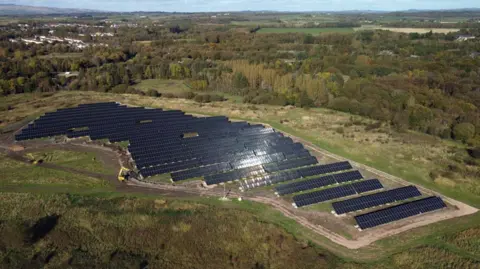
On two former landfill sites in North Ayrshire, more than 20,000 solar panels are soaking up the sun's rays.
They are producing enough electricity to power thousands of homes.
And they're generating cash to support local services too - because in a Scottish first, these solar farms are owned and operated by the council.
Selling the electricity back to the grid, via a deal with OVO energy, is projected to provide an income of £400,000 a year for the next 25 years.
And North Ayrshire Council hopes it will help them reach "net zero" carbon emissions by 2030, with the sites projected to reduce emissions to the tune of 2,700 tonnes of carbon dioxide a year.
Some 240 miles to the north in Orkney, work is ongoing to prepare the ground for three community-owned wind farms.
Orkney Islands Council believes the projects could bring in £3m a year in revenues, both for the council and local community benefit funds.
These kind of projects have been held up for praise; the Accounts Commission watchdog described North Ayrshire as "an exemplar of how to do change and innovation well".
And yet the council has just voted to increase council tax by 8.5%.
In Orkney, a 6% rise has been locked in, reflecting the above-inflation hikes happening across Scotland.
Why is this happening?
 Getty Images
Looking at where councils get their money, about 60% of general funds come from the Scottish government in the form of a grant.
About 20% comes from non-domestic rates - taxes on business premises collected locally - while the final 20% comes from the council tax on households.
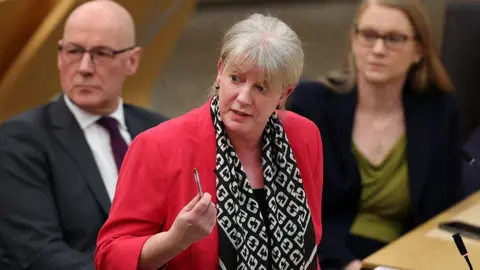
Announcing the Scottish budget in January, Finance Secretary Shona Robison insisted that councils were being given a fair settlement - urging them to take "reasonable decisions on council tax".
Figures from the Accounts Commission do reflect a reasonably steady increase in government funding over the last seven years in cash terms.
But when inflation is factored in, to put things in "real terms", the growth has been minimal.
And over the next three years, the total settlement for councils is projected to stand still - which amounts to a 3.8% cut in funding in real terms.
Cosla - the umbrella body which represents the 32 local authorities - says the medium-term outlook is "deeply concerning", adding that there has to be "a more honest conversation about funding, priorities and local flexibility".
This is because that funding pressure comes against a backdrop of greater responsibility for increasingly-stretched authorities.
Demand is growing for health and social care services delivered by councils as Scotland's population gets older.
The cost of delivering those services has increased too - half of Scotland's councils have reported overspending their budgets specifically on social care.
And then there are things like nationally-negotiated pay deals for teachers and other local authority staff, the expansion of early learning and childcare, and free school meals.
Councils have long complained that large chunks of their budgets are effectively ring-fenced for policies decided at Holyrood, reducing the ability of local politicians to make choices about their spending.
 Getty Images
The latest Holyrood budget did hold out the possibility of some extra revenue streams, such as the "mansion tax" on larger homes - two extra council tax bands targeting houses worth more than £1m.
But that will not come into force for several years yet, and ministers have suggested it might only raise about £14m - which also will be concentrated in a handful of council areas which feature more expensive properties.
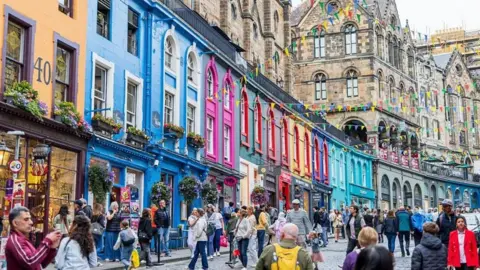
Several local authorities are also exploring "tourist taxes", charging an extra levy on holiday accommodation.
The first such scheme is due to come into force in Edinburgh this summer, which is forecast to raise £50m a year - although that revenue is committed specifically to tackling the housing emergency and improving infrastructure.
So most councils are left with the traditional routes to balancing the books - raiding their savings, hiking council tax, or cutting back services.
Councils do sit on a reasonable financial cushion of reserves - essentially savings, which increased quite a bit during the pandemic thanks to increased funding and flexibilities.
But that is a one-off resource which has to be managed carefully.
Auditors found that half of councils made "unplanned" use of their reserves in the year ending last spring, and that useable reserves for day-to-day spending had fallen by 10%.
Voters generally don't like cuts, or the kind of measures which raise revenues by charging them more for things.
Consider the unlikely campaign of resistance against parking charges in North Berwick, the seaside town where disgruntled locals have taken to vandalising parking meters.
Some councils launched detailed consultations ahead of their budget meetings.
This has the dual purpose of gathering views and thus a firmer democratic basis for changes - but also of hammering home the realities of the financial position to residents.
Consider the itemised menu of savings proposals set out by Inverclyde Council.
Closing the central library in Greenock would save £237,000 over two years; axing the Port Glasgow swimming pool and gym would save £242,000.
Scrapping Community Wardens would save £472,000, while removing the Active Schools service would save £241,000.
Leader Stephen McCabe warned that "there is little or no fat left to trim", and that "drastic measures" had to be considered.
In the end those measures were not required - councillors instead proposed a 7.9% increase in council tax, and dipped into their reserves.
But the hope is that bringing citizens into the decision-making process and underlining the reality of the "tough choices" politicians always talk about will cushion the blow of that tax rise somewhat.
 Getty Images
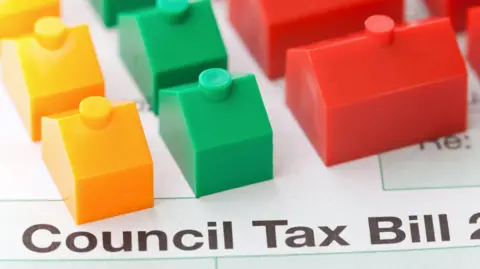
The other notable thing from the Inverclyde decision was that members were asked to agree two years of rises - 7.9% this year and 7.9% the next.
Councils are increasingly drawing up multi-year strategies, and chunky tax increases are invariably part of them.
After almost 20 years of council tax being frozen or capped, last year saw an explosion in rates after constraints were lifted, with the average increase being just shy of 10%.
This year's hikes are not quite at that level, for the most part, but they remain above inflation across the board.
And the rhetoric is pretty dark - after approving a 7.8% increase in council tax on top of £1.5m of cuts, the leader of West Dunbartonshire Council, Martin Rooney, predicted that it "will go bankrupt" in the near future unless things change.
Another report from the Accounts Commission warned that councils "risk becoming financially unsustainable" over the next three to five years.
There is also no prospect of meaningful reform any time soon, with ministers saying any major change would require an electoral mandate - in 2031.
So for all the innovative efforts to find new ways of raising funds and consulting with locals on service changes, it seems like annual increases to council tax are here to stay for the foreseeable future.
