'I have terminal cancer, but I've never felt so mentally well'

 Kevin Shoesmith/BBC
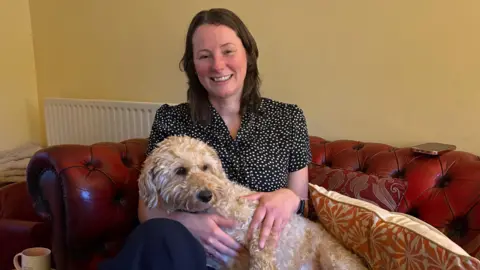
Louise Beevers was told she had breast cancer while pregnant with her fourth child. A month after her daughter was born, she was told the disease had spread to her lungs and was terminal. But the 42-year-old single mum says she has never felt as mentally well, which she puts down to an NHS counselling service.
Louise has bought the pens and stationery with which to write her final letters to her children.
"I even have wax seals," she tells me. "There is something special about a handwritten note. It is so personal. You have written it with your own hand. You have made the time. You have touched that paper.
"But I will only write them when I am given the final countdown from my oncologist. Writing them will be the beginning of the end."
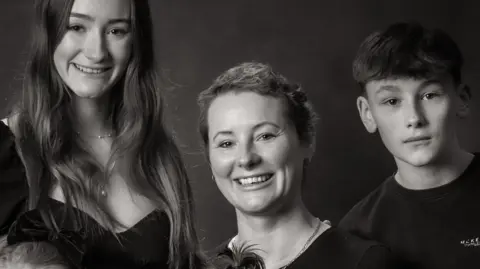
On the wall of the living room in this family home, set in a quaint Lincolnshire village near Gainsborough, are professionally taken photographs, arranged in a diamond, of Louise's four children.
"The first and strongest thought is my children will grow up without a mother," says Louise. "That was the most prolific thought that went through my head when I was told I was terminal."
 Supplied
Her children, who are aged between two and 19, are aware of the diagnosis.
In January 2023, Louise found a lump in her breast, which doctors initially put down to her pregnancy.
Four months later, she was diagnosed with breast cancer, and in the September – a month after her youngest was born – she was told she was terminally ill.
Bromley, the family's rescue cockapoo, is sprawled across Louise's lap. In the corner of the room are children's toys, including a Floor Lava board game.
Louise, and her family, are navigating a path no one chooses to tread.
"As my psychologist told me, I can't change what has happened," she says. "But I can choose how I handle it. It's been a very difficult journey. We maintain a transparency around my diagnosis and conversations are always welcomed."
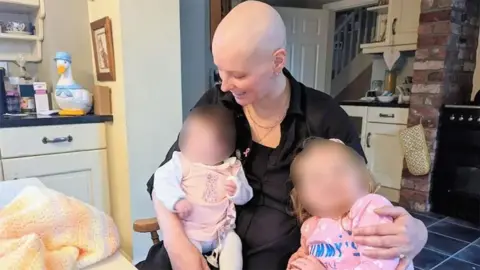
Today, Louise is calm.
"It's taken time to get where I am," she admits. "I screamed when the oncologist told me I was terminal; it meant I was not going to see my children grow up.
"I got home and we all collapsed on the lawn and cried. I spent the whole of the next day sobbing. But the following day I thought, I can spend what is left of my life like this or I can accept this is happening and make the best of it."
During the early stages of her diagnosis, Louise was invited to complete a wellbeing questionnaire, which showed – to quote her – that she "needed a bit of help".
She was referred to the East Midlands Cancer Alliance for psycho-social counselling.
Alongside this, Louise has undergone five rounds of chemotherapy, as well as radiotherapy. She was due a sixth in 2023 but declined, believing it was to be her last Christmas.
"I wanted to be able to enjoy it with my family without feeling ill from chemotherapy," she explains.
 Supplied
Louise also requires an injection every 12 weeks to force her body into an early menopause.
"This was needed because the doctors think the female hormones oestrogen and progesterone were feeding my cancer," she says.
Louise has a CT scan with contrast – a dye which gives a clearer picture of her cancer – every three to four months. Her next is due in February.
So far, she has remained stable, but she knows her cancer is likely to mutate fast.
"You will never quash the anxiety, especially around scan time," says Louise.
"But the counselling equips you with coping mechanisms to logically manage that.
"It has enabled me to live the best life I possibly can with the limited expectancy that I have.
"It's an invaluable service that has given me a positive outlook, even given the dire situation."
Louise says there has been seismic shift in her mindset.
"I'm able to handle very difficult situations a lot calmer and I have a very positive mindset now," she says.
Back to basics
Louise, an assistant practice manager at the village GP surgery, where she uses her own experiences to help soothe others facing similar ordeals, says living with a terminal illness has forced her to take stock.
"I worked with a psychologist who took my life apart," she says. "He took it the absolute bare basics and we uncovered what morals and values I hold dear to myself, and we then worked at building my life back up to enable me to live my life. I found it weirdly enjoyable.
"I absolutely put the length of time I have survived so far down to the counselling service that I received.
"I am also in the best mental state I have ever been in, even with terminal cancer."
Louise has raised concerns about the service she has benefited from moving to a new provider.
The BBC put her concerns to the NHS, but a spokesperson insisted the service would remain effective and of a high quality.
The front door opens and slams shut. Her son has arrived home from school.
Louise says the thought of leaving her children prematurely keeps her awake.
It is the only time the smile wanes.
"There have been situations where I have needed my mum," she says.
"I know there will be times when my children need me, but they won't be able to call me."
Bromley nuzzles into her.
"When I was really poorly, having my chemotherapy, he would go to my bedroom with me," says Louise, massaging the dog's floppy ears.
"He was protecting me. He wouldn't let anyone anywhere near me – not even my mum. Dogs are so in tune."
Life-changing
Louise is pragmatic; she knows the cancer will claim her life prematurely, but she hopes sharing her story will help others facing similar ordeals.
"Give counselling a try," she says. "You will be surprised. It could change your life, like it has mine, and make your remaining days so much more pleasurable."
Louise reaches for her phone and flicks through happy memories.
She stops on one showing a simple white, wooden box, with words on the front. She tells me she has one for each of her children.
They will house her final letters and cards for their key birthdays.
On the front of the box are the words: "I may not be there in body but my spirit lives on in you through the love and memories we have created together."
For now, the paper and pens remain in their cellophane wrapping.
If you have been affected by any of the issues raised in this story, information and support can be found at the BBC's Action Line website.
Listen to highlights fromLincolnshire on BBC Sounds, watch thelatest episode of Look Northor tell us about a story you think we should be covering here.
Download the BBC News app from the App Storefor iPhone and iPad orGoogle Play for Android devices
