Sifting through the Roman rubbish of 'the London lasagne'

 Mola/Andy Chopping
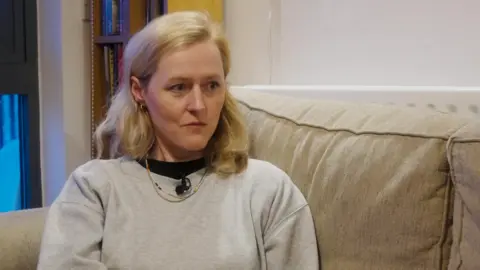
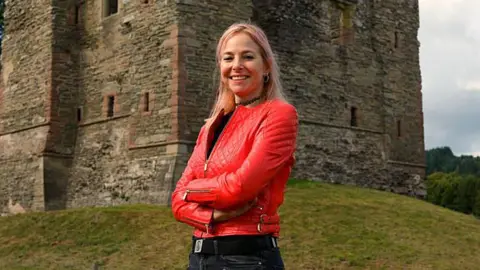
For TV presenter and academic Prof Alice Roberts, archaeology in the UK's capital is rather reminiscent of a famous Italian dish.
"In London, you've got a lasagne. You can dig all the way down to prehistory or you've got very recent Victorian and Edwardian archaeology there as well."
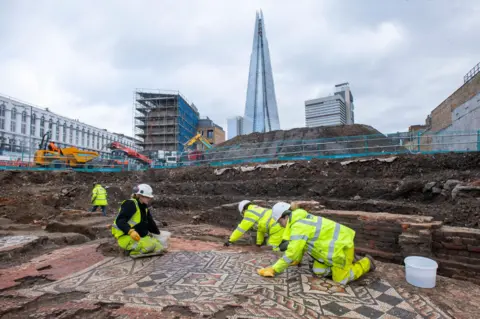
The constant churn of a changing London means new finds are regularly being made across the city as blocks and buildings make way for new developments, providing archaeologists with a brief glimpse into the earth below.
Recent years have seen everything from what is believed to be London's earliest theatre and the city's first basilica being discovered, while a dig in 2021 near the Shard revealed a rare mausoleum and a luxurious Roman villa.
 BBC/Rare TV
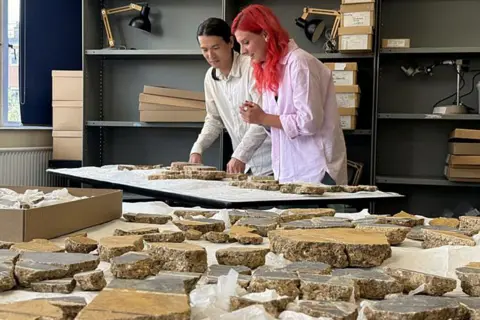
It is this, and in particular 20 colourful frescoes found smashed into 10,000 pieces in a Roman pit, which features in a new series of the BBC Two show Digging for Britain.
"We're seeing these new discoveries as they emerge out of the ground," says Roberts, who fronts the programme.
"We seem to have some quite rare pigments [on the frescoes] and there is a unique feature on one of the pieces, which is a signature, we think, of the artist who actually painted the fresco, so those details are always beautiful and extraordinary".
 BBC/Rare TV
The dig was carried out by a team from the Museum of London Archaeology (Mola).
Sophie Jackson, the group's director of development, says they always knew the work would be taking place between two Roman roads that once had buildings along them, but the pit and wall plaster came as a surprise to everyone.
"Working in London is just fantastic," she explains. "I wasn't going to be an archaeologist, I didn't even have an archaeology degree... but it becomes very addictive because the sites are so brilliant."
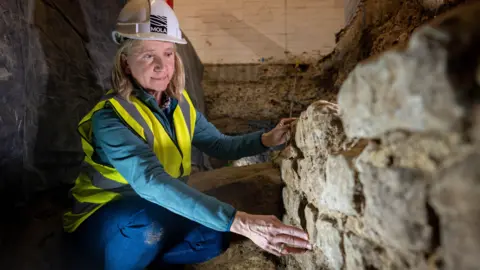
Digging in the city, she says, is very different to other places, with centuries of the past repeatedly piled on top of one another, meaning archaeologists have to "undo time" and "unpack the site in the reverse order that it happened".
 Tony Jolliffe/ BBC
And again it can be the waste thrown away by people 2,000 years before that can prove to be among the most useful finds.
The building of the European headquarters for media corporation Bloomberg last decade unearthed thousands of Roman objects, including what was thought to be the UK's oldest handwritten document.
Jackson says the reason the site was so fruitful was because it was around a waterfront where the Romans had continuously dumped layers and layers of landfill from different parts of the city, which they had regularly built on.
"From that rubbish we were able to tell a huge amount about the changing population in London; that the earliest people tended to be coming from Gaul, from what is Germany and France now... you could tell by things like the brooches they were wearing," she explains.
Finds like these and the one near the Shard have also offered new ideas that Roman London was split into various zones or quarters, with nationalities living in different places.
"So there's a Gaulish tradition in north Southwark, while there are different groups to be found in different parts of the city," points out Jackson.
 Mola
MolaThe sites where digs take place are dictated by where and when developments are being planned.
Not surprisingly, it is London's historic core within the Square Mile which often proves to be most productive for archaeologists.
Jackson says there is still so much in the area she would love delve down into, such as beneath Upper and Lower Thames Street on the north bank of the river.
"It sits above Roman waterfronts so that road effectively protects a whole massive swathe of wonderful archaeology - and that would be early Roman waterfronts, medieval buildings, everything," she says.
 Mola
MolaUnfortunately for history geeks, there are no current plans to build a tunnel through the area just yet.
But one place the Mola team did find themselves last year was in Wapping where the site of a future distribution centre revealed what senior archaeologist Alex Banks calls a "little microcosm of a whole community".
"We had all these building foundations, a school, domestic houses, terraced houses, even some almshouses and a chapel floor," he says.
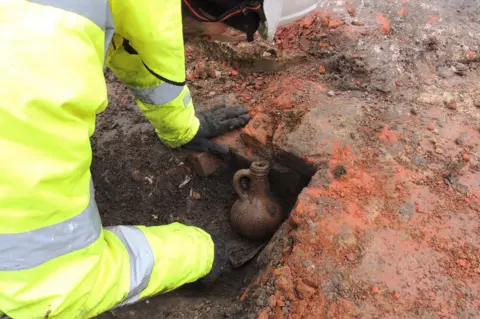
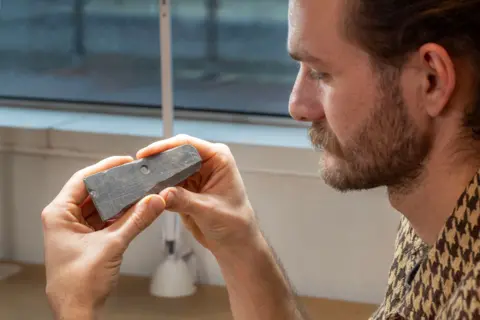
Tonnes of objects were found in the former cesspits and brick-lined wells of the homes, revealing objects like glassware, pottery and clay pipes, originating from Roman times to the Victorian period.
The team says these finds have offered new ideas about an area once known as Sailor Town that had been thought to be overcrowded and dangerous, but was actually home to people from all parts of society.
 Mola/Andy Chopping
Banks says carrying out work like in Wapping is rather different to how archaeology is often portrayed on TV, with digs even occurring in a building's basement while the floors above it are being demolished.
"Archaeology is often seen as being very nice, with excavations perhaps being a little bit slower and research-based... but we're not always using little brushes, we're using diggers, we're directing big machinery.
"That's not to say we don't take a great deal of care and a lot of detailed recording," he hastily adds.
 Mola
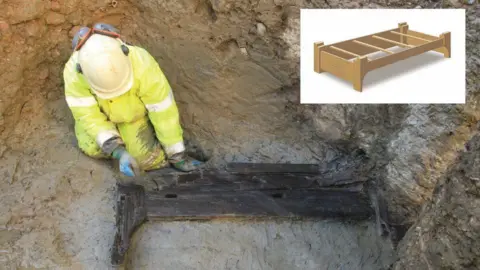
MolaIn 2024 Banks was among the team which came across what is thought to be the first Roman bed to be found in Britain during a dig at an ancient cemetery in Holborn.
"We don't really have anything like it from Britain and even the Roman Empire in general.
"Finding furniture like that is very rare outside of somewhere like Herculaneum or Pompeii so to have it in a very muddy building site in central London is pretty amazing," he says.
Having survived in the dirt for almost two millennia, the bed is currently being treated so that it can be further studied and put on display.
And it is this which Jackson says is key to the work the team does.
"Archaeology does lots of things: it gives a sense of perspective, it allows people to connect with the past in a very visceral way; you can see it and touch it," she says.
"It's to make people aware of their place in London; it's a place that's existed for 2,000 years and we're part of this continuing story."
Additional reporting by Wendy Hurrell
Listen to the best of BBC Radio London on Sounds and follow BBC London on Facebook, X and Instagram. Send your story ideas to [email protected]