Couple's surprise to see Welsh brick on Caribbean pavement

 Steve Thomas
A holiday is usually a chance to escape all traces of normal life - so imagine a couple's surprise when they saw their home county's name written on a Caribbean pavement.
It was after stepping off a cruise ship in Antigua that Steve Thomas, 64, and wife Julie noticed the words "Buckley, Flintshire" on a paving slab they walked over.
But the discovery did not surprise chairman of the Buckley Society Kevin Williams, who said the town's bricks were "world famous".
For 250 years until 2003, building materials made in the town were transported to areas including parts of the former British Empire, and sightings have been made in London, as well as New York, Australia and Qatar.
"[I was] just intrigued to see something from so close to home while in a completely different continent," said Steve.
"I'm from Wales, so its national pride really. It's the other side of the world and Wales has helped play a part in building it."
The couple, who are from Saltney, which is seven miles (11km) from Buckley in Flintshire, had decided to go for a drink in St John's, the island's capital.
It was Julie who noticed the brick on the pavement had "R. Ashton & C: Buckley, Flintshire" on it.
"I wasn't really aware of its significance to be honest, I had to Google it when I got back on the ship," said Steve.
After sending a photo to a friend, he told him about the town's rich brick-making history.
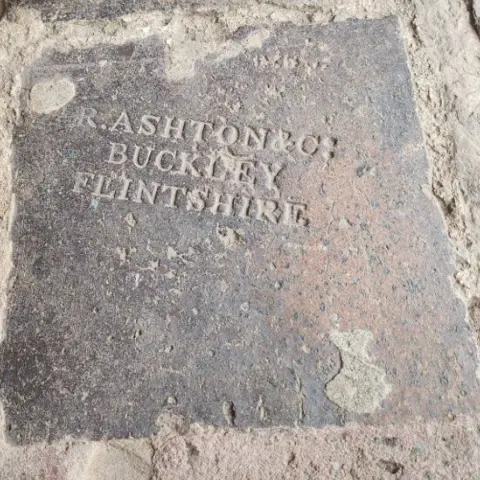 Steve Thomas
These bricks were transported around the world from ports at Liverpool and Dublin.
Renowned for their quality, the north Wales town became central in supplying the materials for a wide variety of countries.
Williams described them as "world-famous", adding: "Countries had to use Buckley bricks because of the hot climates and industry.
"They had to go for the best and that was Buckley."
Closer to home, they were used in parts of the London Underground, and in places such as Hartlepool and Leeds.
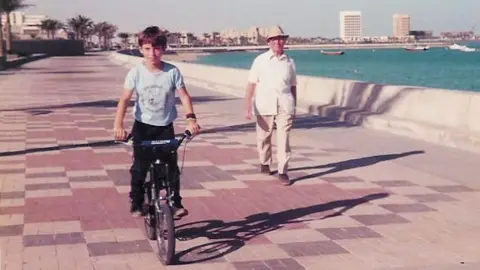 The Buckley Society
Williams, 40, lives in Buckley, and dedicates his time to tracking the history of a town so many of his family have lived and worked in.
"I have generations of family members who have worked in the brick industry, for years and years," he said.
They'd tell me countless stories about it when I was a child.
"My family, along with the family of my friends, have been involved in building some really important parts of the world."
What were Buckley bricks?
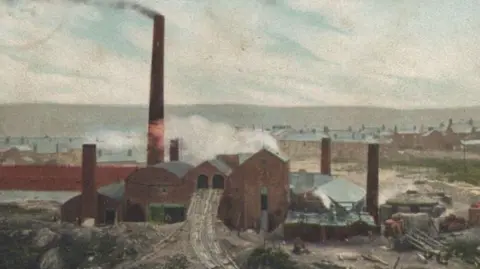 The Buckley Society
Buckley's skyline was once dotted with chimneys from around 20 brickworks.
The area had developed as an industrial heartland from as early as the 1200s, because of the advantages its geography gave it.
The fact heavy faulting of rock formations meant coal seams were thrown to the surface and easily accessible ensured coal mining was the first industry to be developed.
Pottery making soon followed.
Using the local clay, many family-run potteries were founded, with earthenware products taken on the backs of donkeys to Chester Market or exported using the River Dee.
Bricks were being produced in the area from the 1640s - but large-scale production didn't really ramp up until Jonathan Catherall took advantage of the New Dee Canal in around 1737.
By 1815, with the Industrial Revolution in full flight, there were around 14 factories making bricks in the Buckley area to help with the rapid growth in construction taking place.
Buckley became a major player in the industry for more than 150 years.
But by 2004, its last brickworks - Lane End - had closed, and locals mourned the demolishing of its chimney, calling it "tragic".
From once having 20 brick industry chimneys, there were now none.
