'Wonderful' Roman terracotta head found during dig

 The Vindolanda Trust
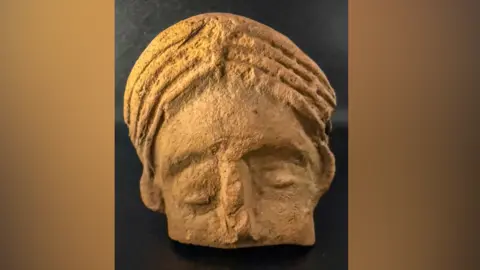
A rare terracotta Roman head has been unearthed during excavations by volunteers and archaeologists at a fort in Northumberland.
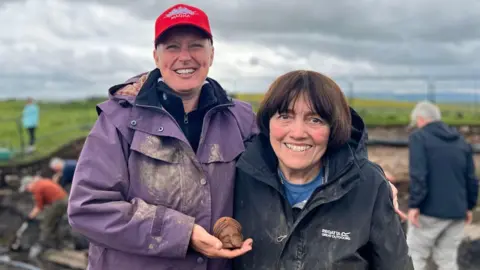
Rinske de Kok and Hilda Gribbin made the striking find while digging at Magna Roman Fort's northern defences.
Measuring 78 mm (3 ins) by 67 mm (2.6ins), the remnant depicts an unknown but regal-looking female figure with a centrally parted, four-strand plaited hairstyle - with some experts suggesting it could be a goddess.
Linsay Allason-Jones, a roman artefact specialist, said the find appeared to be "a practice piece made by an inexpert hand" which was likely made at the fort, near Haltwhistle.
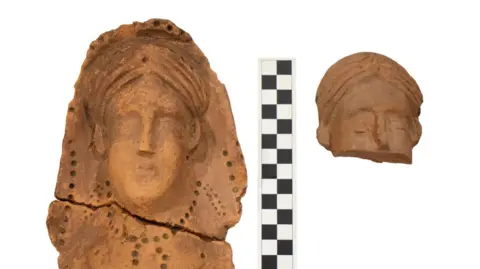
She said while terracotta face pots are common in Roman Britain, free-standing heads are rare, and recalled a second, more accomplished terracotta head found at the Magna site in the 19th century.
The earlier example was donated to the Society of Antiquaries of Newcastle in 1982, and is now held in the Great North Museum in Hancock.
 The Vindolanda Trust
Rachel Frame, a senior archaeologist at Magna, said: "There are clear similarities between the two heads - they are clearly meant to depict the same figure.
"My current hypothesis is that the 2025 find is a locally made copy of the earlier example, which may itself have been imported.
"The woman depicted was clearly important to the people living at Magna."
 The Vindolanda Trust
Malavika Anderson, museum manager at the Great North Museum, said it was "wonderful" to see a newly uncovered terracotta head come from Magna.
She said: "Linking it to an artefact held in our stores demonstrates the importance of safeguarding collections for future research and the new stories they can still reveal."
The identity of the woman who inspired the busts remains unknown, though possibilities include an imperial figure or a goddess.
Barbara Birley, the Vindolanda Trust's curator, said the newly discovered terracotta head will go on display at the Roman Army Museum as part of a recent finds display along with some of the other highlights of the project so far.
