Fort dig reveals glimpse into Roman daily life

 The Vindolanda Trust
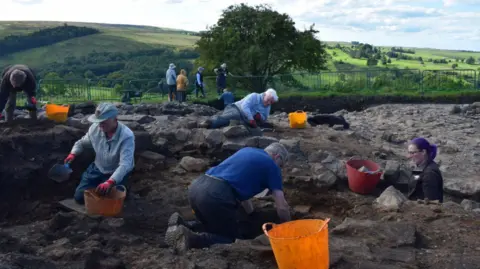
Archaeologists are now three years into a five-year dig at a Roman fort.
Earlier this year the excavation made headlines when eight shoes which were at least 30cm (11.8in) long - the equivalent of a UK size 13 to 14 - were dug up at the Magna Roman Fort in Northumberland
In comparison, of the 5,000 discovered at the nearby Vindolanda settlement in Hexham over the past 55 years, just four or five were that large, according to Roman archaeology expert Dr Elizabeth Greene.
But these mysteriously large shoes were not the only major finds the team made at the fort this year.
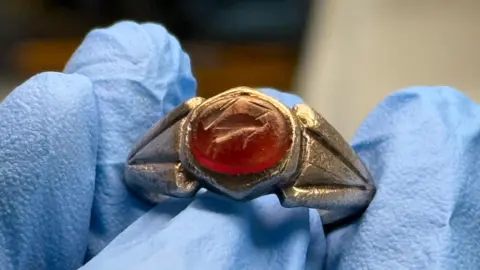
One of the most spectacular finds, according to archaeologist Rachel Frame, was a silver ring which had a picture of a hare inscribed into its gem.
"Archaeology isn't always about the shiny finds," she said.
"But you still have moments… where you go 'oh wow this is not something you see every day in your career'."
 The Vindolanda Trust
Ms Frame said that, following its cleaning, the ring looked like one you could buy in a jewellery shop today and wear immediately.
But she said it was still too early to pinpoint the ring's history as the team had still not determined the exact ages of the ground's specific layers.
"It is one of the big research questions we have," she said.
 The Vindolanda Trust
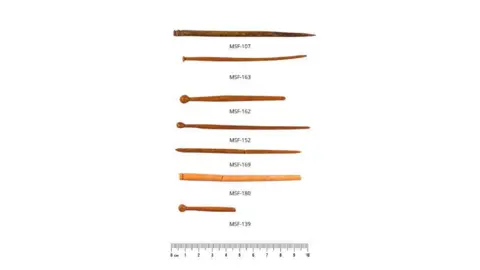
Another find the team made at the site were several hairpins made of animal bone.
Ms Frame said the pins were further proof that women and children also lived at Roman forts.
"Roman soldiers don't typically have long flowing hair that they're putting up in elaborate [hair]dos," she said.
"You can imagine somebody doing up their hair or pinning their hair back to do a task… so it's nice to have these little glimpses into their life."
 The Vindolanda Trust
One of the most puzzling finds from the dig this year was a particular animal bone, said Ms Frame.
"I can tell this was the shoulder blade of an animal," she said. "But I don't know why it's full of holes."
The team eventually figured out that the bone had probably been used to make game counters.
"Romans could use counters like that for a variety of different games and gambling," she said.
Ms Frame said the manufacturer was probably making the counters for themselves and their friends.
"It's a nice sort of glimpse into the daily life as opposed to what everyone thinks of when they think of Hadrian's Wall," she said.
