Water firm flying blind before crisis - regulator

 BBC
BBCA water company was "flying blind" for weeks before a crisis that left tens of thousands of people in Kent and East Sussex without drinking water, a regulator has said.
Some 24,000 properties in Tunbridge Wells, Pembury, Eridge and Frant lost supply or pressure for days, following a "water quality issue" at a South East Water (SEW) treatment works.
Marcus Rink, chief inspector at the Drinking Water Inspectorate (DWI), said the problem began almost three weeks before the company declared the emergency.
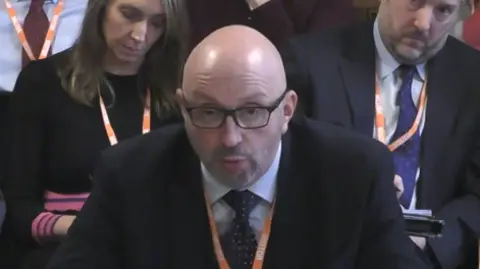
SEW chief executive David Hinton - who earns a base salary of £400,000 and received a bonus of £115,000 last year - apologised and admitted the crisis was a "failure".
He said the water company was "absolutely dedicated" to fixing the network's resilience problems.
Rink told the Environment, Food and Rural Affairs Committee earlier that thefailure "shouldn't have been a surprise" to SEW.
He said Pembury Water Treatment Works had been "operating suboptimally" for months before the outage, which started on 29 November.
Affected customers then faced a nine-day "boil water notice" after supplies returned on 4 December.
SEW was repeatedly criticised during the crisis for its lack of clear communication, with the deadline for restoring supplies extended multiple times.
The committee meeting comes as some properties in Tunbridge Wells temporarily experienced low pressure or no water in a separate incident on Tuesday.
SEW said lower storage tank levels were to blame after a "series of bursts".
It added that, while supplies had been restored, some may have "intermittent supply" overnight.
Hinton told MPs on Tuesday that December's outage happened because a "coagulant stopped performing as it should" at the treatment works, which could have potentially compromised disinfection.
"We didn't know that was the issue initially," he said. "That's why it appeared like the story was changed."
A second coagulant was brought in that solved the problem, but the cause of the issue is still unknown.
Hinton said one theory was that the hot summer lowered levels in its reservoir, which "changed the water chemistry".
But Rink, from the DWI, told MPs there was clear evidence of "inadequate coagulation management", along with poor filter performance, reduced backwash capacity, reliance on manual interventions and a lack of online performance visibility to enable a critical assessment response.
"They were flying blind. There was no electronic collection of data on coagulation."
He said the scientist responsible for the site was off work sick leading up to the crisis.
Alternative supply
Hinton also blamed the crisis on a lack of infrastructure as Tunbridge Wells only has a single supply point.
SEW has said it is updating Bewl Water Treatment Works to ensure the area has another supply, with work expected to be completed by 2028.
The committee was told of people with cancer who had struggled without water and others who had difficulty with dialysis.
Meanwhile, the local business improvement district has estimated some £20m of revenue was lost due to the supply problems.
SEW said it did not recognise this figure and had set aside £2.5m in business compensation.
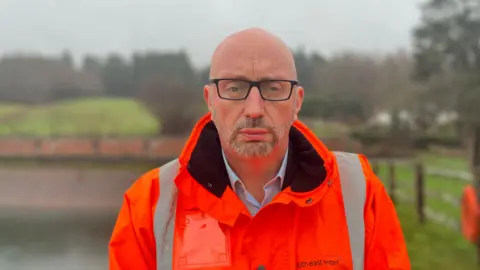
MPs also quizzed Hinton on why he did not speak to the media directly during the outage.
He said he did not give interviews because it would not give him the opportunity to deliver his key message.
Hinton suggested he would have been asked about "dividends, salary", though he was "happy to take those [questions] any other time."
Tunbridge Wells MP Mike Martin repeatedly called on the SEW chief to resign, blasting his leadership as a "total failure".
The committee heard Martin received a call from Hinton asking how he "could sleep at night having politicised the issue".
Hinton told the committee he could not recall the specifics of the conversation, but later said he was "not proud" of his response.
The water boss previously vowed to remain in his post, having said he felt customers' pain.
Hinton told MPs: "I'm deeply sorry to the customers, it's a terrible outcome, I'm just trying to explain the circumstances.
"We have got a number of learnings that we are absolutely committed to putting in place. It was a failure."
Follow BBC Kent on Facebook, on X, and on Instagram. Send your story ideas to southeasttoday@bbc.co.uk or WhatsApp us on 08081 002250.
