Blind patients ask hospital staff to 'walk in our shoes'
 BBC
BBCBlind people have accused hospitals in Coventry and Warwickshire of discrimination, with one woman saying she was not even alerted to food and medicine placed next to her.
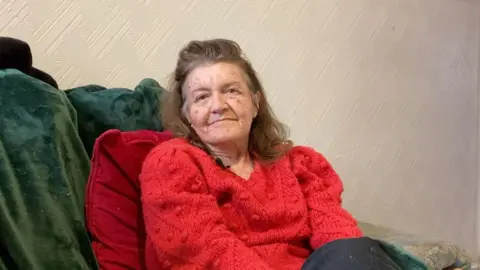
Partially sighted Sarah Lewis said the only way she found meals during a stay at George Eliot Hospital in Nuneaton was "if I reached later for a drink and put my hand in it".
Dexter, who did not want to give his surname, said his neighbours and GP receptionist would read University Hospital Coventry letters to him because staff refused to send them in an accessible format.
Trusts for both hospitals said they were committed to listening to patients and learning from their experiences. George Eliot's chief nursing officer said she was "very sorry" high standards had fallen short.
Lewis spent three weeks in hospital after breaking some bones in her hip.
She said staff would come to her bedside to ask why her medication was still there.
"I was told why haven't you taken the tablets? Because you didn't tell me you were putting them down there," she said.
The extra barriers she has faced to try and communicate with the hospital had left her feeling vulnerable and needy.
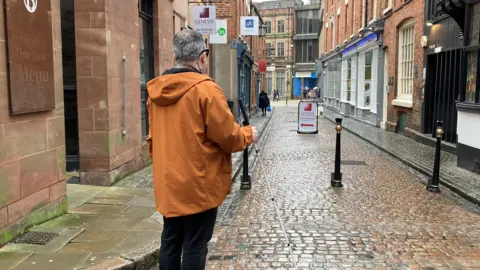
Dexter, 40, has multiple sclerosis. He said despite the word "blind" being written next to his bed, he did not feel he got any extra help during a recent stay at University Hospital Coventry.
At one point, five doctors were brought into his ward without being introduced and all he could see were shadows.
"It's not going to take a lot to make a difference," he said.
"I'm not asking for multimillion-pound initiatives. I'm just asking for people to put yourself in my shoes - how would you like to be dealt with?"
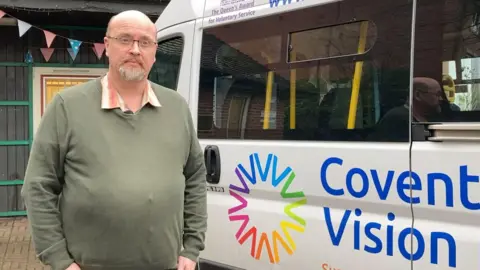
Hugh Sorrill, chief executive officer at the charity Coventry Vision Hub, said their experiences were sadly common.
"Whenever I've talked to people here almost everyone who's been in hospital recently has said they've had all of those issues - so it's pretty much across the board," he said.
Hugh did not think the treatment was deliberate, but came from a lack of awareness of the impact of sight loss.
But he said solutions such as offering information in large print did not have to be expensive.
"Hospitals have a duty to train their staff to approach visually-impaired people in an appropriate fashion - it's not rocket science."
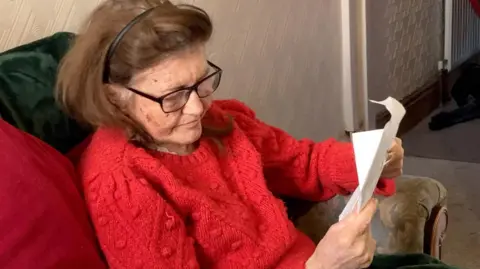
The Royal National Institute of Blind People (RNIB) said blind and partially-sighted people "have a legal right to receive accessible health and care information, but too often this right was denied, creating serious risks to health and wellbeing".
A spokesperson added: "How can anyone attend a hospital appointment if the letter about it was sent in a format you can't read?"
A spokesperson for University Hospitals Coventry and Warwickshire NHS Trust said: "We are committed to ensuring reasonable adjustments are made to provide equitable access for all patients.
"The trust made every effort to resolve the concerns raised and, where appropriate, offer alternative methods of communication.
"We continue listening to feedback and to develop our disability awareness training in order to ensure staff can provide appropriate support."
Meanwhile, Fiona Burton, chief nursing officer at George Eliot Hospital said: "We are very sorry to hear that the patient's experience was not in line with the high standards which we hold ourselves to.
"We expect all our staff to provide appropriate support to patients with sight issues, or any disability, while under our care and we will review the training and support our staff are provided with as a result of this feedback."
Follow BBC Coventry & Warwickshire on BBC Sounds, Facebook, X and Instagram.
