The gothic ruin that became a horror film landmark

 Getty Images
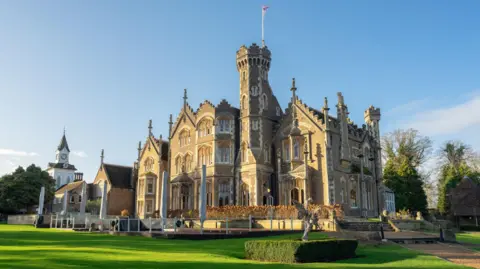
When the Rocky Horror Picture Show's set designer Brian Thomson took film executives to Oakley Court proposing that it was used for filming, he said they left in a "complete state of shock".
The listed building near Windsor was close to Bray Studios, which were also used for filming, but had become increasingly delipidated.
Fifty years on since its release in 1975, the film is one of the most celebrated in musical theatre, and Oakley Court is a luxury hotel.
Mr Thomson said: "[The owners] had taken all the lead out of the roof. All of the water had got in and the interior was just astonishing.
"All this wallpaper was festering and upholstery had all of its springs coming out and I said 'Jim [Sharman, the film's director] here it is. This is it'.
"And so we just had the notion that they had taken up residence in this house."
 Getty Images
Oakley Court, which had also been home for the Hammer Horror Studios, is now "the most recognisable horror film location in Britain" according to Historic England.
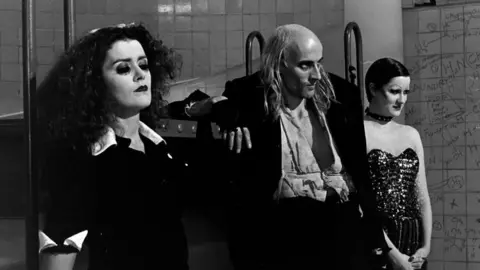
Richard O'Brien, the Rocky Horror Show's writer and who appeared as Riff Raff, remembered everyone had to be "very careful".
"The floorboards were rotten. The ceiling was leaking. The roof was leaking. It was in a very bad state of repair while we were there," he said.
"That added to some of the beauty, the gothic beauty of it, which was rather lovely. Because it was next to the studios, it was very available for filming for people at Bray Studios."
Looking back on the musical's success since it was first released in London and then later in Los Angeles, O'Brien is still amazed at its success.
"It's always been an astonishment that it's gone on for as long as it has on a yearly basis," he said.
 Getty Images
He added: "It's a little entertainment, an enjoyable entertainment and if we'd have been asked 50 years ago whether it was a serious piece of theatre, if it was important, we'd have all said no.
"It's a lovely childish entertainment. Over the years it's become more than that.
"It's a safe haven for the marginalised and for people feeling outside of the mainstream. I'm very grateful for that because I'm very committed to flying the rainbow banner.
"I hate flags in any shape or size because people who are fervent flag wavers are jackbooters – or they're not far behind them.
"But the rainbow banner is inclusive, it's a flag of love and communion and fellowship. I'm glad that Rocky has become part of that movement."
Nell Campbell, who played Columbia in the film, remembered Bray Studios as "the most low-brow studio" and "incredibly impoverished" but is still proud of the role the film has played.
"When the [stage] show opened it was 1973, only six years after homosexuality had been legalised in the United Kingdom," she said.
"Rocky Horror was a complete celebration of everything - heterosexual, bisexual, homosexual, transsexual and crossdressing. It was all just heralded as a wonderful thing to celebrate and embrace.
"It still is magnificent for the LGBTQ+ community and that it is embraced is still thrilling. It is still helping people find community and recognise that they're not alone."
