Can modern Christmas carols become classics?

 PA Media
Church and community choirs have dusted off their Christmas carol books and chosen this year's classic offerings to audiences and congregations. Reporter Seb Cheer explores whether festive songs written in the 21st Century can compete with established tunes and what it takes for them to become as well-known in years to come.
A pair who believe in modern compositions are Don and Jo Pears.
During the last 15 years, the couple from York have written "somewhere in the region of 50 carols" between them, 77 year old Don thinks.
He began writing his own festive tunes because, he says, the price to buy sheet music for performances of existing works was "astronomical" for his community choirs.
He describes himself as having "been brought up in church music" before studying music in Huddersfield and London's Guildhall.
 Supplied
Jo, 57, has been "singing and performing since childhood", she explains, but did not want to pursue a career in music and instead went into amateur operatics alongside secretarial college.
The pair have just released an album featuring 23 of their works, to raise money for the Joseph Rowntree Theatre in York.
The pair recruited 40 choristers, drawn from two choirs Don conducts and "friends who we've known throughout the theatre world", Jo says.
They performed alongside 50 musicians from the York Guildhall Orchestra over a weekend in distinctly non-festive July to have enough time for the album to be published in time for Christmas.
Jo says the point of the project was to enable people to be "enveloped in warmth of joy that we created".
So what makes the couple's compositions work as Christmas carols?
"Most of them have a simple melody, the harmonies are very standard traditional harmonies and you don't have to be a trained singer to join in," Don explains.
Composer and choral conductor Jonathan Willcocks agrees.
"What makes a good carol is a good tune to be honest," he says.
"Most choirs are amateur singers who enjoy to sing a tune and audiences and congregations who come together at Christmas enjoy listening to them."
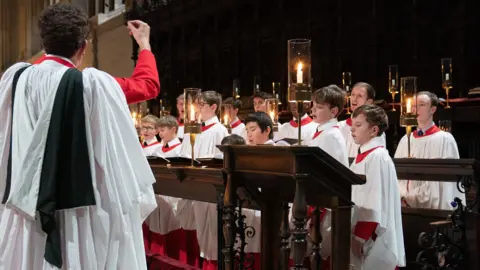
Having grown up as a boy chorister at King's College in Cambridge, under the direction of his father David Willcocks, he knows a thing or two about carols.
He describes the Pears' work as "marvellous".
"I think it's terrific that the choral community has found a way of expressing the same sentiment and enjoyment and bringing the traditions of Christmas to life."
'Bedrock'
"I think if you asked people to write down their 10 favourite Carols, the same ones would crop up time and time again," Mr Willcocks says.
For many people, they are as traditional as mince pies, Christmas pudding and turkey, he adds.
But he also believes it is "essential" that new carols are produced, keeping the tradition "an active, live, progressive thing".
Mr Willcocks' father, who died in 2015, wrote new harmonies and descant counter-melody lines for traditional carols, which are still widely sung today.
They were published in the 1961 book Carols for Choirs, which he describes as a "bedrock" for many choirs' festive repertoires.
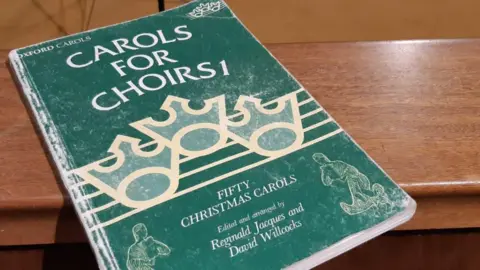
So why do David Willcocks' harmonies and descants for Carols such as O Come All Ye Faithful and Hark! The Herald Angels Sing remain popular?
"My father put it rather nicely in his typically modest way," his son explains.
"He said that in any chord, you've only got a choice of three notes if you're writing a descant, and I had the first choice."
He adds that they were also "beautifully written".
Those attending carol services are "protective" about the music they like to join in with, according to Ripon Cathedral's director of music, Dr Ronny Krippner.
He says there is a "golden trio" of O Come All Ye Faithful, Hark! The Herald Angels Sing and Once in Royal David's City.
"Even the thought of not having Once in Royal to open the carol service is horrifying. That discussion never happens," he adds.
 Bethany Clarke
In between the congregational classics, Dr Krippner says it is important to balance different styles and ages of Christmas carol.
This year at Ripon Cathedral that includes a jazz version of Ding Dong Merrily on High and the 1982 choral anthem The Lamb by the late British composer John Tavener.
Dr Krippner says a carol becomes a "classic" when "people decide we want to hear it over and over again".
"The Lamb is a classic because it's been sung over and over again, and we're not the only cathedral I know doing it this season."
He says there is a difference between choir carols, and those audiences would join in with.
"I don't think I've heard many new congregational carols," he adds, saying nostalgia and community help well-known tunes to retain their popularity.
"Christmas carol singing is the one time - apart from sport maybe - where lots of people come together and start singing, and aren't ashamed by that.
"Isn't that a beautiful thing?"
Listen to highlights from North Yorkshire on BBC Sounds, catch up with the latest episode of Look North.
