How a college carol service became a Christmas institution

 Getty Images
As potatoes are peeled and presents stowed in stockings, one Christmas soundtrack is shared by millions.
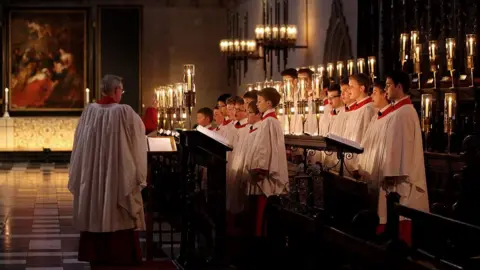
For more than 70 years, carols from the Chapel of King's College, Cambridge, have been beamed into our homes and cars via TV and radio broadcasts.
But how did this simple service become so central to our collective Christmas tradition?
The historic building, considered one of the finest examples of late Perpendicular Gothic English architecture, was built between 1446 and 1515.
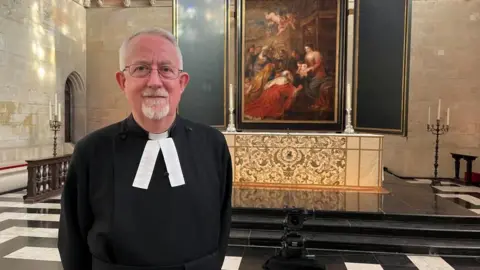
According to the Dean of King's, the Reverend Dr Stephen Cherry, the modern services derive from "a Festival of Nine Lessons and Carols", first held at the chapel in 1918.
 Qays Najm/BBC
It had its first radio outing in 1928, and the TV cameras arrived in 1954.
"As things moved on into the '60s and '70s, and there was a possibility of colour television from here, this became a scene; an arena, a place of music; but also, a place of spectacular visual images, not least The Adoration of the Magi," he explains.
He is referring to the altarpiece painting, which dates back to the 1630s and was originally created by Peter Paul Rubens for a convent in Leuven, Belgium.
It changed hands repeatedly before arriving at King's in the 1960s.
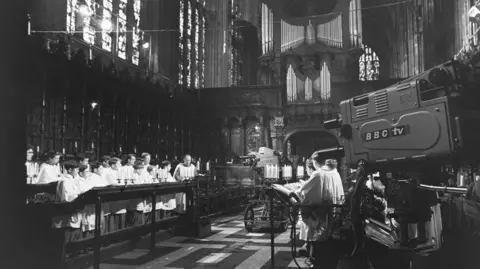
"[The service] brings this sense of majesty and intimacy into people's homes through the television," adds Dr Cherry, who retires from King's in January after 12 years in post.
"I think it's endured because it brings beauty and intimacy very close."
Who takes part?
 Leon Hargreaves/Choir of King's College Cambridge
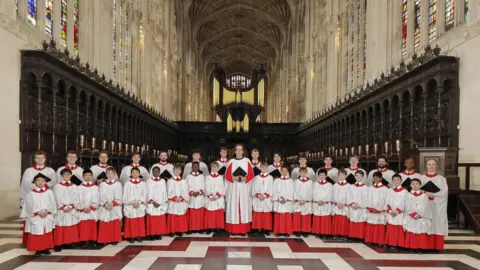
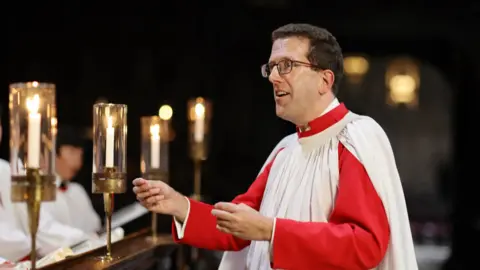
The King's College Choir, founded by King Henry VI in 1441, is made up of boys aged between nine and 13 from the King's College School, as well as male university students.
Alongside a full-time education, the boys sing in the chapel five times a week.
While the radio service – A Festival of Nine Lessons and Carols– is broadcast live on Christmas Eve, the TV service – Carols from King's – is pre-recorded in mid-December, "meaning we can be more creative with the repertoire and the readings", says Daniel Hyde, director of music at King's since 2019.
"The visuals look very similar, but the content changes each year."
Mr Hyde describes the work as "satisfying but also exhausting".
He says: "I often receive a range of letters and emails in January; some of them being very appreciative; some of them expressing great anger that I chose this piece or that piece; some expressing disappointment. It makes you appreciate the responsibility."
 Submitted
For one chorister in particular, there is an especially big moment.
As the red on-air light begins to flash for the radio production, a boy is chosen by Mr Hyde to sing the solo opening verse of Once in Royal David's City.
The tradition was established by Sir David Willcocks in the 1950s, to avoid the chosen boy having too long to think about it and becoming anxious.
Rupert Peacock was selected in 2012 and again in 2013. Reflecting in 2018 on his experience, he said: "Obviously all of us know how the music goes but I thought, 'If I forget the words on live radio that's going to be quite bad.'
"So, I remember actually looking at the copy, rather than singing from memory."
What happens behind the scenes?
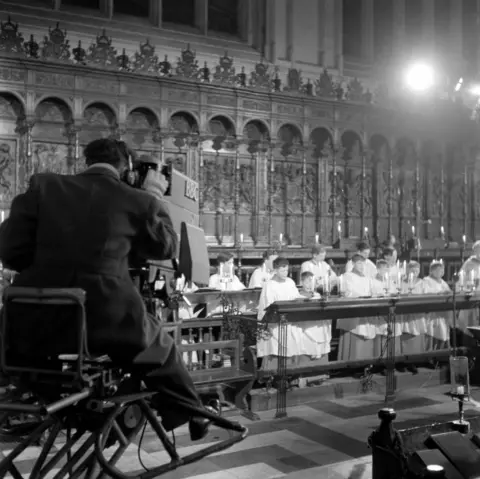
Carols from King's is produced by the BBC Studios ceremonial events team, also responsible for covering major state occasions, including weddings, funerals and coronations.
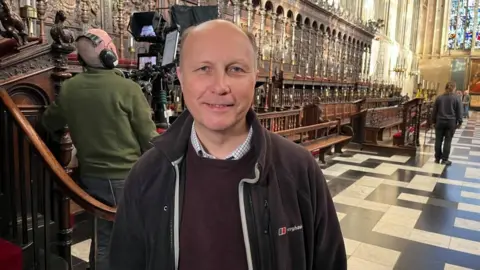
"Our biggest challenge is not to be seen at all," says operations manager, Peter Taylor.
"It's beautiful enough without anything that we add, so what we try to do is blend into the background so that you don't see anything.
"And if you can't tell that we've been here and just get to enjoy the readings and the music, then we've done our job quite well."
 Qays Najm/BBC
Like much of the 40-strong team, Mr Taylor is a Carols from King's veteran.
"I did my first broadcast in 2003, so I've done a fair number of years. I did miss one but otherwise I've been here every year," he says.
"We absolutely love to do it, and it's really that start-of-Christmas moment for us."
Last year's TV broadcast was watched by almost two million people across the UK, while the radio service was streamed across the world.
The two services share much of the same music, but every year the BBC Radio 3 version includes a new carol commissioned for the choir.
Where can I watch or listen?
Tickets to the TV recording and live radio broadcast are harder to get your hands on than gold, frankincense and myrrh.
Until Covid-19, a queue for the Christmas Eve service could be seen snaking from the college lawns to King's Parade.
Nowadays, tickets are made available through a public ballot in November.
The service has been free to attend since its inception, when the-then Dean, Eric Milner-White, decreed it a gift to the people of Cambridge.
For the rest of us,Carols from King's is available to watch on BBC Two at 17:45 GMT on Christmas Eve, and again on Christmas Day at 08:45, and on BBC iPlayer.
A Festival of Nine Lessons and Carolswill be broadcast live on BBC Radio 4, BBC World Service and BBC Sounds at 15:00 on Christmas Eve.
Follow Cambridgeshire news on BBC Sounds, Facebook, Instagram and X.
