Military memories captured before barracks removed

 RMHT
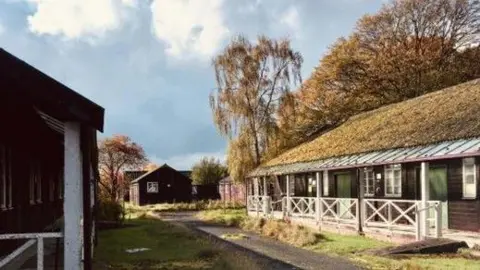
RMHTVeterans from Ripon have shared their military memories for a history project before barracks are demolished to make way for hundreds of homes.
The site, including Deverell Barracks, Claro Barracks and Laver Banks, has been acquired by Homes England for a large housing estate, with the remaining service personnel due to leave later this year.
The Ripon Military Heritage Trust (RMHT) launched a project to interview veterans based in the city, backed by a grant from North Yorkshire Council.
The group said military history was an "important aspect of life" in the city which needed to be preserved and recorded.
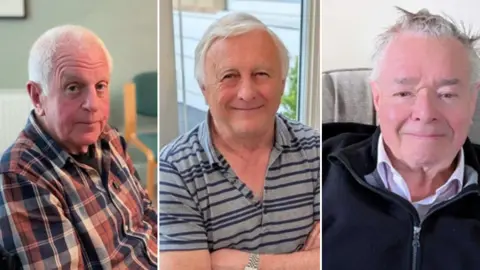
Among those who have shared memories is Keith Punshon, a retired Ripon Cathedral canon.
He was an Army padre who went to Bosnia with the Ripon-based Royal Engineers in 1997 and 1998.
He recalled performing his first exorcism to calm young soldiers at a factory where they were based.
It had been the site of an atrocity during the war and was "a very creepy place", he said.
"Hundreds of young people had apparently been acid-bathed after being murdered in the factory," he recalled.
"The young soldiers got a bit upset about it and things were going bump in the night. So off I went and met the lads and got to know them."
 RMHT
RMHTPunchon said: "I went to the soldiers and said 'right lads I'm going to have an exorcism and these people are going to be laid to rest to go with God, to rest in peace, and you from then on will be left in peace to get on with your work'.
"So it was bell, book and candle, read passages from the Bible, celebrated communion irrespective of whether they were Muslim or Christian, God is God, said prayers, said a Muslim prayer I knew. It settled the soldiers' minds."
Those who served during the Falklands conflict have also shared their memories for the project.
Tony Douglas, 72, a captain with the Royal Engineers, recalled the day the Argentinians surrendered.
"Suddenly two Royal Marines arrived and they were escorting General Menendez, the Argentinian commander who had just signed the surrender document."
He said a naval officer who spoke Spanish began speaking with the general who said: "Gentlemen, first of all I never thought you would come south.
"Secondly when you did I thought our navy would scare you away and then I hoped our air force would.
"Once neither of them worked I knew I'd lost."
 Getty Images
Bob Lisle, 71, also went to the Falklands with 11 Field Squadron Royal Engineers.
He helped load the Atlantic Conveyor container ship with supplies and heavy equipment.
He was one of two engineers who joined Navy servicemen on the journey to the South Atlantic.
Due to the situation at Port Stanley, the ship was unable to dock and senior officers realised they would be unable to unload the equipment.
Lisle was asked: "How are you intending to get the stores off?"
He replied that he did not know.
"They started doing things such as cutting holes in the deck to see that it gets stuff off," Lisle recalled.
"But how do you dig a hole in the deck to take off a large digger?"
Fortunately for the Ripon veteran he left the ship to join the rest of his squadron at the Ascension Islands and the Atlantic Conveyor never managed to unload as it was sunk in May 1982 by Argentinian Exocet missiles.
'Illuminating anecdotes'
The RMHT is hoping more veterans will come forward to share their memories and experiences.
The trust's chairman Guy Wilson said: "We have already learnt so much about military life and activity around Ripon from speaking to people who were there.
"We now have to capture that and more on recordings before it is too late.
"So that the contributions of the people who served in Ripon can be properly understood and remembered into the future and the many humorous and illuminating anecdotes about Army life are not lost to us all."
Listen to highlights from North Yorkshire on BBC Sounds, catch up with the latest episode of Look North.
