Historians hope to uncover stories behind teen's World War One autograph book

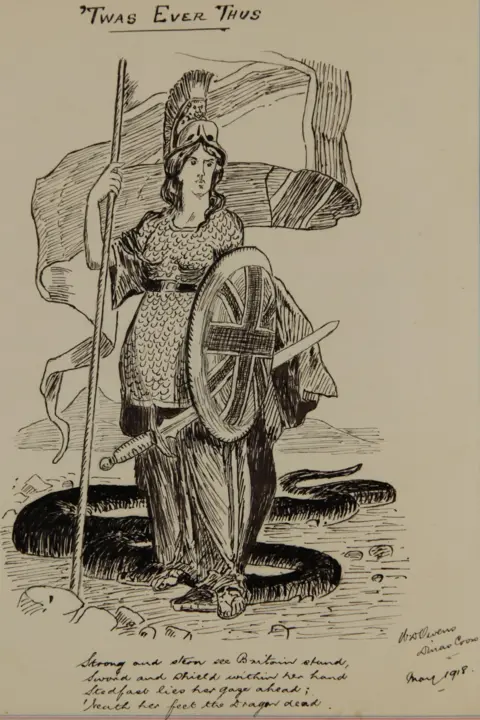 Pembrokeshire Archives
A prize signature for a modern Welsh autograph book may be Gareth Bale or Michael Sheen, but for one teenager during World War One, the entries were rather more eclectic and now historians hope to uncover more about the people involved.
Between 1915 and 1921 Gwladys Mary Jones of Goodwick, Pembrokeshire, collected about 70 contributions from friends, family and even passing strangers.
Ranging from simple greetings to heartfelt poems and drawings, they reveal a fascinating insight into the lives and opinions of ordinary people dealing with the privations of war.
The book was donated to Pembrokeshire Archives, who have been trying to learn more about the signatories, with historians saying the "tantalising" entries give them the chance to "glimpse into the people and feelings behind the dates and places".
Gwladys was born in Carmarthen on 13 July 1899, but by the time she began her autograph book her family had moved to Goodwick - probably to do with her father's work as an inspector for Great Western Railway.
The people she asked to write and sketch in her book vary from neighbours and school friends to a middle-aged solicitor and even a merchant seaman passing through Goodwick over Christmas 1917.
Some are from places further afield, such as Neath, Swindon and Cardiff.
 Pembrokeshire Archives
Pembrokeshire council's archives and local studies assistant Elliot MacMillan said these musings could be interpreted as the social media of their day.
"I believe they were fairly common around the time, though very few still remain. They gave young, and sometimes even older, people a way of identifying as a group, and venting their innermost hopes and fears.
"Where it does differ from modern social media is that it was clearly something which was meant to be kept private within the trusted circle, rather than broadcast to the world, as some of the opinions expressed could have been problematic if they'd have been stated publicly in a time of war."
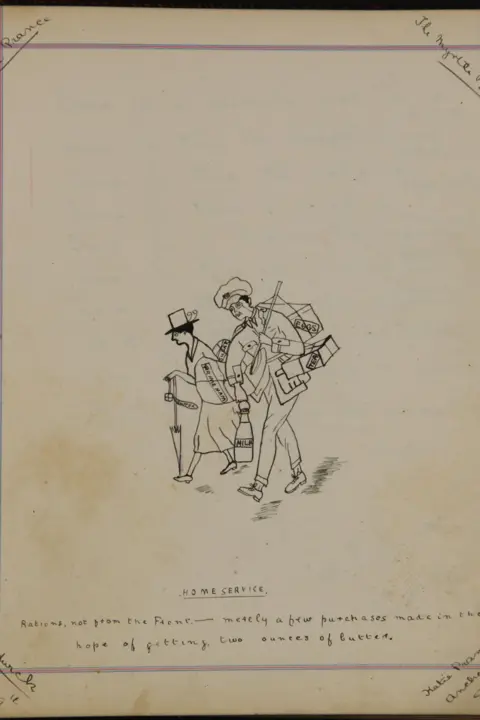
Two of the most commonly-expressed contentious views surround food shortages and the treatment of returning wounded servicemen.
In February 1918, Jennie Thomas summed up the drudgery of rationing in her poem Only a Dream: "Where there's no such thing as a sugar card. And food control is a joke. And the shops have plenty of butter & lard – But when I got there I awoke!"
 Pembrokeshire Archive
A quip by E.W Sayer on 20 September 1918 highlighted the growing frustration with the plight of returning heroes: "May the man that loses one leg in the defence of his country never hop to the workhouse on the other."
Macmillan said: "The black humour in this, and many similar comments, are interesting.
"They foreshadow David Lloyd George's promise to provide 'habitations fit for the heroes who have won the war'.
"No doubt Lloyd George would have been aware of this cynical sentiment and – being a shrewd politician – saw the need to nip it in the bud."
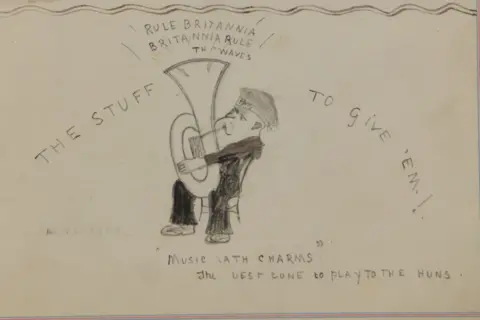 Pembrokshire Archives
Though for Macmillan, the most fascinating aspect of the collection is the things we will never know.
"It's tantalising. Most searches start off with the bare facts of a census, or birth, marriage and death certificates, but this book has given us a glimpse into the people and feelings behind the dates and places.
"The care and thought put into the entries show they really mattered.
"Plus the time they would have taken to create suggest that Gwladys trusted her friends to take the book away and compose them in their own time... imagine if just one of them had spoilt or lost the book, years of work would be down the drain and we wouldn't have it to enjoy today."
By the time of the 1921 census, Gwladys was living in Carmarthenshire with her mother Mary and working as a clerk at an auctioneers, but there is no longer any record of her father Tom.
 Maureen Davies/Fforestfach History Blog
In a report on the outbreak of World War Two in 1939 she is listed as living in Swansea, again with her mother, and this time employed at an automotive factory.
She died in Swansea in 1985, aged 86, though there is no record of her ever marrying or having children.
It is a life which was prophesied in 1921 by schoolfriend Lillian James in a poem called Future Days that imagined Gwladys as an older woman in her armchair wondering "if my album keeps the memories of yore?... takes this book and turns the leaves with many a smile and kiss".
For Macmillan, it is by far the most poignant part of the book.
"Most of the entries are very upbeat and humorous, if not a little dark, but this one is so heartfelt and I find it a little bit bleak.
"Probably that's all the more so because – as far as we can tell – that was exactly the future which Gwladys went on to have."
