Met Office: Winters to get wetter and warmer

 BBC
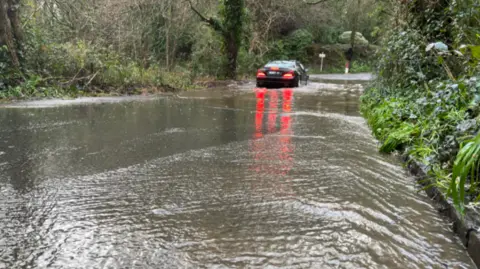
BBCGuernsey Met Office has said weather projections showed winter months were going to continue to get wetter and warmer due to climate change.
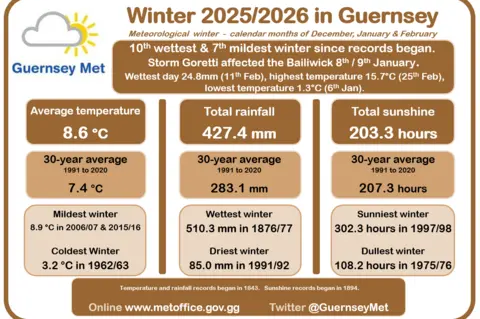
It comes as the weather service recorded the island's 10th wettest and 7th warmest winter since its records began.
The Met Office said global rising temperatures over the past 100 years meant an increased amount of moisture in the atmosphere, creating more rain and warmer winters.
Liz Bentley from the Met Office said the climate was "becoming more extreme" and "our winters are going to become even wetter and even warmer".
The meteorological winter from the start of December until the end of February saw 427.4mm of rainfall, with the wettest day recorded on 11 February.
The average temperatures of 8.6 C (47.5 F) during that period was higher compared to the 30 year average of 7.4 C (45 F).
"You can see that particularly in the last four decades that our winters are becoming wetter and warmer but there's a lot of variation, " said Bentley.
"You can see that trend and we know that's happening because our climate is changing."
 Guernsey Met Office
"Every one degree of average temperature rise, and we've seen about one and a half degrees of warming in the last 100 years or so, we get a 7% increase in the amount of moisture that the atmosphere can hold, " said Bentley.
"Over the last 100 years or so, we've probably seen about a 10% increase.
"So you've got low pressure that's dominated pretty much throughout the three months of December, January and February.
"That leads to the persistent rain, the named storms that have come through in more recent years particularly, and the rain that just doesn't go away, just sits around for days on end, and that's when we get these particularly wet winters."
She said there was also a trend in records showing drier summer and warmer spring seasons.
"You can look across the different seasons, so spring, for example, the spring season is the one that's warming the most.
"But you can look at the records being broken as well, so daily records, monthly records, annual records, particularly for high temperatures, they are the ones that seem to be broken much, much more frequently."
Follow BBC Guernsey on X and Facebook and Instagram. Send your story ideas to channel.islands@bbc.co.uk.
