Conservation carpenter fixing remote science base
A carpenter who has travelled to Antarctica to help future-proof Britain's scientific base says it is currently not able to deal with the change in climate.
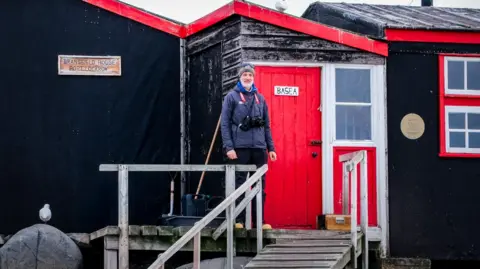
Jo Oliver, a conservation carpenter based in Wedmore, Somerset, said climate change has caused more snow and rain to hit the buildings at Base A, Port Lockroy.
He is doing conservation work in near constant daylight, sub-zero temperatures, and without running water or flushing toilets, as part of a three-year project with a team.
Oliver told BBC Radio Somerset: "With the effect of climate change we're getting a lot more rain and snow, a lot of the buildings aren't built to be able to deal with that."

 UKAHT/Pete Watson
Oliver travelled 9,000 miles with the UK Antarctic Heritage Trust (UKAHT), which has put on the safeguarding programme, in January and returns later this month.
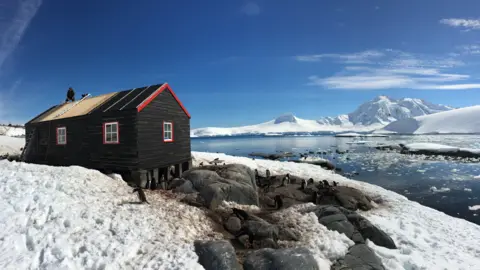
As part of the work the team will complete repair work and general maintenance on the buildings - some dating back to 1944 - as well as counting the number of gentoo penguins populating the area.
The base face structural deterioration because of rising temperatures and extreme weather on the rapidly warming Antarctic Peninsula.
"It's the beginning of a three year project to help weather-proof some of the buildings," Oliver said.
"The buildings were built when there was very little precipitation. It's to future-proof the buildings for more wet."
 UKAHT
UKAHTThe UKAHT is currently recruiting for people to live and work at the base - which is also home to the world's southernmost Post Office and museum - to carry on the work from November 2026.
Oliver said that time of year is Antarctica's summer, with temperatures ranging from –5°C to +5°C, adding the continent is "pretty overwhelming".
"It's very much like being on another planet because it's so, so different to everything you're used to.
"Especially in Somerset. Somerset is so green. There's no green here, it's all grey, all white, and all blue.
"There's no vegetation, no trees. We've basically been living on a barren rock for two months which doesn't sound very interesting but it's pretty amazing.
"It has its own beauty for sure.
"We've got glaciers, mountains, and the skies are so blue. It's incredible. It's very beautiful in a much different way to England."
The charity wants to recruit five team members to take on the next phase of safeguarding the base for six months, and deadlines close on 15 March.
 UKAHT
UKAHTCamilla Nichol, UKAHT CEO, said: "Every year we hear from people who say they want to do something extraordinary with their lives — to step outside the ordinary and contribute to something meaningful. These job opportunities offer just that.
"Port Lockroy is a place of wonder and history and a site where generations of pioneers have made groundbreaking discoveries about our world.
"The team we recruit will play a central role in protecting and communicating Port Lockroy's remarkable heritage, wildlife and environment, while sharing its story with visitors from around the world."
Follow BBC Somerset on Facebook and X. Send your story ideas to us on email or via WhatsApp on 0800 313 4630.
