London homes 'overheating due to climate change'

 Getty Images
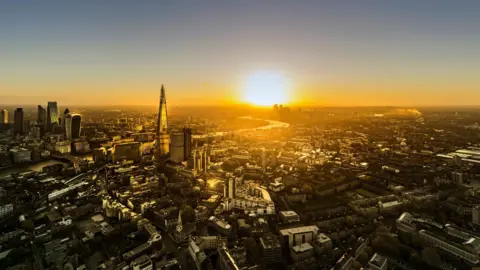
Londoners face a unique overheating risk in their own homes due to climate change affecting a densely built environment and an outdated planning and design system, the London Assembly has heard.
Extreme heat is becoming an increasing issue in London, with more than a 10th of the 3,271 UK-wide heat-related deaths in 2022 in the capital, according to City Hall.
It says this is due to the city's increasing density of buildings and roads leading to the "urban heat island" effect.
City Hall is currently drafting London's Heat Risk Delivery Plan, which could include "cool spaces" around the city, thousands of water refill points and plans to plant thousands more trees.
To AC or not to AC?
The London Assembly Planning and Regeneration Committee is examining how overheating is affecting London's housing stock, who is most vulnerable to the impact of extreme heat, and what more can be done to make homes resilient to rising temperatures.
Currently, the London Plan encourages new developments to adopt "passive" cooling measures – such as trees, green roofs and shading – rather than "active" measures, such as air conditioning (AC).
The 2021 London Plan states that the spread of active measures such as AC systems is "not desirable as these have significant energy requirements and, under conventional operation, expel hot air, thereby adding to the urban heat island effect".
Just 5% of British households have AC units, it notes.
Ed Hezlet, head of energy at the Centre for British Progress, believes that air conditioning has its place and says that as temperatures increase, a failure to encourage efficient active cooling systems means "people will go out and buy lots of inefficient devices".
He added that: "Active measures are very important with dealing with tail risks of very, very high temperatures."
Anna Mavrogianni, professor of sustainable, healthy and equitable built environment at University College London, noted research that found that AC installation rose almost sevenfold between 2011 and 2022 showed it was a phenomenon "we cannot ignore".
She supported Hezlet's point that active and passive cooling should work together, rather than in a hierarchy.
 Getty Images
Dr Joel Callow, founding director of Beyond Carbon, said current regulations had trapped designers "in a system with contradictory aims".
He added: "The planning system pushes for daylight criteria, which means larger windows, which goes against cooling criteria.
"Shading is not a historic part of our architectural vernacular – it's very hard to convince planners to let us install shading, because it might not look like a British building.
"The principal challenge is that both planning and building regulations cannot both be met. A well-designed, modern apartment with all the windows closed should stay cooler than the outside temperature."
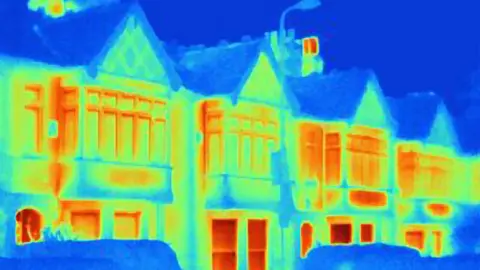
Mavrogianni noted: "There is a lot of emphasis on having large glazing areas with no provision for shading or solar control.
"Windows can be a significant source of solar heat gains – having an unopenable window can contribute to overheating."
Listen to the best of BBC Radio London on Sounds and follow BBC London on Facebook, X and Instagram. Send your story ideas to hello.bbclondon@bbc.co.uk
