Scottish Budget 2026/27: What could you be paying in tax?

 Getty Images
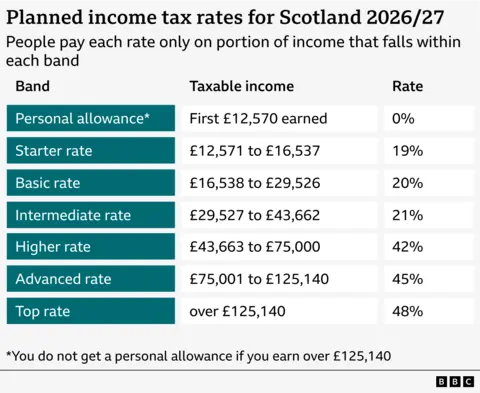
The Scottish government has announced changes to two of Scotland's six income tax bands in its draft budget for 2026-27.
The proposals will see the threshold for the Basic and Intermediate rates rise by 7.4%, in effect cutting tax for lower earners.
However, the Higher, Advanced and Top rate thresholds will be frozen at the current rates until at least 2028-9, meaning anyone whose income rises above £43,663 will begin to pay tax at 42%.
Finance Secretary Shona Robison said 55% of Scottish taxpayers are set to pay less next year than they would do if they lived elsewhere in the UK.
Based on this announcement, tax consultants at Deloitte have put together an analysis of how income tax changes will affect your pay next year.
The lower earner - £16,000 salary
If you earn a salary of £16,000 in 2026-27 and have no other income, the personal allowance of £12,570 will be deducted and £3,430 will be taxable. If you are resident in Scotland, your income tax calculation will be as follows:
- Starter rate - £3,430 at 19% = £651.70
- Total tax = £651.70
- National insurance - £3,430 at 8% = £274.40
- Take home pay - £15,073.90
This is a reduction in income tax of £6.03 compared to 2025-26 due to the increase to the starter rate band.
If you earned the same sum of money but were not resident in Scotland the full £3,430 would be taxable at 20% (UK basic rate) producing an income tax bill of £686. Therefore, you would pay £34.30 less as a resident of Scotland.
- This tax band will include people who work in some part-time roles and in minimum wage jobs.
The medium to higher earners - £33,000 salary
If you earn a salary of £33,000 in 2026-27 and have no other income, the personal allowance of £12,570 will be deducted and £20,430 will be taxable. If you are resident in Scotland, your income tax will be as follows:
- Starter rate - £3,967 at 19% = £753.73
- Scottish basic rate - £12,989 at 20% = £2,597.80
- Intermediate rate - £3,474 at 21% = £729.54
- Total tax = £4,081.07
- National insurance - £20,430 at 8% = £1,634.40
- Take home pay - £27,284.53
This is a reduction in income tax of £31.75 compared to 2025-26 due to the increase to the starter rate and basic rate bands.
If you are resident elsewhere in the UK, the full £20,430 will be taxable at 20%, giving an income tax liability of £4,086. A Scottish resident would pay £4.93 less in income tax compared with living elsewhere in the UK.
- This band includes the starting salary for a teacher (main grade scale) which is currently £34,938.
The £50,000 salary
If you earn a salary of £50,000 in 2026-27 and have no other income, the personal allowance of £12,570 will be deducted and £37,430 will be taxable. If you are resident in Scotland, your income tax will be as follows:
- Starter rate - £3,967 at 19% = £753.73
- Scottish basic rate - £12,989 at 20% = £2,597.80
- Intermediate rate - £14,136 at 21% = £2,968.56
- Scottish higher rate - £6,338 at 42% = £2,661.96
- Total tax = £8,982.05
- National insurance - £37,430 at 8% = £2,994.40
- Take home pay - £38,023.55
This is a reduction in income tax of £31.75 compared to 2025-26 due to the increase to the starter rate and basic rate band.
If you are resident elsewhere in the UK, the full £37,430 will be taxable at 20%, giving an income tax liability of £7,486.00. A Scottish resident would pay an additional £1,496.05 in income tax compared with living elsewhere in the UK.
This may feel particularly acute for employees living in Scotland with earnings between £43,662 and £50,270 who have an effective marginal tax rate of 50% once National Insurance is taken into account, compared to 28% in the rest of the UK.
- This pay grade includes newly qualified train drivers at ScotRail whose salary begins at £50,086.
The higher earner - £110,000 salary
If you earn a salary of £110,000 in 2026-27 and have no other income, you are entitled to a reduced personal allowance of £7,570 because your income exceeds £100,000. Your taxable income is therefore £102,430.
If you are a resident in Scotland, your income tax breaks down is as follows:
- Starter rate - £3,967 at 19% = £753.73
- Scottish basic rate - £12,989 at 20% = £2,597.80
- Intermediate rate - £14,136 at 21% = £2,968.56
- Scottish higher rate - £31,338 at 42% = £13,161.96
- Scottish advanced rate - £40,000 at 45% = £18,000.00
- Total tax = £37,482.05
- National insurance - £37,700 at 8% + £59,730 at 2% = £4,210.60
- Take home pay - £68,307.35
This is a reduction in income tax of £31.75 compared to 2025-26 due to the increases to the starter rate and basic rate bands.
Although the highest headline rate at this income level is the advanced rate of 45%, the marginal rate of income tax for incomes between £100,000 and £125,140 is 67.5% (69.5% including national insurance) due to the effects of the tapering of the personal allowance.
If you are a resident elsewhere in the UK, on this salary you will pay £33,432.00 in tax - £4,050.05 less than north of the border.
- This pay band includes the basic, starting salary for a consultant doctor which is £111,430.
The highest earners - £200,000 salary
If you earn a salary of £200,000 in 2026-27 and have no other income, you are not entitled to a personal allowance because your income exceeds £125,140. The taxable income is therefore £200,000.
If you are a resident in Scotland, your income tax breaks down is as follows:
- Starter rate - £3,967 at 19% = £753.73
- Scottish basic rate - £12,989 at 20% = £2,597.80
- Intermediate rate - £14,136 at 21% = £2,968.56
- Scottish higher rate - £31,338 at 42% = £13,161.96
- Scottish advanced rate - £62,710 at 45% = £28,219.50
- Top rate - £74,860 at 48% = £35,932.80
- Total tax = £83,634.35
- National insurance - £37,700 at 8% + £149,730 at 2% = £6,010.60
- Take home pay - £110,355.05
This is a reduction in income tax of £31.75 due to adjustments to the starter rate and basic rate bands.
If you are a resident elsewhere in the UK, on this salary you will pay £76,203 in tax - £7,431.35 less than north of the border.
- The salary for one of Scotland's most senior civil servants is at least £205,000.
'Small tax reductions but fiscal drag remains a problem'
Garry Tetley, head of tax at Deloitte in Scotland, said: "Adjustments in the lower rate bands will result in small tax savings of up to £31.75 for taxpayers at all levels, but wage inflation will push many taxpayers into higher rate bands.
"While the starter rate band and basic rate bands are both increasing, the higher rate threshold remains at £43,662 for a sixth year running.
"This is still significantly lower than the UK higher rate threshold of £50,270 which has been frozen until 2030-31.
"The commitment (for the rest of the parliamentary session) not to introduce any new bands or increase the rates of Scottish income tax and uprate the starter and basic rate bands by at least inflation provides stability.
"However, the continued divergence from the rest of the UK means that those on the highest salaries will continue to face higher tax bills in Scotland."
- Production by Aimee Stanton, BBC Scotland news senior data journalist
