What next after Storm Goretti tree 'devastation'?

 Hugh Hastings/Getty Images
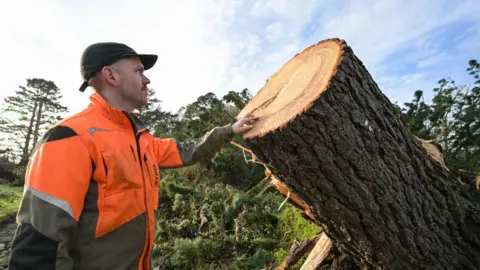
Storm Goretti flattened thousands of trees across Cornwall and the Isles of Scilly when it hit south-west England on 8 January - leaving estates, gardens and conservation charities facing one of the biggest restoration challenges in decades.
How does the region plan to recover and future‑proof its landscapes against stronger storms?
 Hugh Hastings/Getty Images
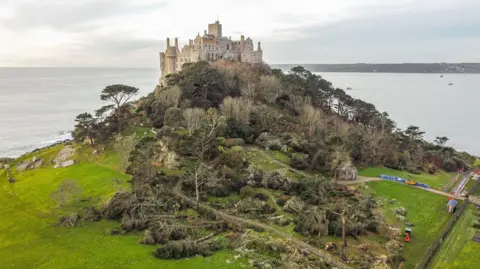
About 119 trees - some planted in the 1950s and 60s - were lost or damaged on St Michael's Mount this month.
Cornwall Council called the storm one of the "most severe in living memory".
"It's sad to see the visible change," said Henry Mathews, of St Aubyn Estates, which owns Friendship Woods and manages St Michael's Mount with the National Trust.
"Around 500 trees have been lost across the estate," he added.
"The next phase is recovery, removing fallen trees and planning for restoration and replanting.
"We won't do it quickly, it will be the right tree in the right place, considering future climate change conditions, biodiversity and landscape character."
He added: "We'll take advice from experts and there will probably be some natural regeneration but there will be some targeted replanting."
Could more trees come down?
As well as dealing with the aftermath of the storm, people in Cornwall are also bracing for the future.
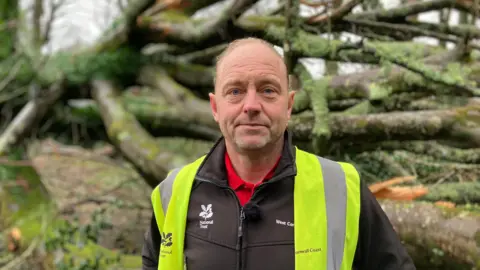
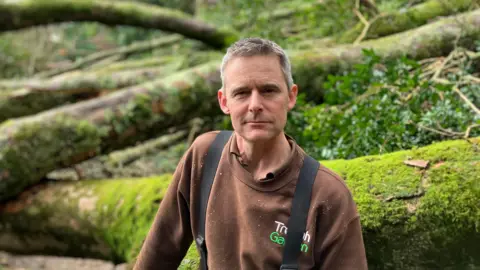
Simon Hocking, the lead ranger for the National Trust in west Cornwall, said the high winds could have weakened trees in the region.
"[The trees have] been buffeted by the winds and their root plates moved. Future storms means those are vulnerable."
He said the focus now was on "future-proofing".
"It's hard to comprehend the scale of the damage," he said as he stepped over the splintered branches of a huge tree felled during Storm Goretti.
He said it was a "huge moment in time" and "unprecedented" in his lifetime.
The National Trust said it planned to continue with its "ambitious tree planting programme" but added alongside clearing pathways and restoring access for the public, it would also let "natural regeneration take place" in some woodlands.
Which trees survive strong winds?
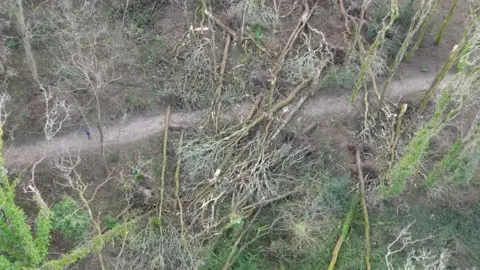
A few miles away, Darren Dickie of Trebah Garden near Falmouth, is thinking about what could replace the 100-year-old trees which did not survive.
"We'll plant trees that are less prone to wind damage," the head gardener said.
"The trees we lost had grown very tall and vulnerable to strong winds.
"We could look at some of the native trees that haven't suffered as much in the storm. It could be holly.
"[It's] trees that will tolerate those extremes in conditions as well as drought, as the climate changes," he added.
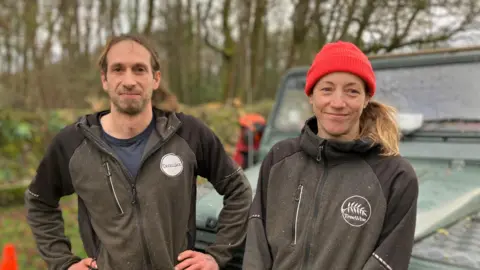
Fiona Curtis, a tree surgeon working at the National Trust's Godolphin Estate near Helston, said she had "never seen anything like it before".
"We've been clearing roads, getting trees off houses," she said.
"There's a lot of damaged trees that are going to need to be sorted and I'm hoping that these kind of storms are not going to become more regular."
How do experts choose climate‑resilient trees?
Comparisons have been made between Storm Goretti and the Great Storm of 1987, which ravaged the south of England.
"When you lose so many trees in one fell swoop it really is jaw-dropping," Cecily Withall of Royal Botanic Gardens Kew, London, said.
During the 1987 about 700 trees were lost there.
"At any point at Kew, if we've lost a tree within our landscape, it's really important to chose a species that's going to survive for the long run," she said.
"We look at the the longevity and the drought resistance of those trees and choose something that's going to be there for the next 100 plus years.
"But it's really important to note that regardless of how we plant and care for our trees, mother nature will always win if she wants to."
Follow BBC Cornwall on X, Facebook and Instagram. Send your story ideas to spotlight@bbc.co.uk.
