Writer's poems helped boost the abolition campaign

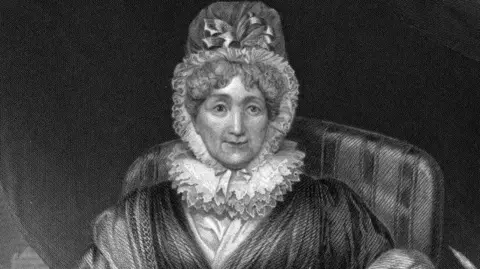 Henry William Pickersgill
Letters written by a prominent abolitionist are being digitised, filling in a "massive bit of the jigsaw" in the abolition campaign history, experts say.
Novelist Hannah More, born in Bristol in 1745, also helped open some of the UK's first schools for working class people.
University of Bristol research fellow Ben Wilkinson-Turnbull, who is helping to digitise her letters, said she is a "prominent part" of the local landscape with many buildings named after her in Bristol and Somerset.
Nailsea historian Dr Jo Edwards said: "It's not just an academic project that doesn't involve normal people. It's a community resource."
Edwards said the letters give residents "a huge insight" into local history.
"Some of these things mean a massive bit of the jigsaw has been filled in," she added.
More wrote a poem called Slavery, which was used as part of William Wilberforce's parliamentary campaign to achieve abolition of enslaved Africans.
Her writing saw her become friends with the likes of Romantic poet Samuel Taylor Coleridge and royalty.
 Ben Wilkinson-Turnbull
Edwards added it was a "fascinating" project, especially for Nailsea's Tithe Barn where More established a Sunday school.
The site, opened in 1792, is one of the abolitionist's most successful schools and was where she led Christian-rooted teachings on how enslaving people was "morally wrong" and "un-British".
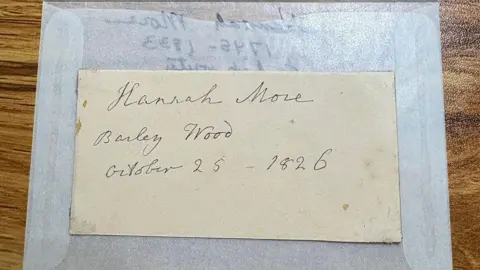
An archive of her letters will also be on show at Tithe Barn.
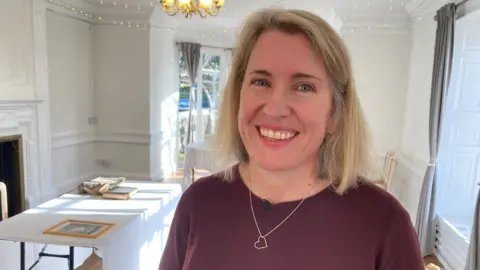
"We want to map the buildings she was connected to in Somerset," Edwards said.
"There are also other places like St Mary Redcliffe Church, in Bristol where she wrote memorials.
"It's absolutely fascinating."
Wilkinson-Turnbull said she was also an important figure in women's writing.
The collection of more than 1,800 letters span from 1766-1833.
"The project is being led by Dr Kerri Andrews from the University College Cork, who has been looking at this for years.
"The section I'm working on is her letters to the MP and abolitionist William Wilberforce," Wilkinson-Turnbull said.
Wilberforce and More's work was part of a movement that led to the enslavement of Africans being abolished in Britain in 1807 and then in the British empire in 1833.
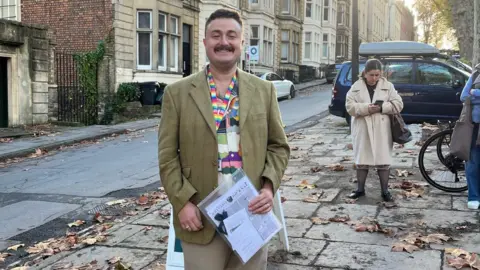 Ben Wilkinson-Turnbull
Wilkinson-Turnbull said the letters covered her abolitionist work and messages of encouragement to get children to go to school.
"In places like Bristol and Somerset, More is such a prominent part of the landscape, schools and community centres are named after her as well as her former house Barley House, which is now a social enterprise," he added.
The letters can be viewed here.
Follow BBC Bristol on Facebook, X and Instagram. Send your story ideas to us on email or via WhatsApp on 0800 313 4630.
