How a Victorian serial baby-killer was caught

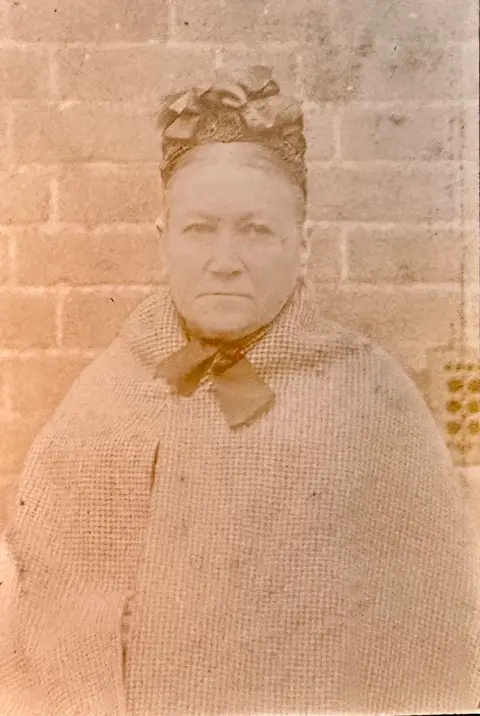 Thames Valley Police Museum
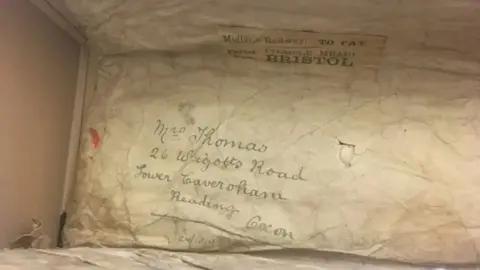 Thames Valley Police Museum
It was in a dark, dusty basement that a former police officer discovered an old box - the contents of which were to reveal exactly how the woman suspected of being Britain's most "horrific" serial killer was caught.
"I was very surprised," recalled Ken Wells, "because she most probably would be the most prolific murderess that we've ever known."
Her name was Amelia Dyer and she was from Reading in Berkshire.
She was executed in 1896 for killing a baby girl, but is suspected of murdering as many as 400 infants.
Warning this article contains content some readers may find upsetting

Amelia Dyer's crimes were exposed on 30 March 1896 when a bargeman pulled a bag, weighed down with a brick, out of the River Thames.
Wells, who still volunteers at Thames Valley Police Museum, said: "Mrs Dyer took in babies to look after them, but unfortunately she wasn't looking after them, she was actually strangling them and throwing them in the river."
He explained that the man used his barge pole to hook the bag and found a sodden brown paper parcel inside: "When he unwraps it and it contains the body of a baby girl who had been strangled".
The baby was badly decomposed and was later identified as Helena Fry.
"Now I can't believe this," said Wells, "when the package was examined, there was a name on it".
The elaborate faint ink script read Mrs Thomas, 26 Piggotts Road, Lower Caversham. Thomas was Dyer's former married name.
Wells continued: "The police descended upon that address immediately only to find that Mrs Dyer had gone.
"When the police raided the place, there were no babies there."
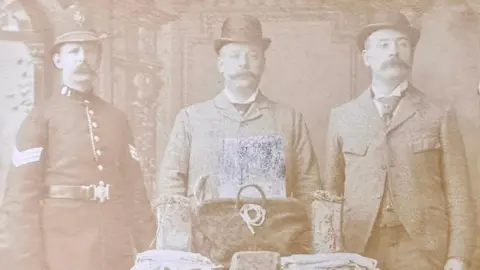 Thames Valley Police Museum
A small team of moustached officers from Reading Borough Police traced Dyer to her new home at 45 Kensington Road, Reading.
Fearing she would flee, they put the house under surveillance.
Former police officer and museum curator, Jim Weems, said many of the techniques used by the Victorian investigators are still used today, albeit without advanced forensics and technology.
He listed house-to-house enquiries, the collection of evidence and witness statements, surveillance, correspondence with other forces and the use of a decoy to "interact with Dyer to see if she would take her child".
During a search of Dyer's rented two-up two-down terraced home officers found string that was identical to the string used to bind the parcel containing Helena Fry's remains and the same type of cord used to strangle her.
There were also letters from parents who had given up their babies into her care, child vaccination certificates, "mountains" of baby clothes and tickets showing she had pawned children's clothing after their demise.
The letters found indicated she was looking after six babies at the time.
None were found.
The police concluded two had been returned to their parents and four were dead.
Weens said there was "no silver bullet" that solved the case.
Much of the evidence collected is displayed at Thames Valley Police Museum in Sulhampstead, Berkshire.
The brown paper packaging, in which Helena Fry's remains were wrapped, was discovered by Det Con Anderson's great-great-grandson, Richard Anderson, in the loft of his family home in Reading and later donated to the museum.
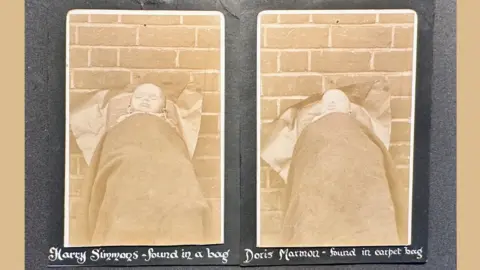 Thames Valley Police Museum
Dyer was able to go undetected for so long as so-called 'baby farming' was a common practice at the time.
In recorded discussions over amendments to "Bastardy Laws" in 19th Century England and Wales, illegitimate children were described as a "moral and social evil" and a "great burden" to parishes.
The legal changes, drawn up by a panel of men in 1834, removed a fathers' obligation to pay towards the care of children born out of wedlock and withdrew parish aid from their "degenerate" mothers.
Their options were then limited, prostitution, starvation, or to quietly "get rid" of their baby.
Baby farmers would offer to take the children off their hands and offer it an alternative future - albeit, not necessarily a happy one.
What followed has been described by historians as an "epidemic" of child abandonment, infanticide and baby farming.
Dyer was born in a hamlet near Bristol, trained as a nurse and was married twice.
She went on to become an alarmingly adept baby farmer promising to take in the infants of destitute mothers for a fee.
At times, she also had unwed pregnant mothers lodging with her.
Dyer moved often to evade detection, living in different parts of Bristol and then Cardiff, Caversham and Reading.
In the countless newspaper advertisements she placed, she described herself as a "highly respectable" woman wishing to give a "healthy child" a "good home".
She often used a false name and travelled widely on trains to collect babies.
Weems said: "In the Victorian-era child death was sadly not uncommon and therefore a lot of child deaths were masked by the times they lived in.
"For example Dyer was arrested previously for a child neglect in Bristol.
"Whether she had good intention or not in the early days, children died under her care and then [she] was allowed to return back to baby farming."
During her time in the west country, Dyer had spells in asylums.
She is thought to have been addicted to laudanum, an opiate dissolved in alcohol also known as Mother's Friend, which was then widely available.
She sometimes used the drug to kill babies, before perfecting her strangulation technique.
On another occasion she was hospitalised after "feigning insanity" to avoid prosecution.
"Dyer was a fairly troubled person", said Weens, "but I don't think she's a criminal mastermind".
"I think she saw an opportunity to exploit vulnerable people and make money.
"So many aspects of the case are fascinating, both in terms of the history, how there was an absence of a welfare state and just the sheer scale of the potential 400 children that came into her care that can't be traced - a very horrific number."
Weens speculated: "At the time, Caversham would have been a fairly dark, cold environment and Dyer would use the cover of darkness to dispose of the bodies."
One of her sinister night-time excursions to "The Clappers" bridge, which used to cross the River Thames by the lock weir, was witnessed by local engineer, John Toller.
Historical records reveal when he recognised Dyer's photograph after her arrest, he recalled seeing her "by the Rising Sun public house" just before 23:00 on 2 April, three days after Helena Fry's body was found.
He described her "coming towards him" and said: "She had just come from under the [railway] arch, from the river.
"I wished her good night as she passed. She said nothing."
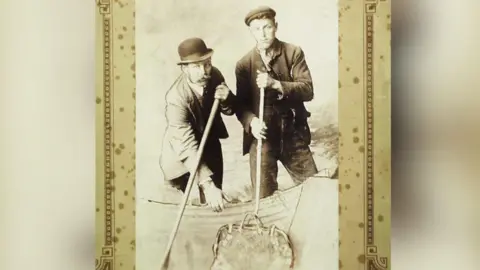 Copyright: Reading Museum
The time-line suggests she had just disposed of the bodies of Harry Simmons and Doris Marmon.
Court records of Dyer's trial at the Old Bailey, London, include the testimony of local labourer, Henry Smithwaite who helped drag the river for evidence.
He told the court: "I found this carpet bag, about half way across the footbridge, across the Clappers, at Caversham.
"Sgt James cut the string, and I saw the body of a female child."
Evidence given by Reading's medical examiner, William Morris, stated the girl had marks made by a "tape or ligature, tied quite tight" around her neck, while a boy had "tape tied twice round the neck, it was tied with a bow".
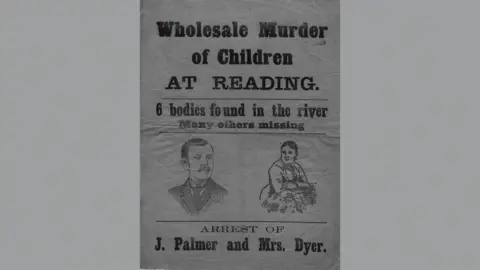 Copyright Reading Museum
As well as a report on the arrests, a broadsheet newspaper featured in the archives of Reading Museum contains a verse titled Reading Murder that was sung to an old folk song tune.
The chorus reads: "The offspring of love, ruin and seduction, to these baby farmers too often must go, and then like those found drowned at Reading, the number that's murder'd we never shall know."
Both Dyer's daughter, Mary Palmer, and son-in-law, Arthur, were suspected of being complicit, after one of the handmade bricks used to weigh down a baby's corpse was matched to a pile found in the garden of their London home.
Wells said when Dyer heard, she panicked: "'Oh, my son-in-law's been implicated, my daughter', so this prompted her to write letters of confession."
In a letter to Supt Tewsley, she took sole responsibility, conceding: "I do know I shall have to answer befor [sic] my Maker on [sic] Heaven for the awful Crimes [sic] I have committed."
The execution of Amelia Dyer
Despite being directly linked to seven infant corpses pulled out of the river in Reading, Dyer was only charged and convicted of Helena Fry's murder.
Wells recalled the jury returned their guilty verdict in "less than five minutes" and she was sentenced to death.
At 09:00 on 10 June 1896, she was led to the gallows inside the walls of Newgate Jail, while a large crowd gathered outside.
Wells said: "The hangman wanted to know her weight to establish the drop and she weighed 15 stone, she was 57 years of age."
He added that the hangman "pulled the lever, bang, and that's where she went".
Dyer's daughter Mary gave evidence in court during Dyer's trial and her husband, Arthur, was tried as an accomplice, but "discharged".
The couple faced justice later instead, in 1898, after moving to Brize Norton, Oxfordshire.
A baby girl Mary had picked up from Plymouth was found alive in an abandoned parcel and the Palmers were arrested.
They were sentenced to two years in prison with hard labour, for "desertion".
Amelia Dyer is reported to be the most notorious of eight baby farmers hanged for murder in the UK, including Jessie King who blamed "drunken melancholy".
But Weems wondered how many more serial baby killers escaped the noose: "Baby farming existed all over the country.
"It's a facet of Victorian Britain that needs greater research."
You can follow BBC Berkshire on Facebook, X, or Instagram.
