Rescue tiger undergoes root canal to save teeth

 Noah's Ark Zoo Park
A rescue tiger has undergone root canal treatment in a bid to save its top two 7cm-long canine teeth.
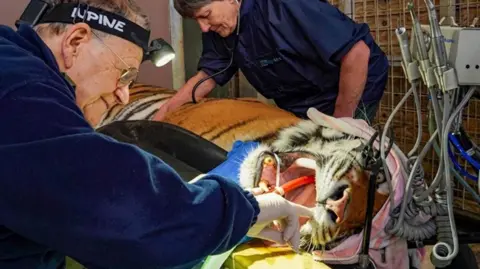
Aqua the tiger underwent the two-hour procedure at Noah's Ark Zoo Park in Wraxall, near Bristol, after keepers spotted he was having problems eating.
The tiger, which was rescued from illegal traffickers in 2019, has lived at the zoo since October.
Specialist Dr Peter Kertesz, who did the procedure on Aqua, said he had to have "total trust in the ananaesthetist" for the "standard procedure".
Zoo curator Chris Wilkinson, said "specialist equipment designed for big cats" was used to perform the "equivalent of a human root canal" and the tiger was now "back on his feet and his usual self again".
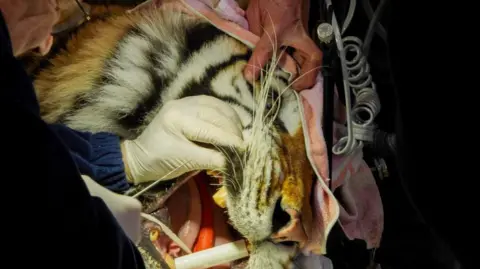
To perform the operation, six members of staff had to lift the 22-stone (142kg) anaesthetised animal on to the operating table and ensure its jaw was kept open so the team could work safely on his teeth.
Kertesz, who has worked on about 300 cats, drilled 3in (7.6cm) into the teeth and removed any decayed pulp before filling the cavities.
"Of course, the size is enormous. While your tooth might have a 10mm root, in this case it's about 80mm," he said.
 Noah's Ark Zoo Park
Aqua was discovered, along with nine other tigers, "covered in faeces" and crammed into a horse box at the Poland–Belarus border nine years ago.
Thought to be around 7-years-old, the tiger spent several years at a rehabilitation centre in Spain before he found his current home in Somerset.
The zoo said "historic dental issues" were "unfortunately common in big cats with challenging pasts".
Follow BBC Somerset on Facebook and X. Send your story ideas to us on email or via WhatsApp on 0800 313 4630.
