Patient hails 'incredible' robotic cancer surgery

 Shaun Whitmore/BBC
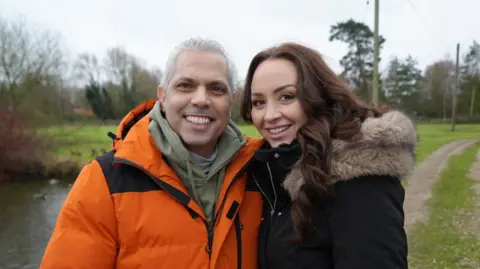
A patient who underwent pioneering robotic surgery to remove a cancerous tumour and create a new food pipe said the "amazing" 12-hour procedure allowed him to be back on his feet within days.
Nick Samiotis, 54, from Norfolk, says if he had had open surgery, he would be facing a hospital stay of three weeks and a longer recovery.
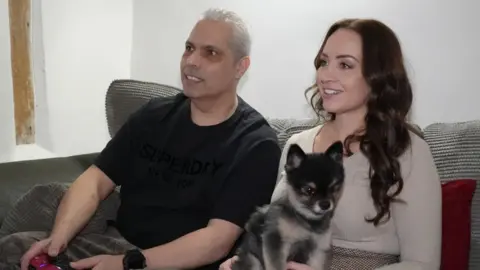
Instead, the computer game prop designer has minimal keyhole scarring and has been able to return to walking his dog nine days after his operation.
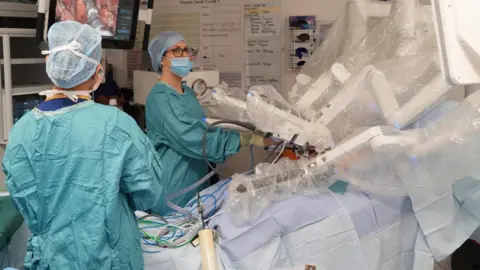
Surgeons performed an oesophagectomy at the Norfolk and Norwich University Hospital (NNUH), now the largest provider of multi‑speciality robotic surgery at a single site in the East of England.
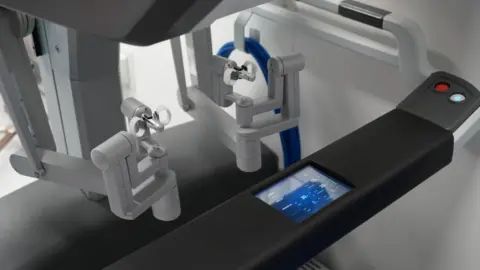
The NNUH has doubled its number of Da Vinci surgical robots from two to four, with fundraising for a fifth under way.
Surgeon Nicholas Penney said the technology meant patients were in "a lot less pain" and it was "more precise, with fewer complications".
 Shaun Whitmore/BBC
Nick said he first sought medical help after he found he could no longer swallow food or walk far with his border collie.
He also suffered heartburn and anaemia, often needing afternoon naps.
He was diagnosed just before his birthday in August and had chemotherapy to shrink the tumour.
But he described the robotic procedure as "incredible".
"It's a lot less trauma to the body so your recovery period is much reduced," he said.
"Otherwise, you'd end up with this huge scar down the side.. it takes a lot longer to recover."
 Shaun Whitmore/BBC
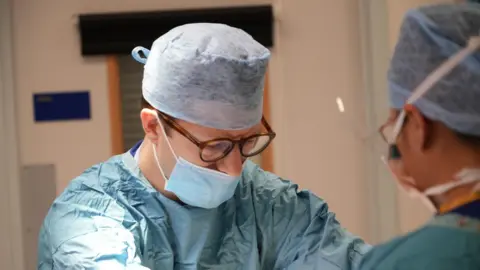
The surgery left him with 15 small keyhole scars. Despite not looking "pretty", he said, it was "far easier to recover from than lots of big incisions and they just seal them up with medical grade superglue".
Penney said they were seeing fewer pneumonia cases because patients could breathe better after surgery, due to less damage to the chest and ribs.
"We are seeing them leaving hospital quicker and getting back home and to normal life much sooner," he said.
 Shaun Whitmore/BBC
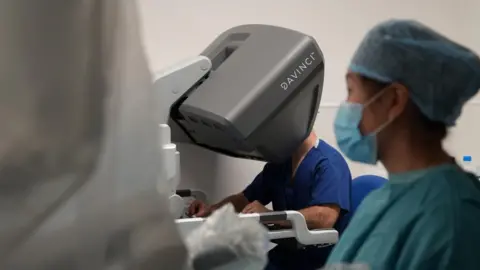
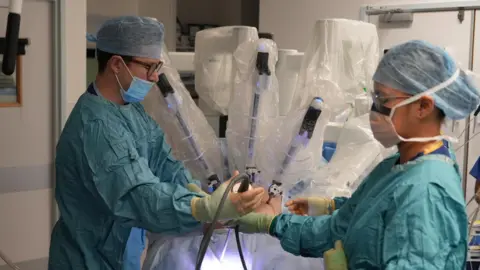
During the robotic procedure, Penney says the surgeon sits at a console with a 3D view.
"The movements we make are miniaturised and we can move the instruments like our hands… it's all very stable," he explained.
That, he says, gives surgeons a better chance of removing more of the tumour.
Robots were introduced at the NNUH 10 years ago, but their use is rising.
The new Da Vinci robots mean the hospital is now the largest provider of multi‑speciality robotic surgery at any single site in the region.
Two of its new robots were paid for with £2.8m donated to the Norfolk and Norwich Hospitals Charity, which is now fundraising for a fifth that could also support paediatric procedures.
Addenbrooke's in Cambridge currently has three robots, while Ipswich and Colchester Hospitals share four.
 Shaun Whitmore/BBC
Before it expanded its offering, 25% of all oesophagectomies at the hospital were performed robotically. Penney hopes that will rise to all appropriate cases by the end of the year.
James Hernon, NNUH associate clinical director, said robotic‑assisted surgery was "fast becoming the future of surgical practice" and strengthened the hospital's ambition to be a leading training centre with the University of East Anglia.
NHS England said that 9 in 10 of all keyhole surgeries would be delivered with robot assistance within the next 10 years, up from 1 in 5 today.
Nick described his operation as "life or death".
Without it, he said, he would not be able to eat - and the cancer would have spread.
"My family are massively relieved I've come through the operation and I'm standing 10 days later," he said.
"You wouldn't know I'd had an operation unless you were there."
 Shaun Whitmore/BBC
Because his oesophageal cancer is advanced, Nick now needs further chemotherapy and must adjust to a liquid diet, then soft food, and a much smaller stomach.
His daughter Tabitha, 38, was initially worried about robotic surgery.
"I remember talking to the nurse and they told me that three years ago this surgery wouldn't even have happened, but in the end, you just have to trust the professionals," she said.
"The surgical team were remarkable people.. you've got to be positive, he's a fighter."
Her father said the important thing was that he was hopefully cancer‑free.
"I would tell my past self not to worry," he said.
"I feel quite amazing… as soon as I've finished here, I'm off to take the dog for a walk!"
 Shaun Whitmore/BBC
Follow Norfolk news on BBC Sounds, Facebook, Instagram and X.
