'My 15-month wait for MND diagnosis has been absolute hell'

 Jamie Niblock/BBC
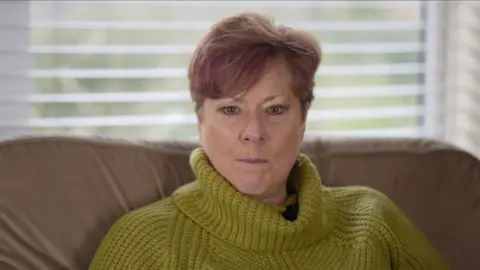
It was when she could not grip her pen properly that Lynne O'Neill first realised something was wrong.
That was in August 2024. Last month, she was diagnosed with Motor Neurone Disease (MND) at Norfolk and Norwich University Hospital's neurology unit.
"It's been 15 months since my first symptoms to finally being diagnosed, and it has been absolute hell," says Lynne, 59.
"You don't know what to do, where to turn. There is no help for anybody until you are actually diagnosed in black and white."
Now unable to walk without a stick, Lynne, of Long Stratton, Norfolk, is calling for quicker diagnoses and better identification of MND.
The condition causes muscle weakness that gradually worsens and has no cure.
According to the Motor Neurone Disease Association, six people per day in the UK are diagnosed with the condition, which affects up to 5,000 adults at any one time.
It also kills six people per day in the UK – just under 2,200 per year. A person's lifetime risk of developing MND is one in 300.
 Connor Bennett/BBC
Lynne first noticed her muscles weakening while trying to write in her job at a plumbing firm.
"Things that you do normally – writing, putting in earrings – I just couldn't do them," she explains.
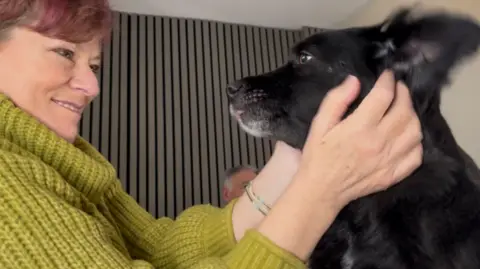
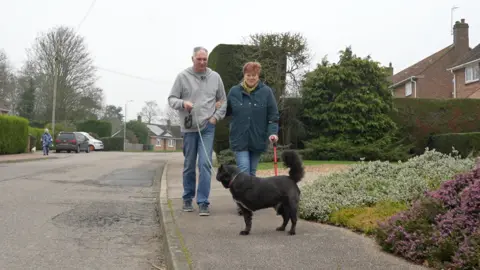
"Walking the dog was one of those things I'd do every single day, but now I can't.
"There is no signal going to my nerves, which means my muscles don't work."
A tingling sensation was another early symptom.
"My hand didn't want to work. I felt something pinching on my right side and thought I just needed some physio," she says.
"The last thing on my mind was MND."
She does not want others to wait as long as she did for a diagnosis and believes terminal illnesses need to be fast-tracked.
"There needs to be more transparency through the diagnosis. Are there symptoms that can be identified as definitely MND?" she says.
"Potential MND should be flagged, identified, so we can say 'Let's get moving and give this person as much time as they possibly can [have].
"With this disease, time just isn't on your side. I know my body is giving up. MND is a death sentence."
 Jamie Niblock/BBC
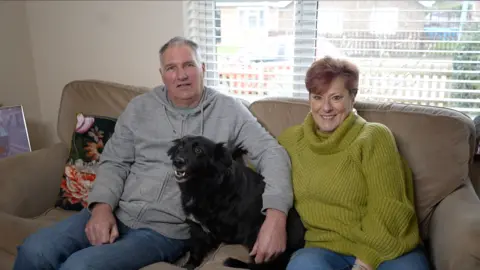
Lynne lives with her partner of five years, John Hall, 60, a groundsman and former RAF serviceman.
The pair met online after she moved to Framsden, Suffolk, from Durban, South Africa, in a "dart in the map" choice.
John is caring for Lynne as her condition deteriorates.
"We came together later in life. The frustrating part is not getting any answers, but the hardest part is making sure that Lynne is all right, and not in too much pain," he says.
Lynne adds: "He didn't sign up for this. I told him he could leave, but he has been my rock."
 John Fairhall/BBC
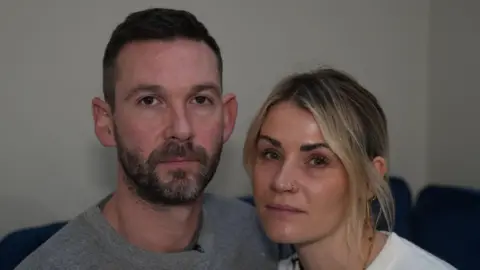
Lynne contacted the BBC after reading the story of 39-year-old plumber Ryan Horsfall of Stowmarket, Suffolk, who was diagnosed with the condition just three months after first flagging his symptoms.
"I don't know if there's a difference in diagnosis," she says.
"Ryan's was three months, but I'm now in my 16th month. Why is there such a difference?
"Is it different depending on what hospital, whether you go private? I don't know what the norm is or what to expect. It is very frustrating."
World renowned physicist Prof Stephen Hawking lived until 76 with a rare, slow-progressing form of MND, but for most, life expectancy is just a few years.
Only one drug is currently licensed for the treatment of MND in the UK and approved by the NHS.
Riluzole slows progression of the disease and increases survival by several months.
Earlier this month, Lynne and John were informed she could expect to live for a further five years, but she feels she could have been on medication to slow the progression of the disease earlier.
 Jamie Niblock/BBC
A spokesperson for NHS Norfolk and Waveney Integrated Care Board said: "We extend our heartfelt support to Ms O'Neill and to all individuals affected by Motor Neurone Disease.
"The journey from initial symptoms to a definitive diagnosis of MND can take time as it is difficult to diagnose, and it often requires a process of elimination.
"We strive to diagnose patients as quickly and carefully as possible, but it is not unusual for this to take a year to 18 months for MND, which we know is hard for people going through the process and their loved ones.
"Hearing from patients and carers about their experiences helps us to understand what we can do better and to make improvements."
The MND Association, based in Northampton, is a charity focused on improving access to care, research and campaigning for people affected by the disease.
Sally Hughes from the charity said it would support Lynne and anyone else affected.
"We know it takes too long and unfortunately that's because the nature of MND is quite complicated," she said.
"It's a process that has to be done by excluding other things, but we are working on different approaches to try and make that quicker.
"Our new research strategy is actually making sure that detection and diagnosis of MND is an absolute priority.
"Right now, we're able to give GPs very clear symptoms to look out for to help them find and support people to get that diagnosis sooner.
"Every day really matters with MND. If you are concerned about symptoms, go to the GP, who can identify the red flags."
The BBC contacted NHS England, which declined to comment.
Despite the "incredibly tough" news, Lynne is remaining positive.
"I feel I can finally move forward now. I was in limbo. I know what I am fighting," she says.
She is looking forward to seeing her future grandchildren.
"Those good hours in the day I have left, I am determined to spend them doing good."
She says she is not afraid of dying but jokes that she wants to be able to come back to haunt people.
"I have a list," she says.
Follow Norfolk news on BBC Sounds, Facebook, Instagram and X.
