How AI and robots help ease pressure on pharmacies

 Matt Knight/BBC
A pharmacist says using artificial intelligence (AI) and robotics is helping to take the strain off their services as demand from patients grows.
Cross Chemist in Benfleet, Essex, has adopted the technology to help dispense its 11,000 medications a month, freeing up more time for staff.
But pharmacist Hema Patel said the sector was "on its knees with funding" and more financial help was needed from central government for dispensaries to continue helping to ease the pressure on GP surgeries.
A Department of Health and Social Care spokesperson said it had increased funding to community pharmacies by £3.1bn for 2025-2026.
Automation
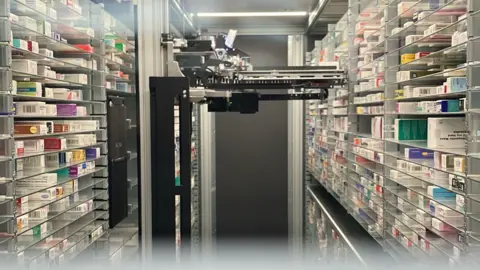
Patel said they had automated their dispensing process with the aid of a robotic device in its stock room.
It uses barcode recognition to identify an item, pick it up and send it down a chute to waiting staff. Using AI, the robot is also able to automatically prioritise medication with the shortest expiry date.
"A good proportion of those [11,000] prescriptions don't need to be checked because the robot and the system are doing that for us," she said.
Patel said the technology would be too expensive to implement at her other three pharmacies, but was a cost-effective solution for their busiest chemist.
"Because we've got quite a big clinical arm here, we needed the automation… to free up the pharmacy's time," she said.
"I can't afford to hire another [robot], but as long as funding is right, this can absolutely support healthcare and the NHS and the ever-growing population."
 Matt Knight/BBC
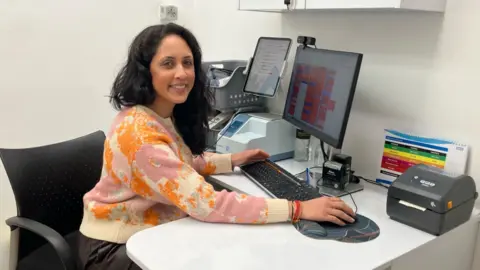
Patel said the Benfleet pharmacy saw about 30 patients every day, adding that it was "a great use of our skill" as medical professionals.
"We didn't go to university and study for the best part of five years to check a box, that's not what I wanted to do," she said.
"We are making positive changes to people's lives every single day, and so I feel great that I'm able to do this in my career."
Patel said her pharmacy had built extra consultation rooms due to the increase in demand, but pharmacies needed more funding if the service was going to be viable in the longer term.
"Business rates are going up, minimum wage going up, national insurance contributions went up, electricity went up," she said.
"Drug costs are [also] going up, our reimbursement isn't right for those drugs either."
The Department of Health and Social Care spokesperson said: "Community pharmacists have a crucial role to play as we move more care out of hospital and into the community.
"For 2025-26 funding for the core community pharmacy contractual framework was increased to £3.1bn.
"This represented the largest uplift in funding of any part of the NHS at the time - over 19% across 2024-25 and 2025-26.
"We are also expanding the role of pharmacists and pharmacy technicians to make better use of their skills and ensure patients can access the right care, closer to home."
Follow Essex news on BBC Sounds, Facebook, Instagram and X.
