Robot 'mice' developed to inspect hadron collider

 PA Media
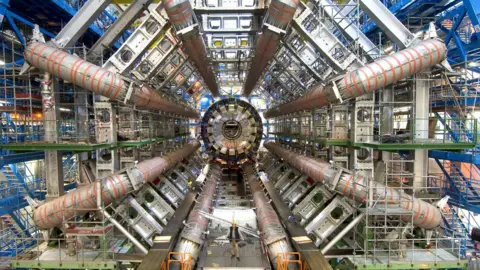
A mouse-sized robot has been developed, in part by UK scientists, to inspect the Large Hadron Collider (LHC) on the Swiss-French border.
The UK Atomic Energy Authority (UKAEA), which is based in Oxfordshire, partnered with the European Organisation for Nuclear Research - known as Cern - to develop the robot.
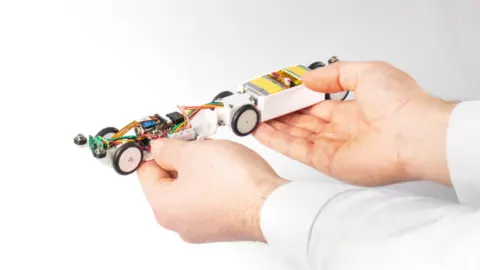
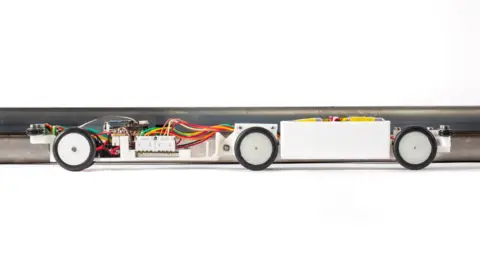
A first-of-its-kind, the robot - which is 3.7cm (1.5in) wide - travels autonomously through the narrow pipes making up the 27km-long (17 miles) collider.
The invention, which has made it much easier to check areas which can be extremely tight and cold, was recently awarded with a prestigious engineering honour celebrating innovation.
Nick Sykes, director of the UKAEA's robotics centre, said he was "proud to apply" the organisation's expertise to support Cern's "world leading experiments".
"By combining our remote handling experience with CERN's scientific excellence, we're helping ensure the Large Hadron Collider operates safely and efficiently for years to come," he added.
 UKAEA
UKAEAThe Large Hadron Collider, which opened in 2008, pushes two particle beams to near the speed of light and smashes them together.
It's hoped these collisions lead to the discovery of new physics phenomena amongst the debris - such as the Higgs boson, which was unearthed at the site in 2012.
More than 1,200 "dipole" magnets are arranged end-to-end to steer the particles around the circular tunnel - which is 100m (328ft) under the French-Swiss border, near Geneva.
Those magnets are kept at -271C and surround the narrow beamlines, which themselves are vacuums - making the tunnel extremely difficult for humans to inspect.
Cern recently turned to the UKAEA's robotics centre in Culham to develop a robotic solution to the issue - mostly due to the organisation's expertise hazardous and hard-to-reach environments.
Together, they developed 'PipeINEER' - which has a name derived from a portmanteau of pipe and pioneer.
 UKAEA
UKAEAThe 20cm (8in) long robot captures detailed images along the beamline, and then uses artificial intelligence to spot any deformities.
Dr Giuseppe Bregliozzi, from Cern, said the robot would "transform how we inspect and maintain the LHC".
"It marks a major step forward in keeping our experiments running smoothly," he added.
It was recently awarded as Highly Commended for The Engineer's Collaborate to Innovate Award - which Sykes said "highlights the power of international collaboration".
You can follow BBC Oxfordshire on Facebook, X (Twitter), or Instagram.
