Letters reveal tensions at Stormont over money allocation

 PA Media
Tensions at the heart of the Northern Ireland Executive over funding pressures have been laid bare in an exchange of letters seen by BBC News NI.
Executive ministers are set to meet this week to discuss how money will be allocated as part of a Stormont mini-budget, amid outstanding public sector pay pressures.
Pay deals for healthcare workers, teachers and police staff for this year have yet to be resolved - earlier this year the executive committed to find the money.
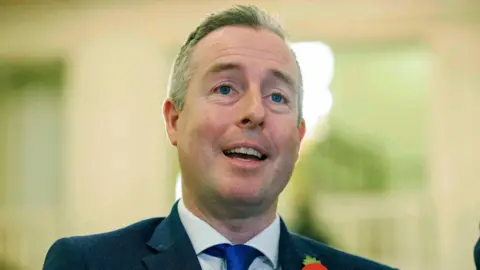
It has emerged that DUP Education Minister Paul Givan wrote to Sinn Féin's Finance Minister John O'Dowd at the end of October, warning that without extra funding his department would "unquestionably overspend" this year.
 PA Media
He said unfunded pay pressures for teachers for 2025/26 were the reason for much of the anticipated overspend.
But in a letter back to Givan in early November, O'Dowd rejected this rationale, saying the pay issue would have been "well-known and understood" when the education minister backed the executive's budget for this financial year and that he should have accounted for it.
'Damage cannot be overstated'
He went on to warn Givan that any overspend by the Department of Education would "directly negatively impact front-line services in the future for your own department and other departments, and this will adversely impact on the people of the north next year and in years to come".
"This damage cannot be overstated," added O'Dowd.
Givan then responded directly to the finance minister on 19 November in a letter stating that his department's assessment of its funding pressures "can come as no surprise to you".
"You cannot simply have woken up to this reality in recent weeks," he said.
Givan said his department's current forecast overspend for this year is £288m, with "staff costs" the main factor behind it.
The minister went on to say that "being aware of the challenges and having the capacity to materially address them are two entirely separate matters".
Responding to O'Dowd's point that ministers knew the pressures facing departments when they backed a budget for 2025/26, Givan said: "Were I, and my party colleagues, to have refused to sign off on a budget until one was brought forward which I (or for that matter any education minister) could live within, there would have been no budget agreed."
'Effectively impossible'
 PA Media
He went on to warn: "It must be apparent to you that the course you are presently embarking upon in this correspondence will make agreement of a budget for next year effectively impossible."
Ministers and officials from all departments have been in discussions ahead of the finance minister bringing plans for a multi-year budget to the executive for discussion before Christmas.
It would allow better planning for day-to-day spending across the next three years, but reaching agreement on it could be difficult.
The chair of Stormont's Finance Committee, Matthew O'Toole, said the idea of not getting a multi-year budget agreed "is deeply worrying and frankly goes back to the dysfunction at the heart of the executive".
Appearing on Sunday Politics, the SDLP MLA and leader of the opposition at Stormont, said minsters complaining about funding should have been better prepared.
"They got those totals way back in June, they knew to plan for these things, they knew what the headroom was going to be, they knew the decisions and choices they were going to have to make, all of this could of and should have been sorted out much earlier in the process," he said.
"Yes they are difficult decisions, but that is what they're paid and elected to take."
The vice-chair of the Finance Committee, the DUP MLA Diane Forsythe, said "real pressures" are being felt.
She told Sunday Politics that "under the executive restoration package we have only just seen our funding uplifted, to our level of need, but not quite.
"We've had years of under-funding and we are trying to get back on top of it."
Forsythe also empathised with her party colleague, the education minster, saying within the education department, "compared to a lot of other departments, there is not that much flexibility".
"Every minister is fighting the best they can in their own department, with education, a lot of the pressures are statutory based, a high percentage of the education budget is salaries, so a lot of that is immovable pressures."
Last week, the finance minister said the executive was facing into a potential £440m overspend this year.
In his letter to Givan in November, O'Dowd said while the Department of Health is also projecting a £100m overspend, he said the "key difference" was that it has taken action to "significantly reduce its funding gap".
Nesbitt has also accepted that any year-end overspend will be deducted from his department's opening budget for next year.
In his letter, Givan dismissed O'Dowd's suggestion that departments should not have expected significant in-year top-ups to their budgets, adding: "For many years access to significant levels of additional funding via in-year monitoring rounds have been key to the Northern Ireland block grant operating within budget."
The DUP minister said he was "alive to the implications of overspending" and its ramifications in future years.
But he concluded: "However, cuts of the levels required this year – even were they to be deliverable – which they are not – would be devastating to the education system this year."
What pressures are the executive facing?
Ministers are already due to discuss funding issues this week, in what is known as a monitoring round.
These are financial exercises carried out by the executive several times a year, involving the reallocation of unspent funds by departments, as well as new money which flows from Westminster spending decisions.
Last month's Budget at Westminster saw the government allocate £370m to Stormont over the next three financial years - O'Dowd later clarified that only £18.8m is available for use over the rest of this year.
The executive has also been asked to consider another funding pressure - the issue of compensation for a major Police Service of Northern Ireland (PSNI) data breach two years ago.
It could cost about £120m and the Treasury has rejected repeated requests from the executive for help with it.
Last week Justice Minister Naomi Long wrote to executive colleagues asking for support on a way forward, to ensure costs do not rise further.
She suggested that the executive should prioritise funding from its budget for next year (2026/27) in order to allow the PSNI to begin negotiations on a universal offer and prevent costs from rising further.
It is not clear whether all executive parties are backing this proposal, but the minister said neither her department nor the PSNI could absorb the associated costs.
However, agreement to ring-fence the money from the overall budget for next year will exacerbate pressures in the executive's starting position for 2026/27.
