The Cold War bunker beneath a Berkshire university

 BBC
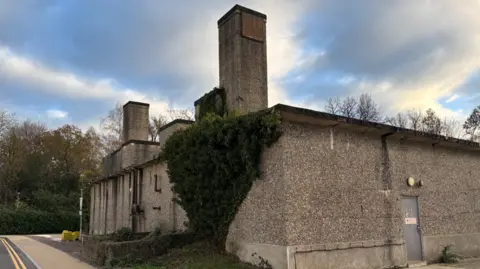
BBCHidden beneath a busy university campus in the south of England lies a nuclear bunker war room, built for emergency planning during the Cold War.
At the time of global political tension, England was divided into a dozen civil defence regions, each governed by a regional commissioner designed to take absolute control if central government fell.
From these, the commissioners - usually a civil servant or minister - and staff would have directed the strategic response to air raids throughout their region.
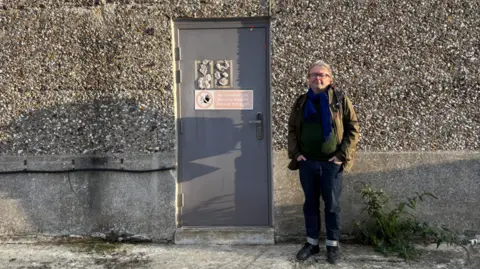
Radio Berkshire's Lorin Bozkurt has been exploring the origins of the hidden room beneath the University of Reading with historian Prof Patrick Major.
"The Soviets detonated their own atomic bomb in 1949, much earlier than the West was expecting," said Major.
"There was sudden panic where we decided we had to build bomb-proof structures to keep the government going in the wake of a nuclear war."
During World War Two, Reading became important for meteorology and reporting about the weather, he said, so existing buildings on the university site were adapted and the bunker was "a kind of add-on to them to give them some protection".
"If there were an atomic bomb in the vicinity, it would protect them against blast and some flash," he said.
Designed for about 50 people, the facility was built on two levels, with the bunker lying beneath an unassuming 1950s-era building covered in pebbledash.
Major said: "There are a number of dormitories with bunk beds, showers, toilets. There was one central room, which is in the middle and covered both levels, and that was the control room.
"A bit like the Battle of Britain films you see, the control room where they can push planes about on some sort of map, they'd have something like that, and there were a lot of controllers who sat facing the map on two levels, each of them had their little desk and a telephone, so they would be trying to get information on, for instance, where are the bombs dropping."
While there was no provision for nuclear bunkers for the general public, in the 1970s, a Protect and Survive campaign aimed to show people how to build their own shelter in their home.
"It was very much take your doors off your rooms, put them into a lean-to, try and make some sandbags using soil from your garden and then you would just sit in there and try and wait it out," said Major.
"But you'd have had to wait for months and months," he added.
Two years after it was completed, the Soviets tested their own hydrogen bomb, which was a thousand times more powerful than the previous atomic bomb.
Major said: "This [Reading] bunker was really designed for bombs the size of Hiroshima and Nagasaki. It couldn't cope with the new age of thermonuclear war."
Instead, a new, bigger and better underground facility, called the Regional Seat of Government 6 (RSG 6), was built at Warren Row, a few miles east of Reading, said the professor.
"The reason we know about that was there was a bit of a scandal in 1963 when a group of anarchist protesters, who were a splinter group from the Campaign for Nuclear Disarmament, managed to break into it," he said.
"They purloined all of the secrets, took photos and then they circularised the media, and it became a bit of a thing."
The discovery of RSG 6 "caused some upset", prompting questions in parliament over protections for the general public, said Major.
"These bunkers are not for the ordinary population," he said. "They will be told to stay at home. For, in Britain, unlike Switzerland or Sweden, there's no plan for massive civilian protection.
"It [a nuclear bomb] would have been a kind of cataclysmic event.
"One which we perhaps don't like to think about but I think recent events in global politics suggest that perhaps some of these things might be a possibility.
"But I think there is a kind of widespread sense that a nuclear war would just be too big to protect all of the population."
Major said at the time, for Britain's nuclear submarine crews, the test of whether the worst had happened was to listen to the BBC.
"They were supposed to listen in for the Today programme on the BBC and if that was still going, everything was still OK but, if the Today programme came off the air, that was the signal that it was the end of civilisation."
